Categories
tracks & scat

The callusness of foxes

Telling the difference between canid tracks is hard work, and more than a little tricky. I’ll usually decide tracks belong to a wild member of the dog family, and call it there. I used to be more likely to wade in all confident with an ID, but I’ve learnt the importance of a good dose of humility in tracking. At least for excitable folks like me. Mother nature is wiley. Respect.

There is one surefire tell though. One “definitely-for reals-a-fox” sign that even a tracker playing it safe can feel pretty darn good about.

Fox on our property go through periods when they’re kind enough to leave frequent scent markings, by peeing all over the place. So I can sometimes sniff my way to an ID. (Taking me for a walk involves a lot of pit stops wherever the canids have made… pit stops.) Fox urine has a distinctive skunky/musky smell. And fox in our woods do tend to follow the behavioural cues I’ve read about — fox here tend to tightrope walk on fallen logs, and wander more curiously around the woods. Hopping up on to rocks and dilly dallying all over. Whereas the coyote tend to cut straighter and more focused paths. And the neighbours’ domestic dogs stay on their side of the property line, mostly. (Though every once in awhile our trail camera picks up a very cute beagle sniffing the lens.)

But you can’t always be sure you’re catching the scent at a pitstop, and some fox walk in straight lines, while some coyote might decide to wander. There are big fox and small coyotes, so even print size isn’t necessarily that helpful. Fox and coyote prints are not dramatically different in size, and as the snow melts, even a little, accurate measurements can melt right along with it.

But if you are very lucky, you might come across a print which carries the one definitive sign that its a fox track. And not just a fox, but specifically a red fox (even grey fox apparently don’t have this trait)…

A callus ridge.

On the “interdigital pad”, the fleshy bit between the toes, red fox have a “callus ridge”: a hardened bump that runs horizontally in a sort of chevron shape on their paw.

The other day, I found such a print. Apparently it shows up quite well in mud tracks, but less so in snow. This is only the second time I have happened across a very clear callus ridge in a snow track. I was, to put it mildly, excited.

Squee!

Here’s what all three of my tracking books have to say about the callus ridge. I cite, and use, all three because they often don’t totally agree with each other, and more’s the better when it comes to cross-referencing.

“The red fox track has one good characteristic that is distinctive, if you have a track showing details. The heel pad has a chevron-shaped or straight “bar” protruding from the hair of the foot… In mud, shallow snow, or otherwise a firm surface, this bar may show without the rest of the pad.”

~Peterson Field Guide to Animal Tracks

“On firm snow, a transverse bar across the heel pad of the red fox may obscure the print of the pad.”

~Field Guide to Tracking Animals in Snow

“Red Fox….(d)iffers from other canids by having a ridge of callus on the interdigital pad.”

~Scats and Tracks of the Great Lakes

Though scent-sniffin’ already had me convinced that our woods are full of fox tracks at the moment, I still love a “visual” confirmation. And below, a fluffy fox butt seen by our trail camera a couple of days ago. Pictured/not pictured: the callus ridge.

Walk on, you callused beauty.

~Kate

Categories
birbs fauna tracks & scat

A bird in the bush

A couple of Sundays ago, we went for a tromp around our friends’ woods and fields. Leaving our own big snowshoe prints in the snow, we were surrounded too by the tracks of other critters — canids and deer, rodents and rabbits.

While I was stopped to look closer at something on the ground, I heard a noise behind our friend D. Walking in snowshoes can make quite a racket. Bindings squeak and snow squelches. Not to mention how warm wooly hats can muffle sound. But I was sure this funny little rustle from the brush was something “real”. I turned to look, and heard it again. A rabbit perhaps? Or maybe it was just a branch settling in the snow?

The answer revealed itself a moment later, a brown and buff ruffed grouse flushing from the brush nearby. It flew up and away out from the scraggle of growth, briefly earth brown against the blue sky, before its shape was reabsorbed by the trees at the other end of the field.

I took off my snowshoes so I could scramble into the brush where the little grouse had exited. Seeing the spot in the snow where a bird has taken off or landed is a real treat. That’s what you see in the image below. The trail the grouse forged walking through the deep snow, and then a deeper *fwomp* where it decided it had enough of us, and took off for other pastures.

I am sunk in the snow up to my knees, while the light boned bird only sunk a few inches, before escaping the ground altogether. Its lightweight body isn’t the only reason it stays aloft in the snow though…

Apparently we were not the only ones wearing snowshoes that day, as according to Hinterland Who’s Who:

“The Ruffed Grouse is specially adapted to handle winter weather. Where the snow is deep, soft, and persistent, grouse travel over it with the help of their “snowshoes”—lateral extensions of the scales of the toes. They also burrow into the snow, which keeps them warm and protects them from predators.”

https://www.hww.ca/en/wildlife/birds/ruffed-grouse.html

and

Called pectination, the “snowshoes” are a comb-like fringe along the sides of the toes. This increased surface area allows the grouse to stay aloft — accomplishing essentially the same thing as the large, furry feet of snowshoe hares. It also gives them extra grip when they perch on icy branches to eat tree buds. Unlike the shoeshoe hare, however, the grouse grows this special comb each fall and loses it in spring.

https://fmr.org/news/2017/12/27/nature-notes-snowshoeing-grouse

I hang my snowshoes up in the spring too little grouse! We have so much in common.

~Kate

Categories
technology thinking big

Being the Bear

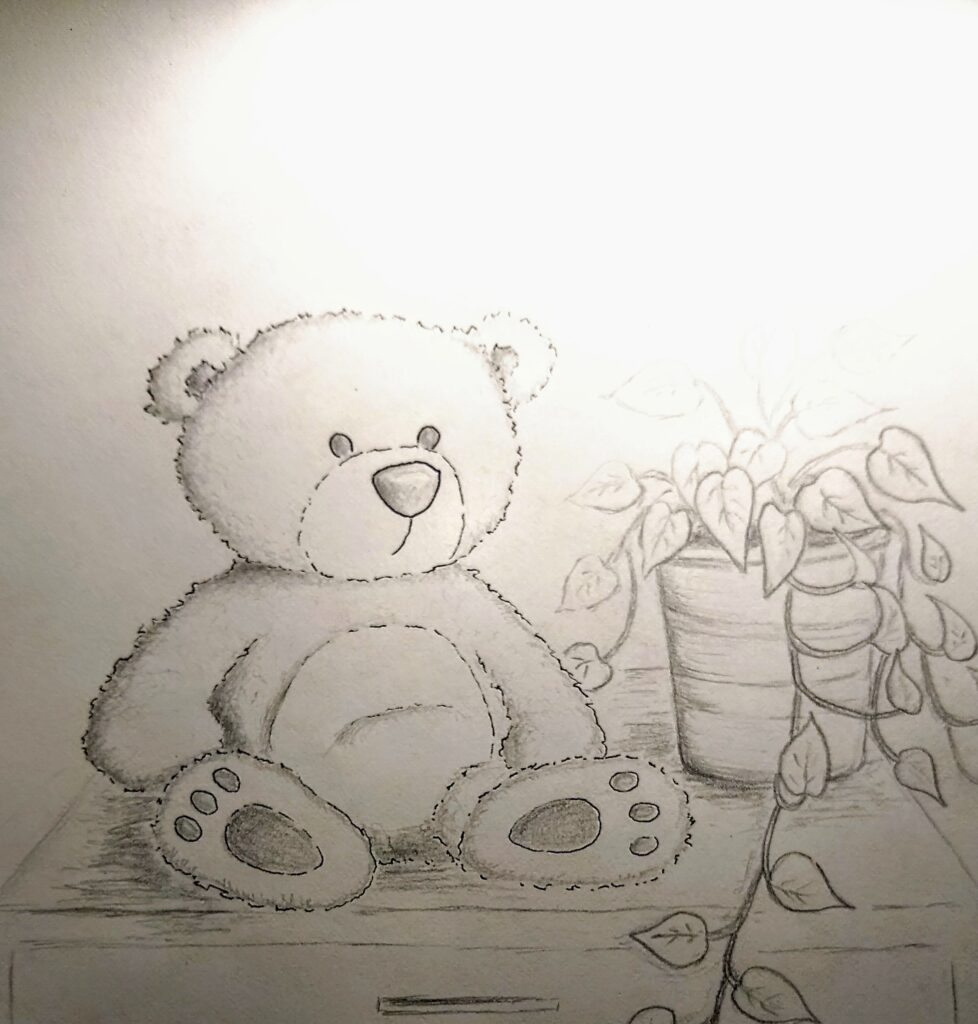
There is a bear at Stanford who sits on top of a filing cabinet. It’s a stuffed toy bear, and it belongs to one of the professors. When the professor’s students get stuck on a problem, and want to ask for his help, they first have to go and explain their problem to the bear.

Most of the time, the bear is able to solve the problem.

Or rather, the students are able to solve their own problems, by talking them through “with the bear”.

I can’t find the right combination of search terms to dig up the origin of this story again. And who knows how much truth has merged with fiction. But whether this teddy bear-tactic professor ever really existed or not, this story is true at our house.

We don’t literally leave a stuffed bear around. And anyways my only stuffed animal options are an alligator, a puffin, a monster dressed as a ninja, and a flying squirrel. As stuffed animals go, they’re solid. Though I don’t know if any of them are good listeners.

But Neil and I are often “the bear” for each other. We work on projects together and alone. If one of us is stuck on a problem, the other person might understand enough about what we’re doing to offer a helpful suggestion, a fresh perspective, or a different tactic. But even when the stuck person is working way outside our expertise, we can still “be the bear” for each other. We simply sit and listen, while the other person explains their problem to us.

Talking to the bear lets you untangle your own thoughts. Brains can be messy, and that’s okay. But sometimes, when we leave a problem in there too long, our thoughts simply pull the existing knots tighter and tighter.

Our minds are capable of holding contradictory or “gappy” ideas. But the plot holes and conflicts often become apparent once we start teasing our thoughts apart into sentences. As we start to untangle our ideas, because we’re trying to communicate them to someone else — even if that someone else is a stuffed bear — we can often uncover the crux. And find our way out of the tangle, all “on our own”. It might even seem incredibly obvious as soon as we begin speaking aloud. A handful of sentences spoken aloud to the bear uncovers the root of, and solution to, a problem you’ve been rolling around in your mind for an hour.

At our house, if we notice the other person is stuck on a problem, we will say “do you need me to be the bear?” and come sit in their office for a bit while they figure it out. Or we might seek the other person out, saying “can you be the bear for me?” And occasionally, when Neil has drifted into explaining a complex coding problem to me that he’s stuck on, I will tuck my arms in to my sides and slowly raise them to a 90 degree angle. Sometimes it helps to get into character.

Anyone can “be the bear”. So often we just need someone to sit still with us, and listen.

~Kate

Categories
fauna

Fun in the sun for a bun

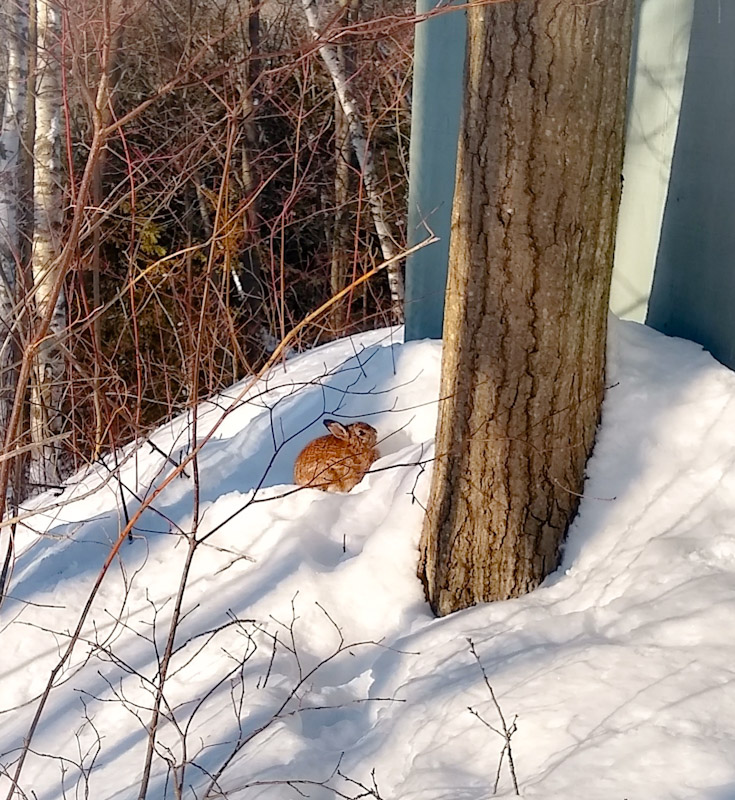
Scrappy is still with us! The little bunny from the summer with the chunk out of his ear. Scrappy has always been a little “off” — perhaps from the scrap when he lost part of his ear? — but he keeps on keeping on. He’s made a snow fort by our shed. There’s a bunny diameter hole in the snow directly ahead of him where he can secret himself away. But during the day he sits out in the sun like a furry stone. Then come evening, he makes bunny runs between the dogwoods.

The other day we had a couple of friends over to snowshoe our woods. As we passed, Scrappy darted into his hole. But when it’s just Neil and I, he stays where he is. Seems like the recognition may run both ways… And if Scrappy feels comfortable staying in stone-mode with us, I am deeply flattered.

~Kate

Footnote: We call Scrappy “he”, though they might well be a she. In the summer Scrappy kept company with another rabbit Neil christened “Scrapulet”. However they roll, they are most welcome here.

Categories
weekly report

Weekly Report

Snow falling on cedars. Though I’ve not read the book or seen the movie, I think the phrase every time the snow falls. Snow fell on cedars. The snowy ground swells up and the heavy cedar branches drift down. It is unapologetically winter here and each luscious cold day is savoured. At the edge of the woods, the wind has sculpted the snowfall into hills and valleys, with drifts higher than our thighs, even with the boost of snowshoes. We pour the winter into ourselves because the snow cannot stay. “…we want more and more and then more of it.”

The chickens’ waterers freeze three times a day, even placed on heaters, but still the little chickens lay their eggs. What must be done. Seasons and bodies both keep their clockwork. On the coldest days, SooZee seems to be doing an impression of a rotisserie chicken, snuggled up so close to the heat lamp’s red light that her feathers look pink. The three “Wyandoodles” and little Turtle — the tiny black and white chicken with the green-shelled eggs — still leave eggs in their nests most days.

Lin, one of our oldest hens, died this week, not from the cold, but from the inevitability of death. She lived a good life here. On her first day with us, she rode shotgun with me, in a box marked “Linens and Mittens”. On her last, she sat in a row with Pedro and SooZee — after pecking Turtle in the head for trying to eat corn before her elders were finished. We did not have to euthanize Lin. She had trouble for a day or so, and then was dead in the morning. There is always a morning you don’t get to see. Fill the days in between with life.

A tiny bunny has started frequenting our yard. Going out around dawn one day, I startled it by the side of the house. A blur of brown bunny darted a few feet, and then decided to “play rock” instead of run. One of the three Fs of self-defence: flee, fight, feign rock. I moved to the outside of the path, and made a show of pointing my forward-facing predator eyes the other way. No rabbits, only rocks here.

On the other side of the house I found a bunny freeway between the dogwoods. A serpentine path of furry feet, stopping for nibbles, and leaving piles of scat. Retracing its path so thoroughly it looks like a trail left by snow snakes. In the dead of winter, bark is delicious. The dogwood can take it. In the warmest months, I’ve pruned it harder.

Tiny mouse tracks are everywhere. Popping out from their world under the snow for a sojourn topside — to run around a twig, and take the next tunnel back underground. I don’t know why that twig is special, but the mouse does. If it could tell me why this one and not that one, I would listen.

Junco tracks zigzag across the fresh blanket of snow, stitching it in place. The little birds are everywhere, their tracks covering the ground so completely you forget that’s not what newfallen snow looks like. My favourites though are when, on a quiet expanse of snow, there is a sudden flurry of feet, with nothing before or after them. Of course I remember, of course. Birds can fly.

“It has always been a happy thought to me that the creek runs on all night, new every minute, whether I wish it or know it or care, as a closed book on a shelf continues to whisper to itself its own inexhaustible tale.”

~Annie Dillard

~Kate

Categories
D-I-Why Not homeMADE

Making Ice Lanterns

Many many many years ago, I saw a Lee Valley product that was a mould for making “ice lanterns”. The photograph was enchanting. A winter walkway lined with glowing ice. I thought it was completely delightful… for about a minute, and then the logistics of putting together such a scene rolled over me. You’d need a mould for each lantern, or to mould one lantern at a time, you’d need to freeze each mould, etc etc.

But the idea went into deep storage in my mind. Fire and ice, together at last.

(My love of fire and ice runs deep. Before Neil shared his dream with me of a wedding shared with family and friends, I originally wanted to elope in a red dress at an ice hotel in Sweden. Perhaps for our 50th anniversary…)

Sometimes when I get a few steps further down the maker path, I’ll suddenly realize that I now know how to make an old idea come true. With all this good cold weather recently, I was inspired to look up D-I-Y Ice Lanterns, and the internet did not disappoint.

I used a hybrid solution, based on a few different suggestions. And with a bit of trial-and-error, and one false start, it turned out beautifully!

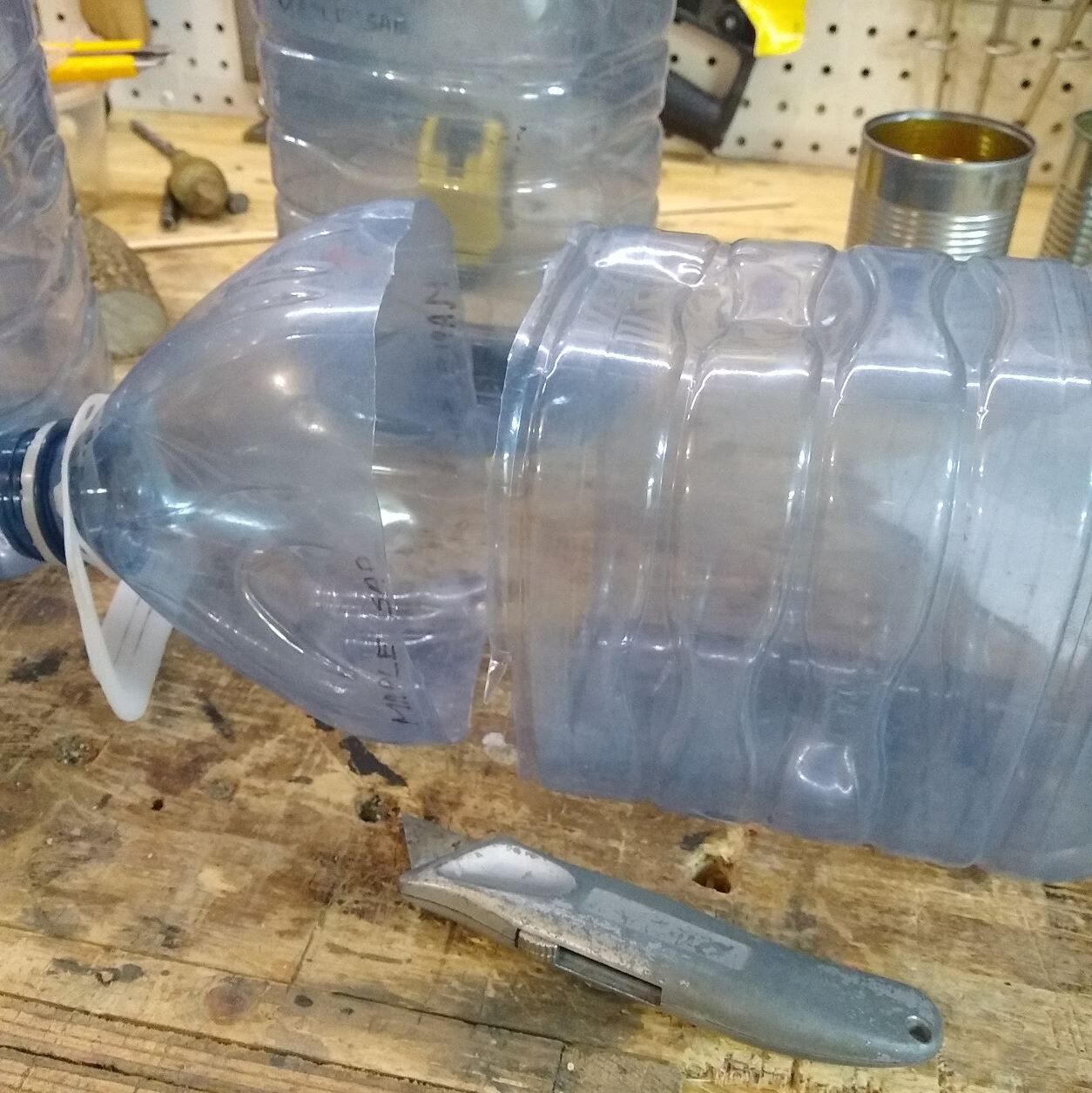
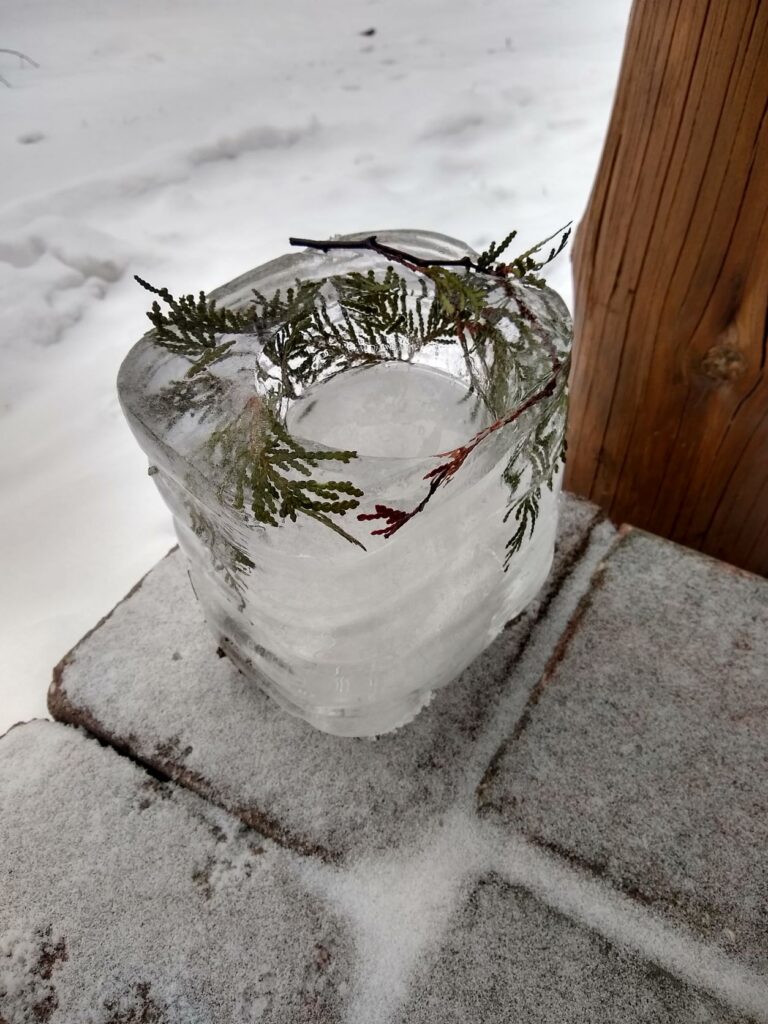
Step 1 was to make a mould. For this, I used one of the many plastic water jugs we keep for transporting maple sap. We buy in distilled water to top up the batteries on our electric side-by-side. Once the jugs are empty, they go into service to transport sap from tapped trees during maple syrup season. Now they’d be starting their third life — as ice lantern moulds.

Cutting off the top of the jug. The opening needs to be big enough for the ice to come back out again.

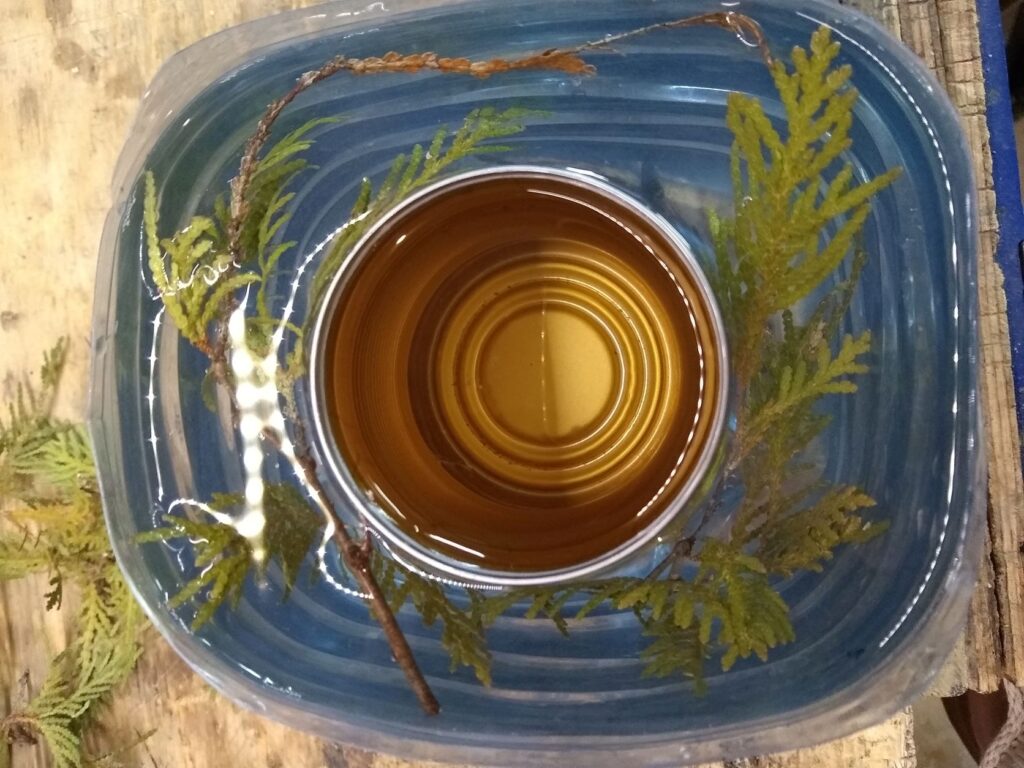
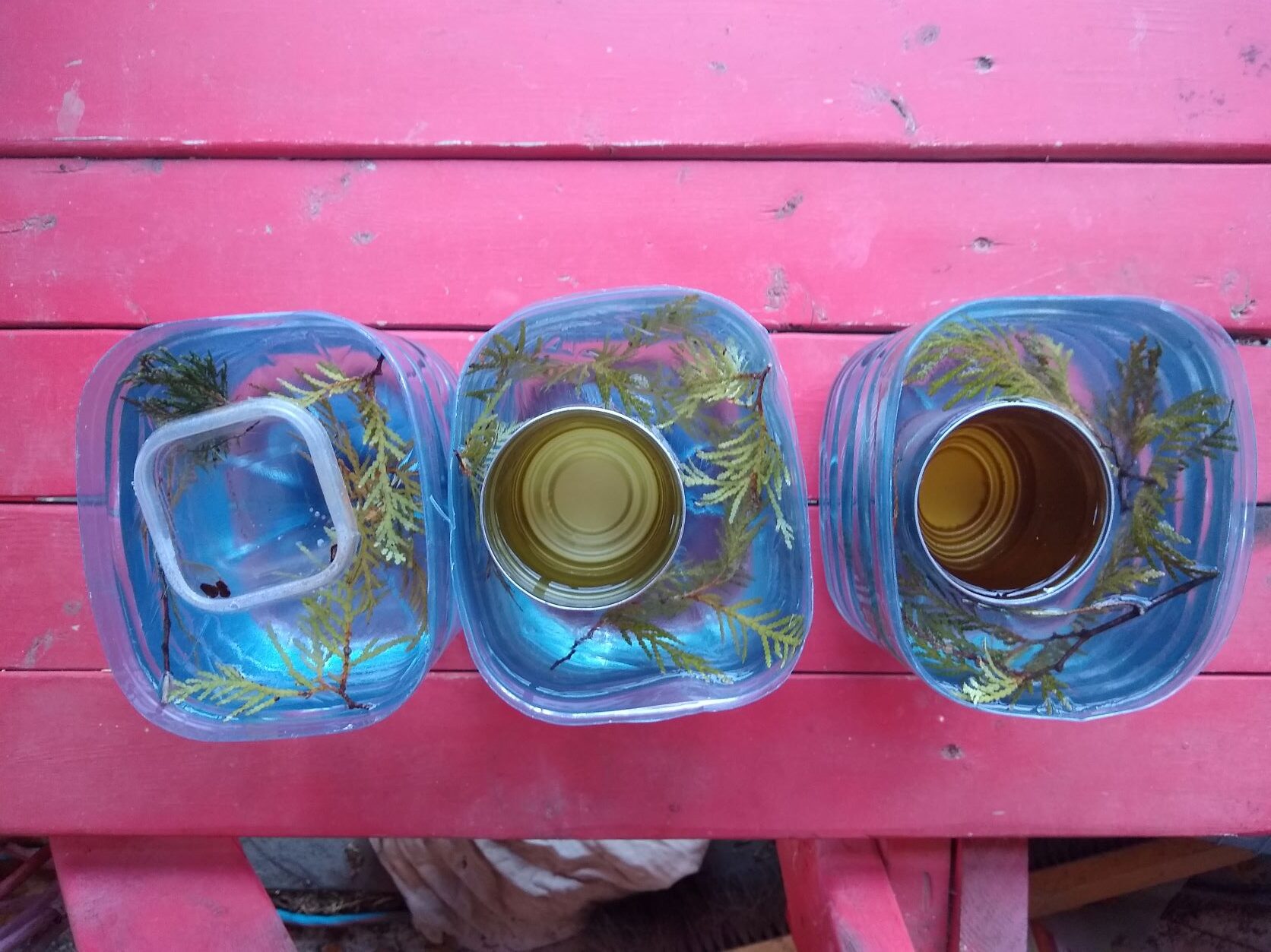
Step 2 was to find a smaller vessel to float inside the jug. This reserves the space where your candle will go. For this, I used an empty soup can from the recycling — which, btw, could later become its own tin-punch lantern. It’s DIY lanterns all the way down baby.

Your smaller vessel — the can, in this case — needs to be small enough that when both the can and jug are filled with water, the smaller vessel (the can) is floating a good distance off the bottom of the larger vessel (the jug). A good few inches. The role of the can is to reserve a space where your candle will go. If the can is touching the bottom of the jug, there won’t be any ice under the candle. Too little ice under the candle will also mean the lantern won’t last as long as it melts.

You can come up with little rigs using clothespins and wooden blocks to ensure your can remains centered in the jug. This wasn’t important to me because I didn’t mind if the candle wasn’t perfectly centered. But there are lots of tips out there to jerryrig something if this is important to you.

One of my bigger, sillier, a-ha moments in this project was realizing I didn’t need to space to freeze the lanterns in our freezer. I think the original Lee Valley listing said something about making sure you had sufficient freezer space for your moulds. So that just lodged in my head as The Way To Do It. But we only have a small chest freezer now, and only a fridge-freezer at the time, and – since I am part squirrel – our freezers are always full. My “a-ha!” was realizing that if it was cold enough outside for ice lanterns, it was cold enough outside to make ice lanterns. Boom. So I just waited until the forecast called for a chilly few days, and popped the moulds outside to freeze.

The plastic container I tried at left did work, but the tin cans made a much nicer depth.

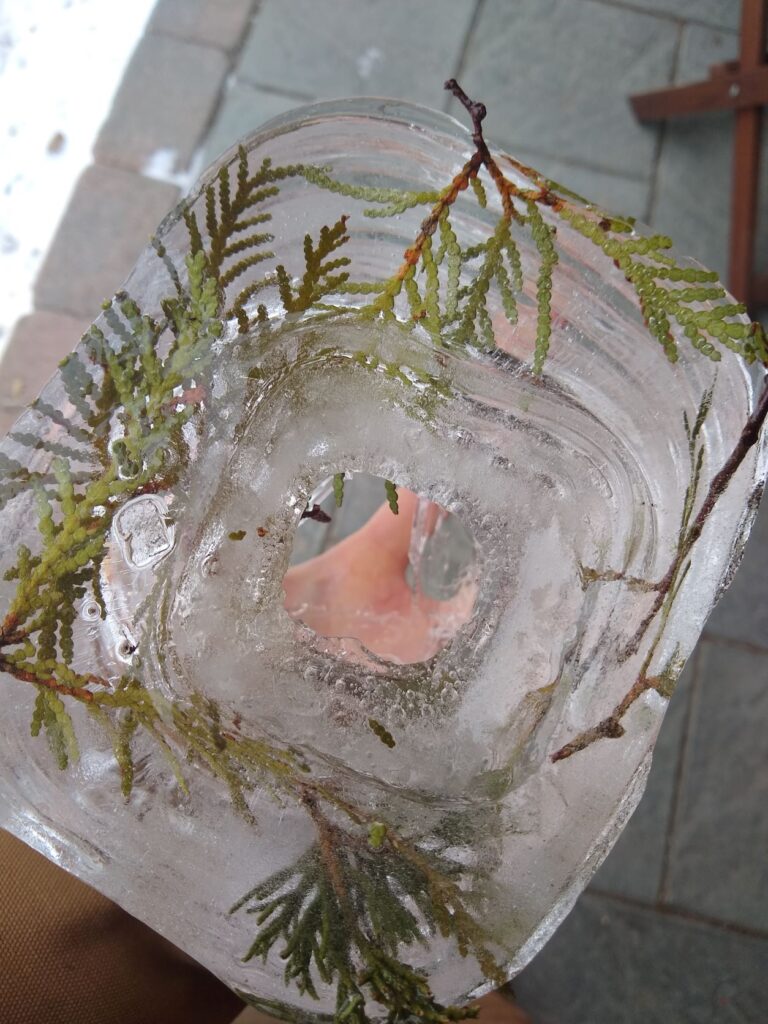
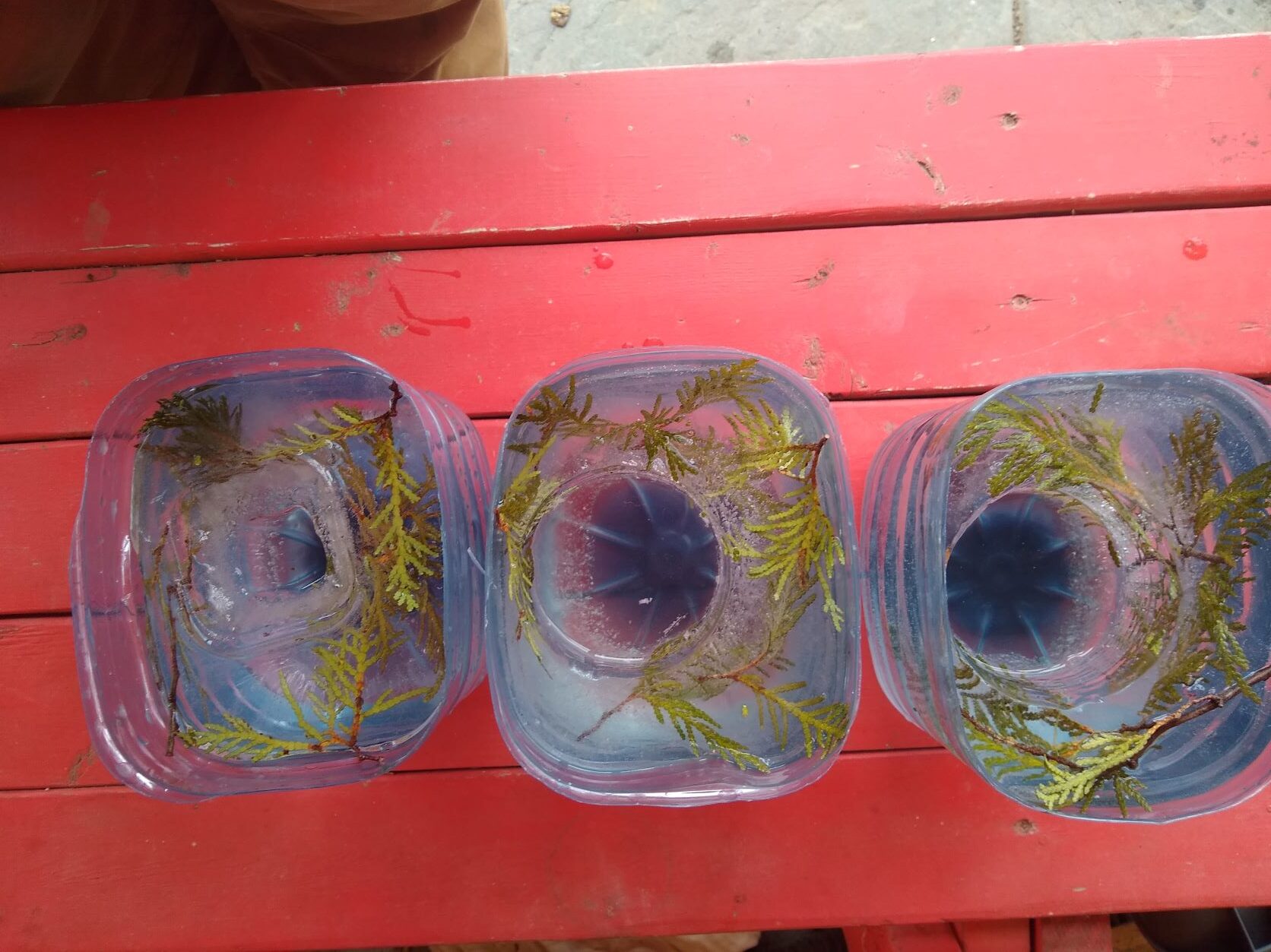
Though it was chilly, the temperature did fluctuate a bit, and the first time I tried to unmould the lanterns, though they seemed frozen, they hadn’t frozen completely. The space under the can was not frozen through, leaving an opening to the bottom.

Dang.

But being a maker is all about problem-solving and iteration. I realized I could just pop the semi-frozen pieces back in the moulds, pour more water through the hole in the ice until there was water covering the bottom, and leave them to freeze again.

Round two!

To unmould the lanterns, think of them like frozen popsicles — you just pour warm water over the outside of the mould until the inside becomes loose enough to pop out. The same is true for the can. I poured warm/hot water directly into the can until the ice inside the can melted, and then warm water into the now empty can until the can was loose enough to come free from the ice in the jug. An alternative I have seen is to put rocks in the can instead of water — just enough to keep it floating flush with the jug’s surface. This would mean you don’t first need to melt the ice away before you can warm up the can to remove it.

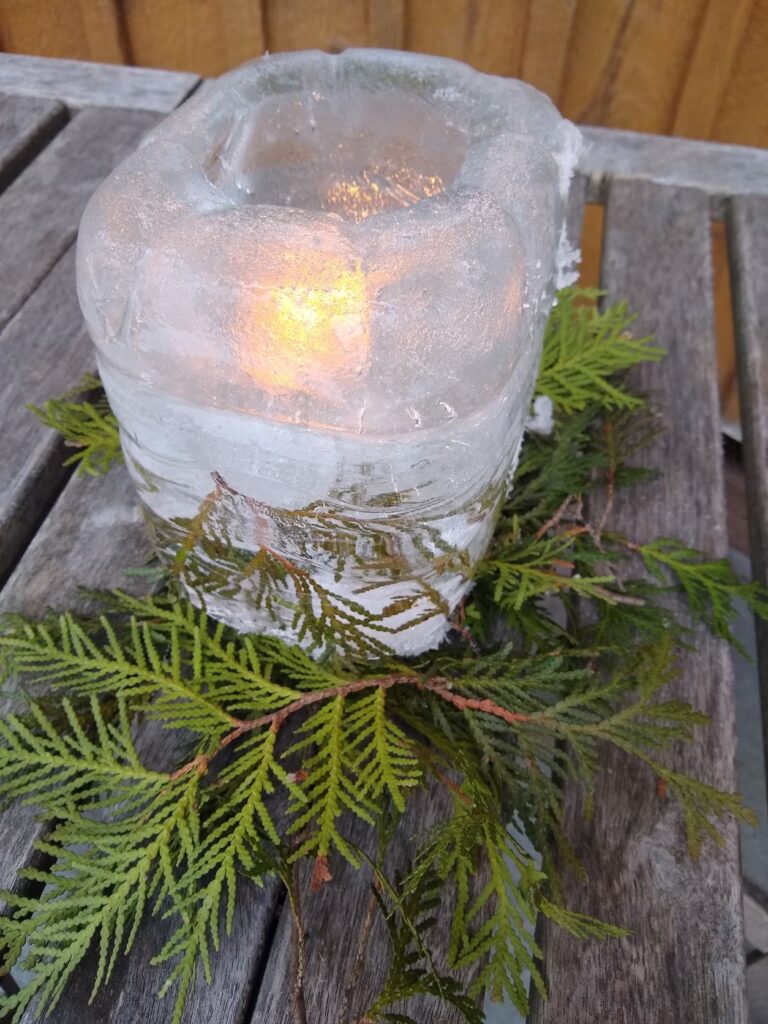
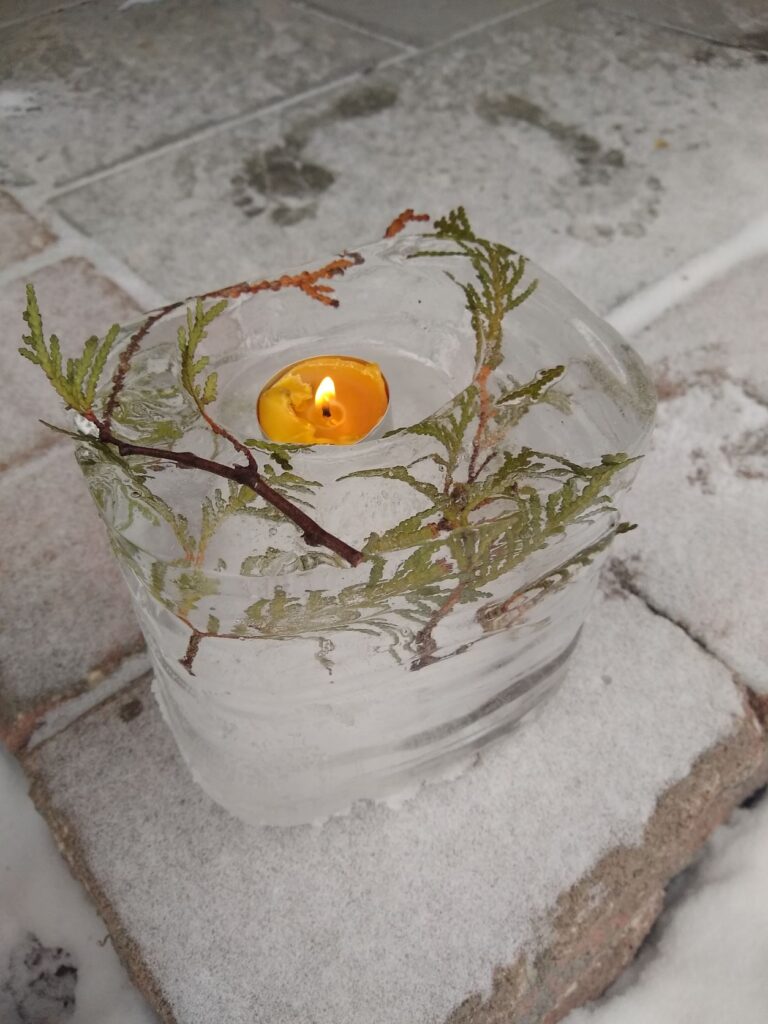
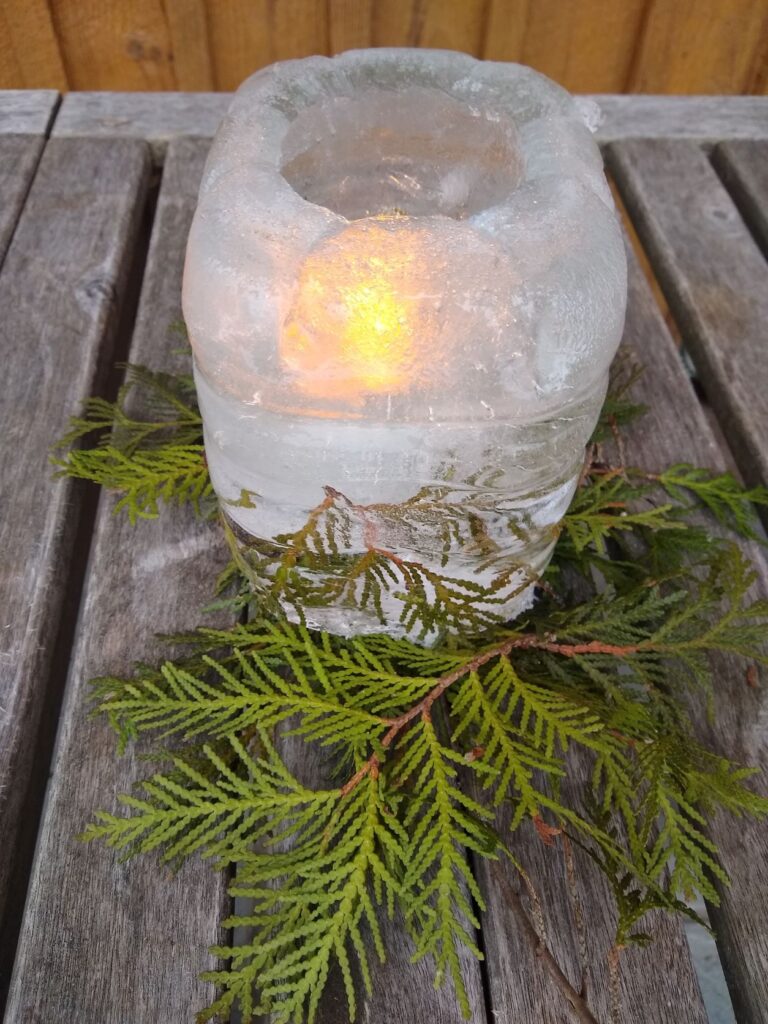
The second try was much more successful. And the trick to just refreeze the base worked a charm. The can popped free of the ice, and then the ice popped free of the jug. Add a tealight, and shazam!

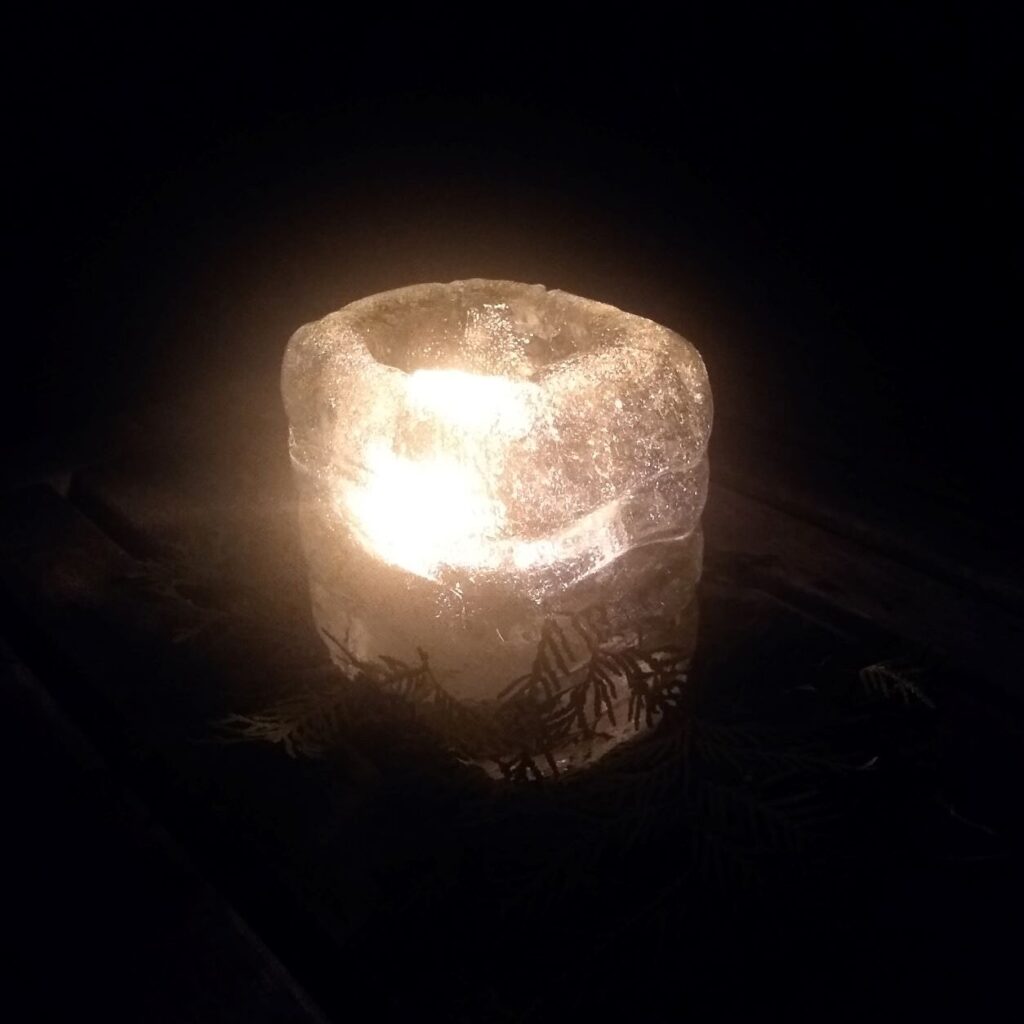
They look glorious at night.

And that’s it! A plastic water bottle, a tin can, a tealight, some water, some cold, and some time, and you’ll have your own ice lanterns.


I’ve always known I would like ice lanterns. But like everything homemade, the DIY ones definitely glow a little brighter. <3

~Kate

Categories
chickens D-I-Why Not homeMADE homestead

On a cold day

A very cold day here starts with a walk to the chicken coops, around 7:30AM. We close the coop doors when there is windchill or severe lows, so the chickens stay snug as fluffy bugs inside and I let them out in the morning. Next is a check of their waterers. Though the waterers sit on heaters, the water in the reservoirs can still freeze on very cold days. If there is ice building up in the drinking tray, we swap two sets of waterers in and out of the house over the course of the day to keep them thawed. Plenty of food gets dispensed to keep the chooks warm, then back to the house to do the same for the humans.

The OG chicken crew in their coop. Pedro, SooZee, and Lin. Each of them ~8-9 years old+.

We’re not dependent on our woodstove for either heat or cooking, though we often use it for both, and it’s indispensable when the power goes out. When we moved in here, the house had an oil heater. We got rid of that on day one (technically day two…), replacing it with an electric heat pump that has served us well. But we use the woodstove a lot through the winter. The heat pump keeps a nice baseline of “not cold”, and we use the woodstove to top things up to comfortably warm.

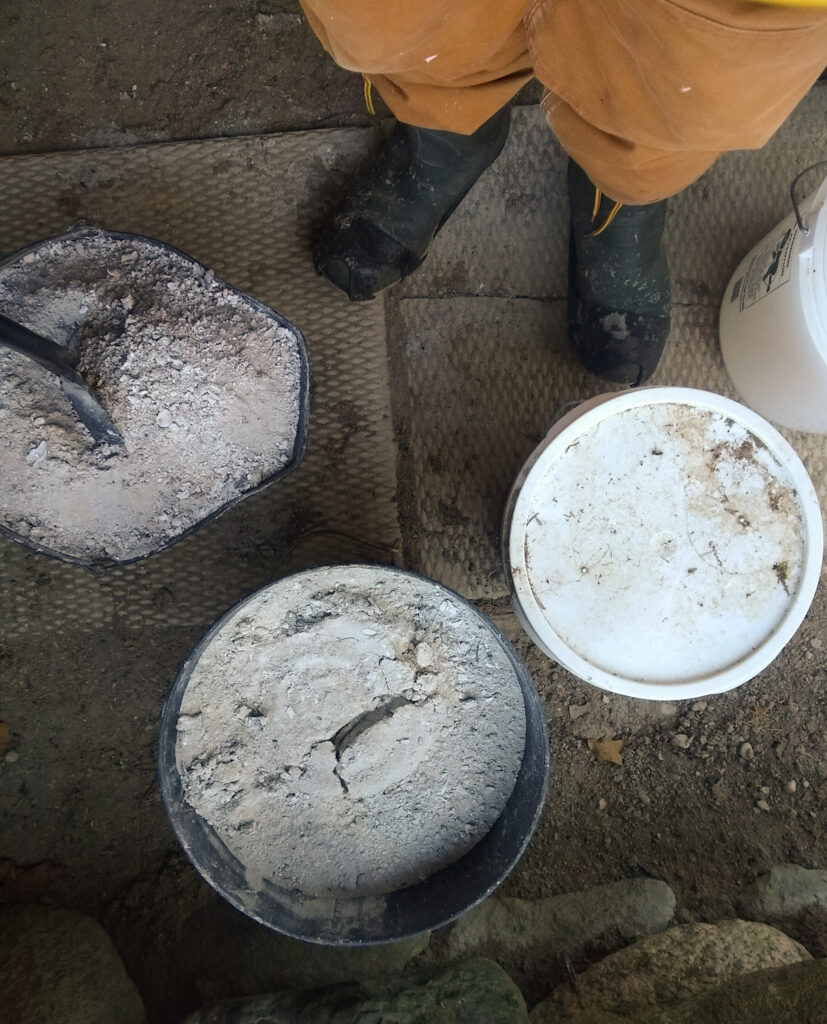
Today that first means clearing out the ash, and emptying the ash bucket. I like things here to get double or triple use, and that’s certainly true of the stove ash. From the stove it goes to a metal container outside, to ensure it is really and truly cold before being put to other uses (too many stories of friends and neighbours accidentally setting their outdoor ash storage on fire). Once it’s stone-cold cold, we use it to help clear ice on the driveway, sprinkle it around for traction, and mix it in to the chicken’s dustbaths to help combat parasites. For household use, I once used the ash to make a batch of lye, which I combined with lard to make soft dish soap. (The soap works beautifully and I hope to make more again sometime.)

Left in metal, fresh from the stove. Centre in metal, chilled outside. Right in plastic, fully cold and ready for use. Human well bundled and wearing ice grippers on her boots.

The ash cleared away, it’s time to get the fire going. Lots of extra shavings from the hand planes in the woodshop provide excellent tinder. The kettle and frying pan get popped on top of the woodstove, to start warming up straight away. While the fire gets going, I’ll get some water in reserve. Any time the weather is very X, there’s a decent chance we’ll lose power at some point. So a big jug is filled with drinking water and grey water tubs topped up with whatever’s left in the chicken waterers (for flushing), to be on the safe side.

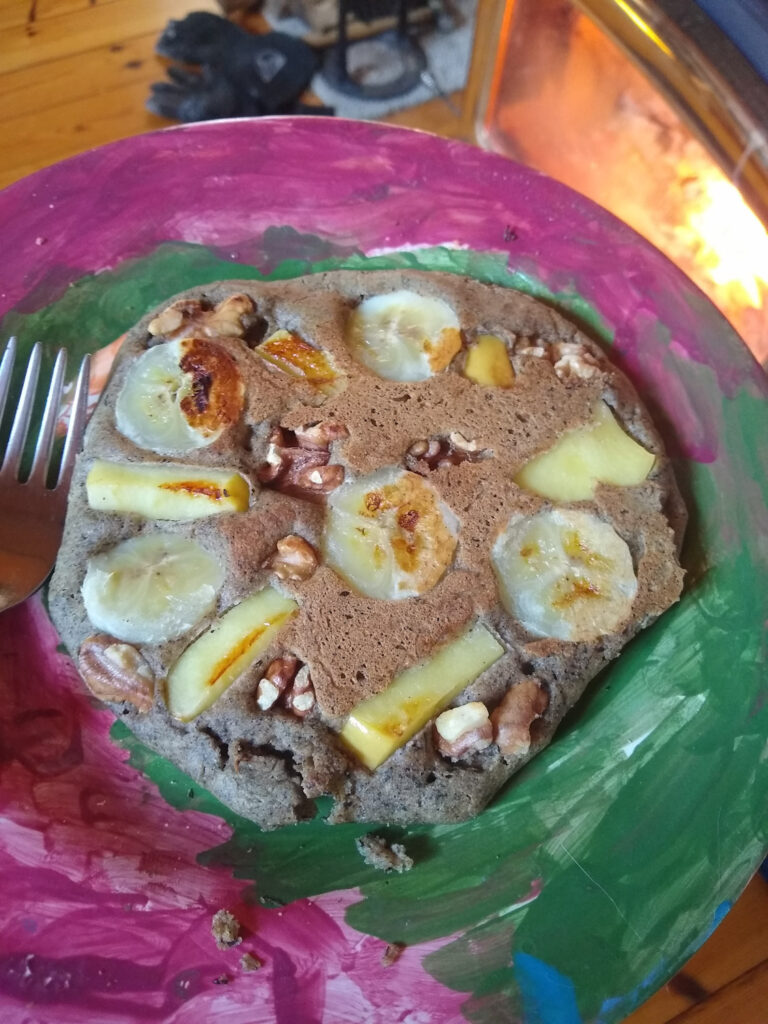
Today’s breakfast will be buckwheat pancakes with maple breakfast sausages, plus a few delicious cups of tea. Then, fuelled up and rewarmed, we’ll embark on the rest of the day. And it seems like a rather perfect day to empty out and defrost the freezer. Since I think we’ll have *no trouble* keeping the contents cold if we pop them outside today… 🙂

Have a wonderful weekend folks!

~Kate

Plate by my Uncle Richard. Thanks Uncle Rich! ♥️

Categories
birbs

Winter Plumage?

Weird bird at the window feeder this morning. Very fuzzy. Long tail. Maybe winter plumage?

If it fits, it sits.

~Kate

Categories
birbs fauna QoTD

Biomimicry for everyday use

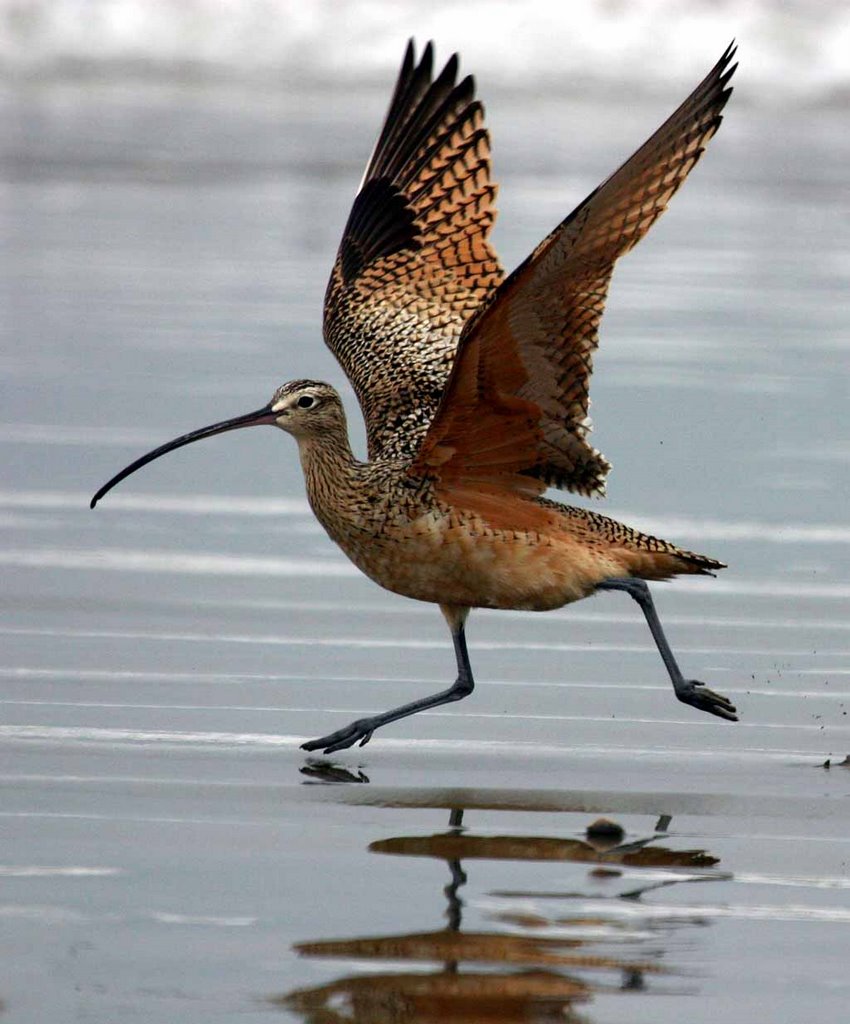
© “Mike” Michael L. Baird / CC BY 2.0

…the Long-billed Curlew protects its territory with a variety of moves, one of which is “Concealment,” in which it runs towards its opponent, then “suddenly flops down in grass, disappearing from view.” The opponent looks around, perplexed, until the defender springs up and advances aggressively, then drops and hides again. I am going to try this on my next zoom meeting.

~Rosemary Mosco. From her excellent newsletter, “Flight Club

Categories
QoTD tracks & scat

QoTD: Wonder

“… It’s here that I’ve begun to feel wonder again.
Like when I was a kid.
And this makes me deeply happy.
I wish I could say ‘Thank You’, just so, straight into the universe.”

~Never Cry Wolf, 1983 film version.