No matter how intently one studies the hundred little dramas of the woods and meadows, one can never learn all the salient facts about any one of them.
Aldo Leopold
 Maker's Dozen
No matter how intently one studies the hundred little dramas of the woods and meadows, one can never learn all the salient facts about any one of them.
Aldo Leopold
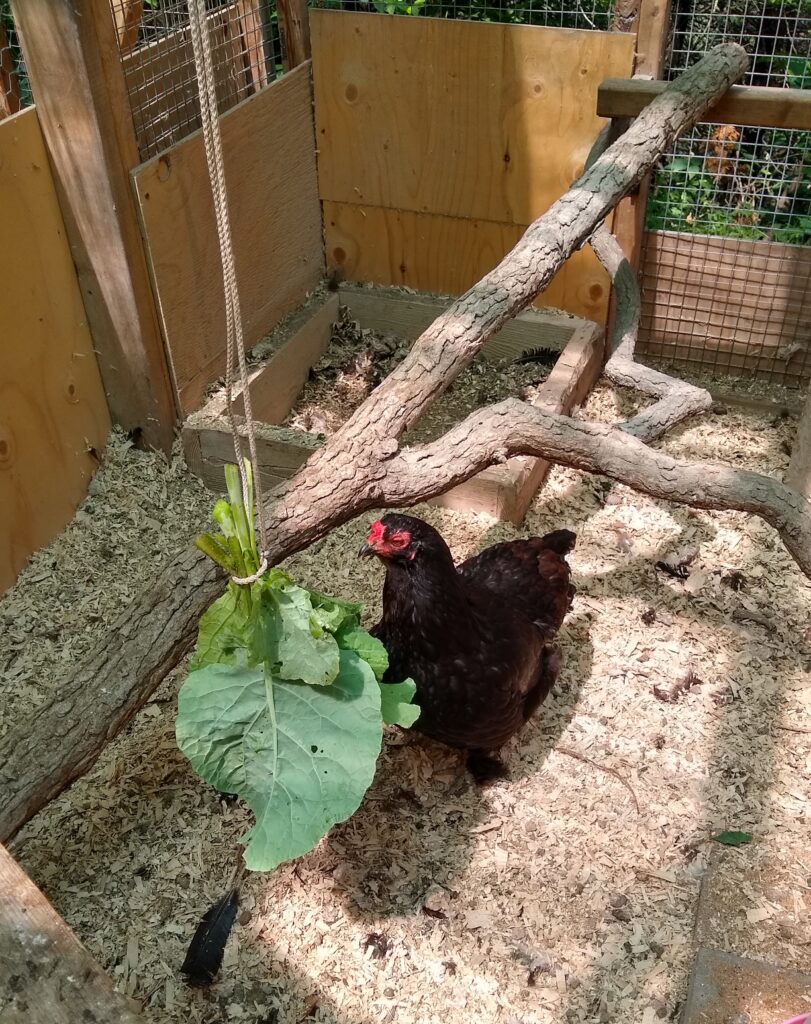
Here’s Lin enjoying a kale and borage piñata. One of the summertime treats we put out to feed the chooks/enrich the runs. And the kale comes complete with complimentary cabbage white caterpillar topping!
I know she looks skeptical, but that’s kinda just how Lin always looks (she is a very sweet chicken). That piñata will be annihilated by day’s end.
~Kate
“Acts of creation are ordinarily reserved for gods and poets, but humbler folk may circumvent this restriction if they know how. To plant a pine, for example, one need be neither god nor poet; one need only own a shovel. By virtue of this curious loophole in the rules, any clodhopper may say: Let there be a tree – and there will be one.”
~Aldo Leopold
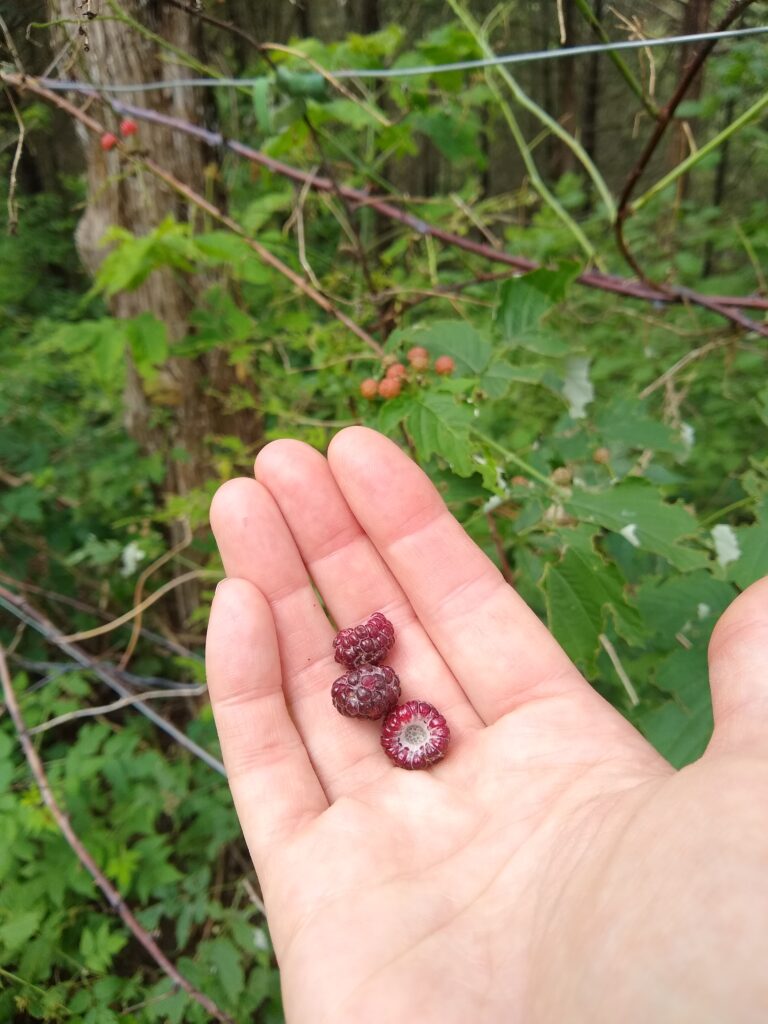
The first of this year’s wild raspberries. The vines were partially defoliated by the LDD caterpillars, but the caterpillar population collapsed and died en masse just in time for the raspberry to still produce this year.
We’ve had a bumper crop of mulberries this year, possibly in part thanks to the LDD moth. Our mulberry bush is usually partially shaded by red oaks, and this year they were bare for much of June, giving the mulberry bush lots of extra sun — though the beautiful old oaks are beginning to grow their leaves back now. One tree’s struggle is another’s boom.
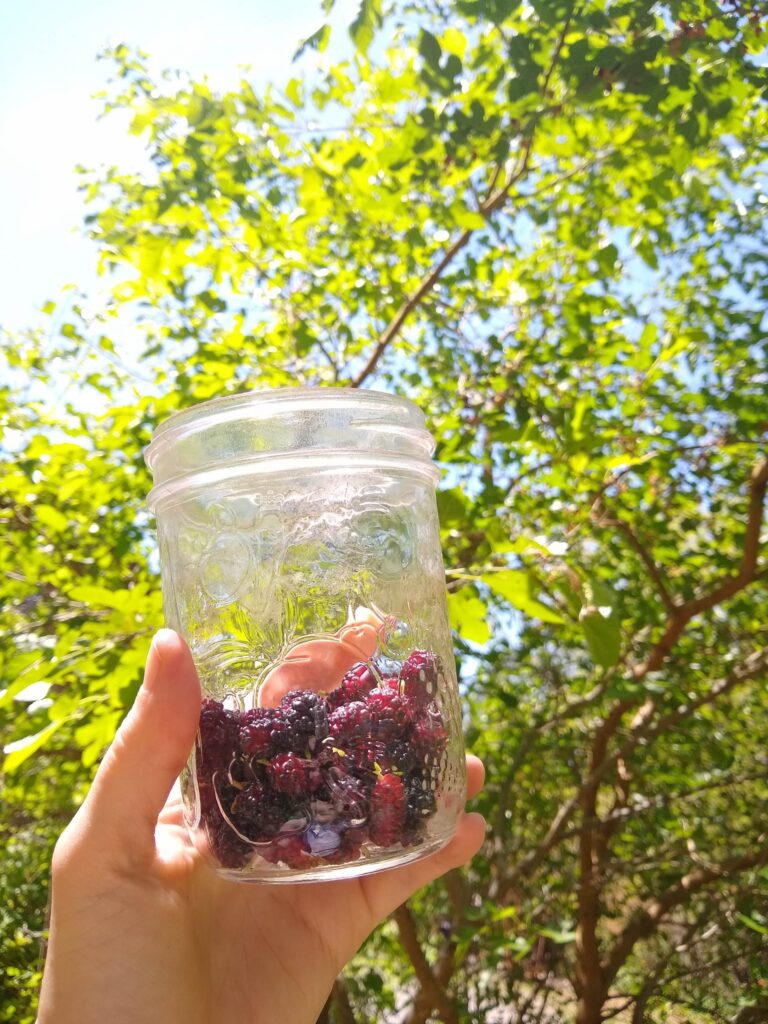
Like the mulberries, the raspberries here are a rolling harvest. Usually a small handful each day once it gets going. A berry perfect after dinner treat.
~Kate
Sometimes we glimpse the pure volume of life here and it’s nearly overwhelming.
We were watching the woods flickering with fireflies this evening, and began talking about the other nearby critters, just the ones we know about, who were also going about their evenings, on the ground and on the plants and in the trees around us.
The phoebe sitting on her eggs, in her nest on one of the logs that make up our house. Who periodically cliff-dives down past the living room window, to catch a bug or have a sip of water.
The robin, on her own clutch, sitting on top of the nest box by the wood’s edge.
The hawk who flew over the yard today, carrying a snake.
The four swallowtail caterpillars in the carrot patch.
The flying squirrels, whose day begins as ours ends. Who take off from our roof, each evening at twilight.
“Scrappy”, the eastern cottontail missing a chunk from his ear, who visits the yard every evening, and who seems to have developed a taste for milkweed as well as the other forage.
The eastern grey squirrel we saw building a new drey today in one of the junipers.
The monarch babies on the milkweeds, some of which are evading Scrappy.
The cabbage white eggs on the kale.
The bat who has been using the roof’s overhang as a sometime roost. Leaving little bat poop “I was here” sign on the deck.
The hummingbird who buzzed my head today, intent on getting a drink from the red flowers of the scarlet runner beans.
The tiny bees in the yard’s clover.
The wolf spider carrying her egg sac.
The mystery russet-coloured bird who flushed from the ground up into the trees, when I rode past on my bike.
The veerys, singing their pan-flute songs as dark sets in.
The barred owl, whose call drifts through the night and in the bedroom window.
Just a few of the critters we happened to notice today. Just the ones whose paths crossed ours.
Each one of them living their lives, coming and going and breeding and eating and resting.
Multitudes.
Goodnight moon, goodnight birds and bees and bugs and beasts. Goodnight all.
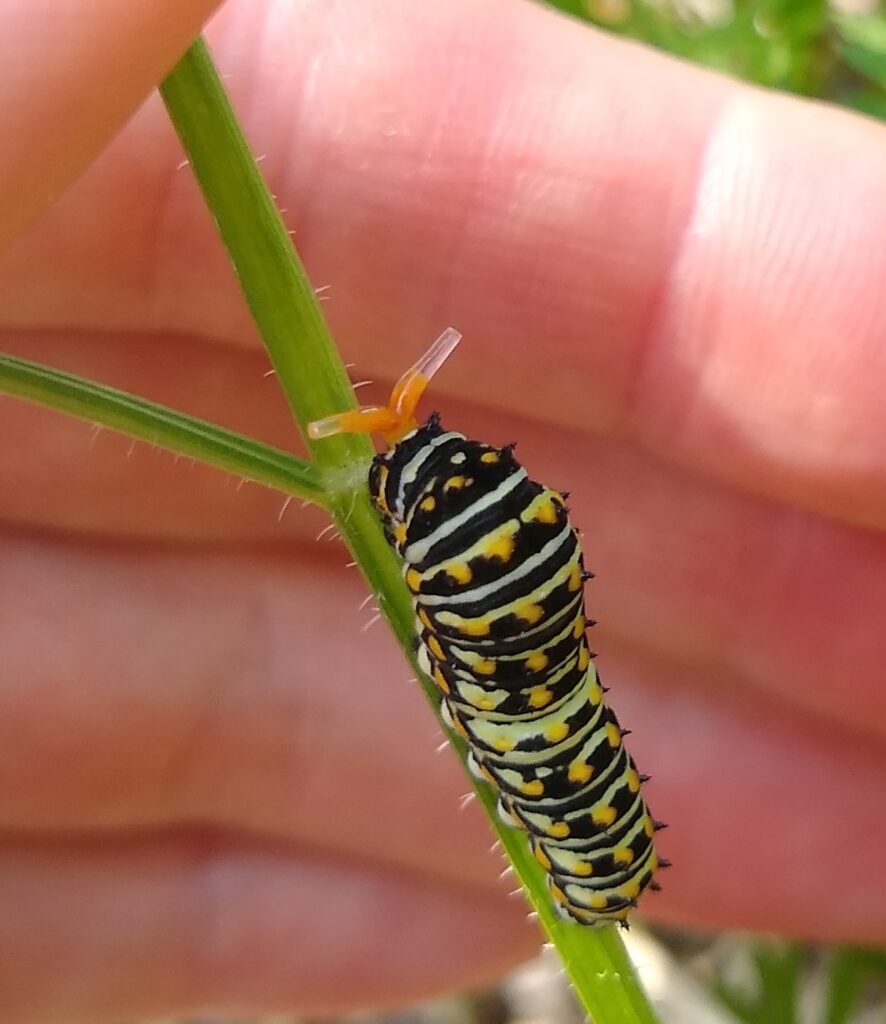
“All swallowtail larvae have an eversible horn-like organ behind the head known as the osmeterium (osmeteria, plural) that looks like a forked snake tongue. It is a bright yellow-orange color on the black swallowtail. When the caterpillar is disturbed it rears up and the organ is extended for a short period of time. When everted it it releases a chemical repellent with a foul smell to repel predators. It is harmless to humans, however.”
From Wisconsin Horticulture
One of several black swallowtail caterpillars (all different instars — a younger one pictured below) found munching away on the carrot tops. I wasn’t trying to alarm it into pretending to be a snake, but just my looming presence in the carrot patch was probably a bit alarming.
It would be better for our crisper if the caterpillars were on the usually abundant Queen Anne’s Lace instead of our domestic carrots, but until the wild food gets going, I don’t mind sharing. The veg patch can be a pop-up pollinator garden.
~Kate


Agent of destruction. Ah, no, I don’t mean the caterpillar shown here. I mean humans. We’re capable of a lot, and not all of it is great. This hungry hungry caterpillar — Lymantria dispar dispar (“gypsy moth”, hereafter “LDD moth”) — is only here because in 1868 one man thought he could use them for silk. Étienne brought them over from Europe, and “kept” them at his house. They got out, of course. When will humans learn it is one of life’s truths… Death, taxes, and they will get out.
We live here in a forest full of oaks, the LDD moth’s preferred food. Many of our trees are completely bare. In the middle of a green spring, dry leaves crunch underfoot. If we step out of our house *at all* recently, we get caterpillars all over us. The ground is slick with their frass. Later this summer, the moths will fly so thick they’ll hit us in the face. Maybe they should be called “truth moths”…
But I do not hate the LDD moth. It is a caterpillar eating leaves. There is no malice there, no forethought. Humans, on the other hand, might need a time-out to think about what we’ve done. And, importantly, what we plan to do. For nearly anything ecological today, not much has changed. We still chase quick fixes. How quickly, how quickly can I stop looking at this and pretend what I want to be normal is normal. But the complex fights our efforts to make it simple. And nothing complex will be simply solved. At least not without making more problems…
The good news is that while some outbreak years are brutal to witness, the data to date shows that these moths, even though they’re not from here, now collapse very much the same way as endemic species with outbreak cycles do. From diseases and the weight of their own populations. We are already seeing here the extraordinary number of caterpillars beginning to die off in equally extraordinary numbers. The crawling masses suddenly gone still. Healthy (deciduous) trees can withstand a couple of years defoliation. And if trees are unhealthy, well that’s a different string to follow…
It’s a tangled web indeed, but the bugs didn’t start this.
~Kate
There is no stop on the tour when you are out for a walk alone in the unmediated woods. No guide raises a colourful umbrella to get your attention. There’s no floating arrow directed at points of interest. No plaques. Just your own eyes and whatever you pay attention to.
When you walk with a companion, you can see with their eyes as well. When Neil and I walk together, there is usually a fair amount of quiet pointing while we chat about other things. An interesting tree, a patch of new blooms, fruits emerging on the mayapples (oh the mayapples…). But no one stops you from walking right past something marvelous. It is up to you to notice. And there’s an awful lot that hides in plain sight. And not all of it is small.
A couple of days ago I was walking the woods alone. I had gone up to the woods to try for a gentle run, and did a walking lap of the woods first. I often end up walking a full lap before running it. It just gets my feet used to where I am. Besides, my head was many places other than where I was. And that is usually a good recipe for a turned ankle. So I did a walking lap to let my thoughts ramble and untangle. But as I neared a large mayapple patch, I doubled back. Had I seen tiny tracks in the dirt? I retraced my steps, crouched down to the ground, and decided… yes! I had. Tiny hoofprints leading into the mayapple patch. Deer. But so small. Was this the right time to be seeing fawn tracks? I wasn’t sure. Would they be big enough to be walking around? I walked on, thinking to myself about how much I love learning to see animals even when they’re not there in front of me. Oh how right and wrong I was…

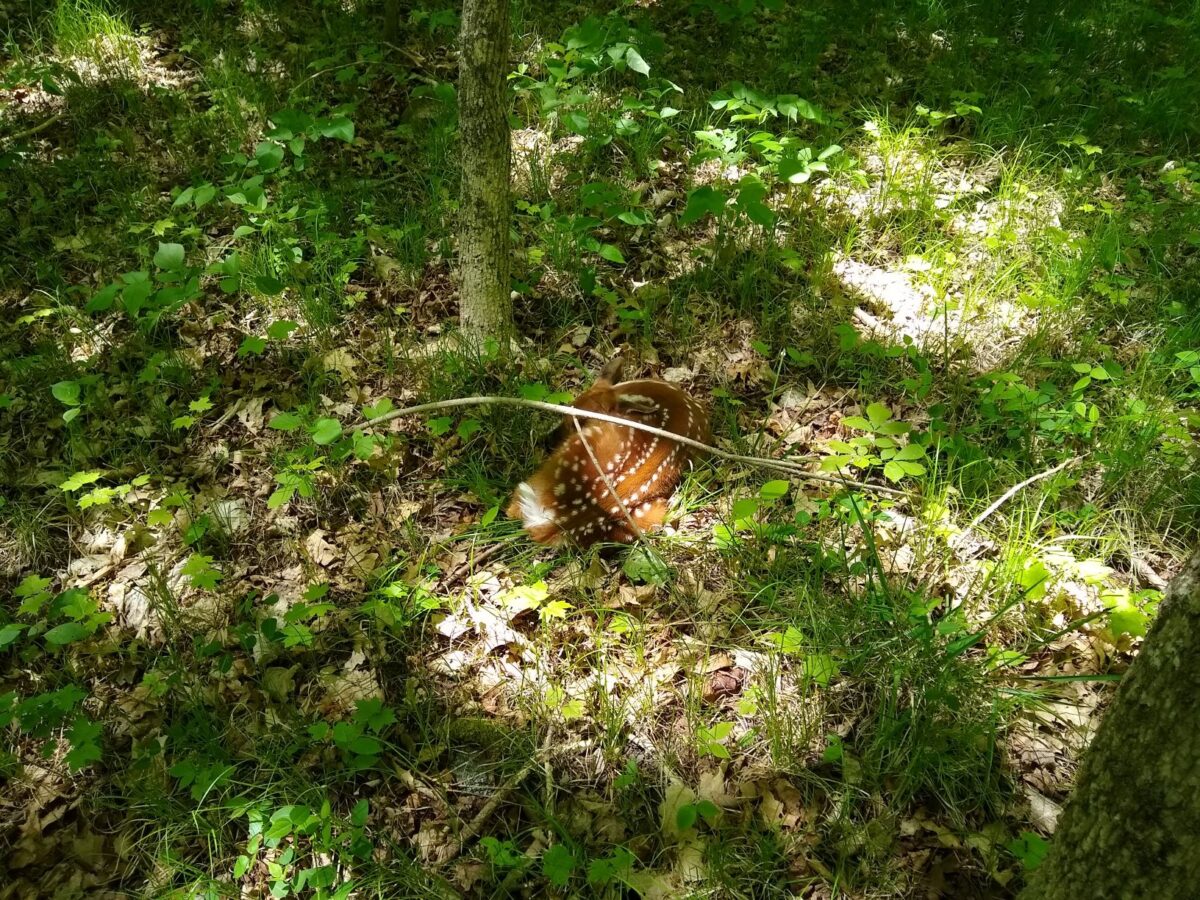
I finished my first lap of the woods, and began again. As I passed the mayapple patch for a second time, I thought about the unseen deer. And a few metres further on, I *gasp* SAW. Not a hoofprint, not a flash of white tail bouncing away. A little tiny wee baby deer, curled up and resting in the grass right beside me. And I do mean, right beside me. Three feet away, if that. I had gone right past it on my first lap, moments after spotting those prints. Right past it, and it was right here.

Though I had never encountered a baby deer like this before, I knew well enough to leave well enough alone. I took this fast photo with my phone and then I was the one who hightailed it out of there. The best thing I could do for this baby deer was am-scray. Though my best day is one when I see a baby deer, a baby deer’s best day is when it sees no one.
Baby deer (yes I know they’re called fawns but baby deer) can stand and walk shortly after they are born. But they’re not fast enough to keep up with mom, and they also don’t carry the scent that mom has, and which predators might use to find them. So, for the first few weeks of their lives, mom keeps them safe by keeping them away from her. She leaves her babies secreted and alone in various spots during the day, coming back only to nurse them, once every four hours or longer. In this way, baby deer are very similar to baby bunnies, whose moms also protect them by staying away. (Deer and rabbits are also similar in that our handling the babies and leaving our scent on them may cause the mother to reject it. Excellent reason to keep our paws off the wildlife. This is not, by the way, true of baby birds, an idea that is widespread but unfounded.)
At this age, being perfectly still — and wow was that baby ever still — and being perfectly tiny is a fawn’s best defense. A healthy baby deer lying quietly and still and alone is doing exactly what a baby deer is meant to do. Like so many other times, with so many other critters, the best thing I can do to show it I love it… is to walk away. Just because something is still does not mean it is not frightened. Its mom keeps it safe and alive by leaving it alone, and I should do the same.
Is that easy? NOPE. This is your brain, this is your brain on baby deer. Aaaaaaaaaaahhhhh! As I walked quickly away I literally had to hold my hands over my heart to keep it from bursting out of my chest. A baby deer! Heaven! We have spooked fawns in the woods before, been right on top of them with no idea until they suddenly flush from under our feet. But never this. A baby deer at rest. So perfect and perfectly still.
I thought I would finish my walk in a daze, processing what I had seen. In the moment, I had trouble connecting my eyes to my brain. It was a baby deer! It was right there! I was right beside a baby deer! Etc! Seeing them in the wild… it’s difficult to process. A fawn staying perfectly still looks like every photograph or illustration of a deer you’ve ever seen. I ran it over and over in my mind as I walked. Curled up, russet-coloured, big ears, white spots, right there. And oh, no, wait…no…nope.. no way… what is that over there??

I was clear on the other side of the woods when something caught my eye. Much farther away from the trail, but a shape I had just seen, and which I guess my eyes will now always search for — it was another baby deer! You can see it in the photo above. That reddish patch in the centre of this zoom. Thaaaat’s a baby deer. A second baby deer spotted on one walk. If you need me, I’ll be over here holding my exploded heart.
In the first few weeks mother deer “store” sibling fawns separately from each other, so this spotting of a second baby was another good sign that all was well and normal. If there were signs things were not well and normal, well, that is a discussion for another day. My decisions around hard questions are not drawn with hard lines. But in general, if it has a human cause, I will intervene. If not, I will let nature run its own course. I have intervened before, on smaller scales, and cost another critter its dinner. I tread more carefully now around my “help”.
Now did I worry about the baby deer? Yuuup. Of course I did slash do. I know what else is in the woods, why it is so important to be still and quiet and scentless. And, for human concerns, people drive too fast on the roads near here, hunt both in and out of season, and it was not out of the question that mom was not coming back.
I will pause here to say that I do eat meat, including deer, and that I am not opposed to hunting, in principle. Though not hunting done ignorantly, or wastefully. A lot of hunting seems to just be a socially-acceptable reason for men to go sit alone in the woods. Which is just… sad. You shouldn’t feel you need to justify a long walk in the woods with a death. It makes a real mess of things. That said, one bad day in an otherwise wild life is incomparably better than the “lives” of almost all the meat we eat.
I decided to keep an eye on things as lightly and from as far away as possible. I thought about leaving a trail camera, but ours flashes red when it takes a photo and I had seen evidence of it spooking deer before. I certainly didn’t want to be the human cause keeping mom away. So I went up the next day to check as discretely as I could. Baby one, by the trail, had not been moved, but baby two was gone. Which I decided was a half-good sign. Some guides will tell you to be concerned and perhaps intervene if the baby hasn’t been moved in 24 hours. So what about baby one, by the trail? But I asked some wise animal-knowledgeable friends of mine who suggested that it was just as likely that mama deer had simply decided it was a good spot. So I waited another day, and checked again. Sure enough, baby one was gone. No signs of anything gone awry. Just a tiny deer bed, the sign of it already being covered over by the growing woods.

I am so glad to have seen these beautiful babies, and even more glad they have safely moved on. I hope to see one again sometime, though perhaps at a greater distance. Where I could enjoy getting a glimpse of it, and it could enjoy that the human was not quite so close to where it rests until mom returns.
It was good to meet you wee ones. Have a good life, you dear little things.
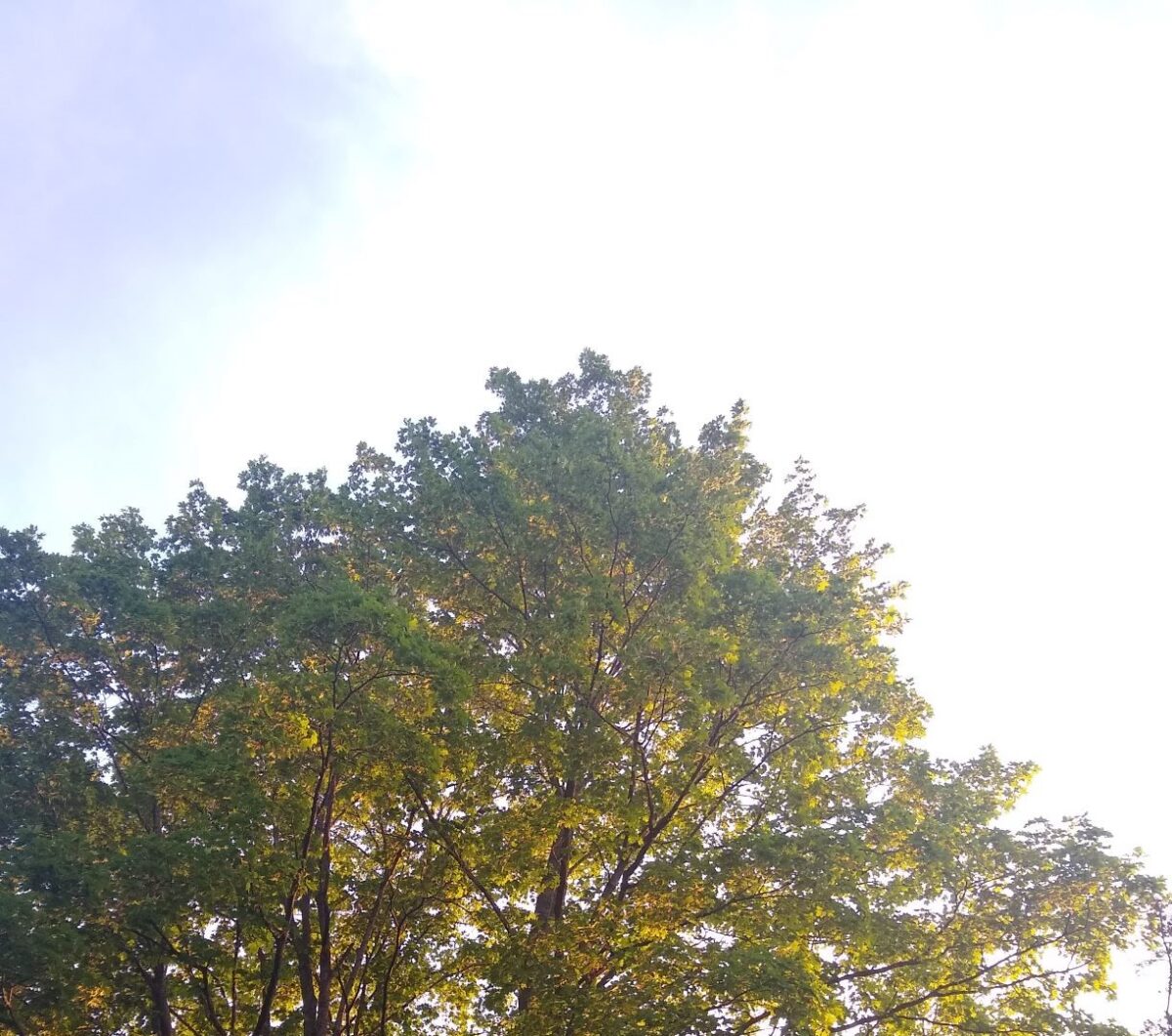
We try to have days in balance here. I have a new policy that if I think I am too busy to go walk the woods, that is exactly when I have to go walk the woods. It turns out that it is just good math. Even a half hour “off the clock” and in the woods generates many hours of a much calmer, happier, more productive me.
Some days though, even with this policy enacted, I just can’t seem to find that half hour in my day, or the steep hill just looks a little too tall for a tired body.
I believe the world is made up of rich and complex interactions between life forms of all shapes and sizes. The wild worlds of microbiomes and mycelliums. Big and little worlds, in, on, and around us. But while I don’t think I believe the woods has a singular sentience that keeps an eye on us here, some days it certainly feels that way.
On the days we can’t or don’t make it up to the woods, nature has a tendency to send an emissary to us instead. “Look at this!” the world seems to shout, or whisper. Nudging something marvelous in our direction. When we don’t go to the woods, the woods comes to us.
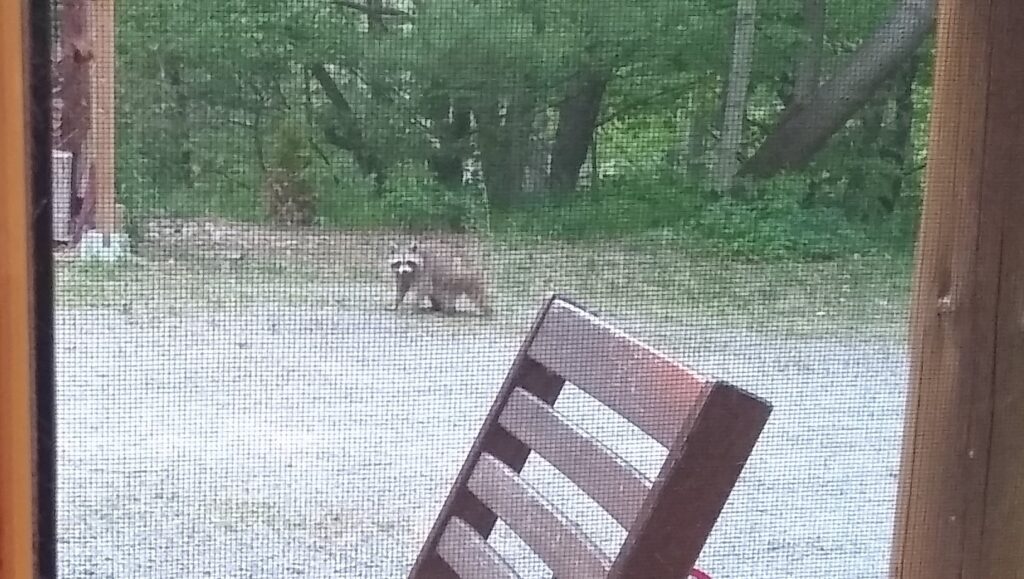
Yesterday I was “too busy” and a raccoon wandered past my office window. This morning while I was on a call, a wild rabbit lay down languorously in the grass of the front garden, nibbling greens while recumbent and resting. A tiny long-eared greek god supping grapes off its chest.
Having chickens means we pop out to the garden a few times a day no matter how full the daily docket gets. And between tasks the other day, while swapping chicken waterers, I was buzzed by a good-sized (broad-winged?) hawk. It was not alone though. It was flying fast away from a pursuer! Which turned out to be… two robins. They were the literal vision of “hot on your tail”. Whatever the hawk’s original plans, the robins were having none of it.
Though this is an extremely common occurrence, little birds attacking big ones, I had never witnessed it before moving here. Though now I see it all the time. Tiny birds, birds we often classify as such a hawk’s “prey”, little winged timbits, dive-bombing a “predator” an order of magnitude larger than they are. And, surprisingly, astonishingly, the prey is winning.
It’s a subject I’ll likely come back to here again and again — these misconceptions of predator and prey. Of “good” animals and “bad” animals. Dangerous animals and tame animals. Clean animals and dirty animals… it goes on and on. I structured my understanding of the world around models that aren’t just out of date, not just expired, they were never true. Mama animals take care of the babies, dad animals get the food. Bears growl, bunnies are sweet, the tiny are afraid of the large. “Not so” the world keeps shouting at me here, “not so”. “Look, look, look and begin to see.”
Ask someone who works with bears and they will tell you that bears hardly ever growl. It’s just not how and when they vocalize. As Mike McIntosh who runs the bear rehabilitation centre Bear With Us put it: “They don’t make a lot of sounds that we often hear and think they make. Bears are usually only vocal when they’re either afraid or in pain. Most of the time they’re quiet”. The cartoon version, the scary bear in the movie, it’s not just a caricature, it’s a lie. Like the lemmings who were dumped over the cliff in the fake-umentary that shaped all our understanding of those rodents, it was not is not never was true. Sweet little rabbits will rip each other’s fur out in territory disputes. Father birds will sit on eggs, mothers will build nests. We either just didn’t look, or didn’t see.
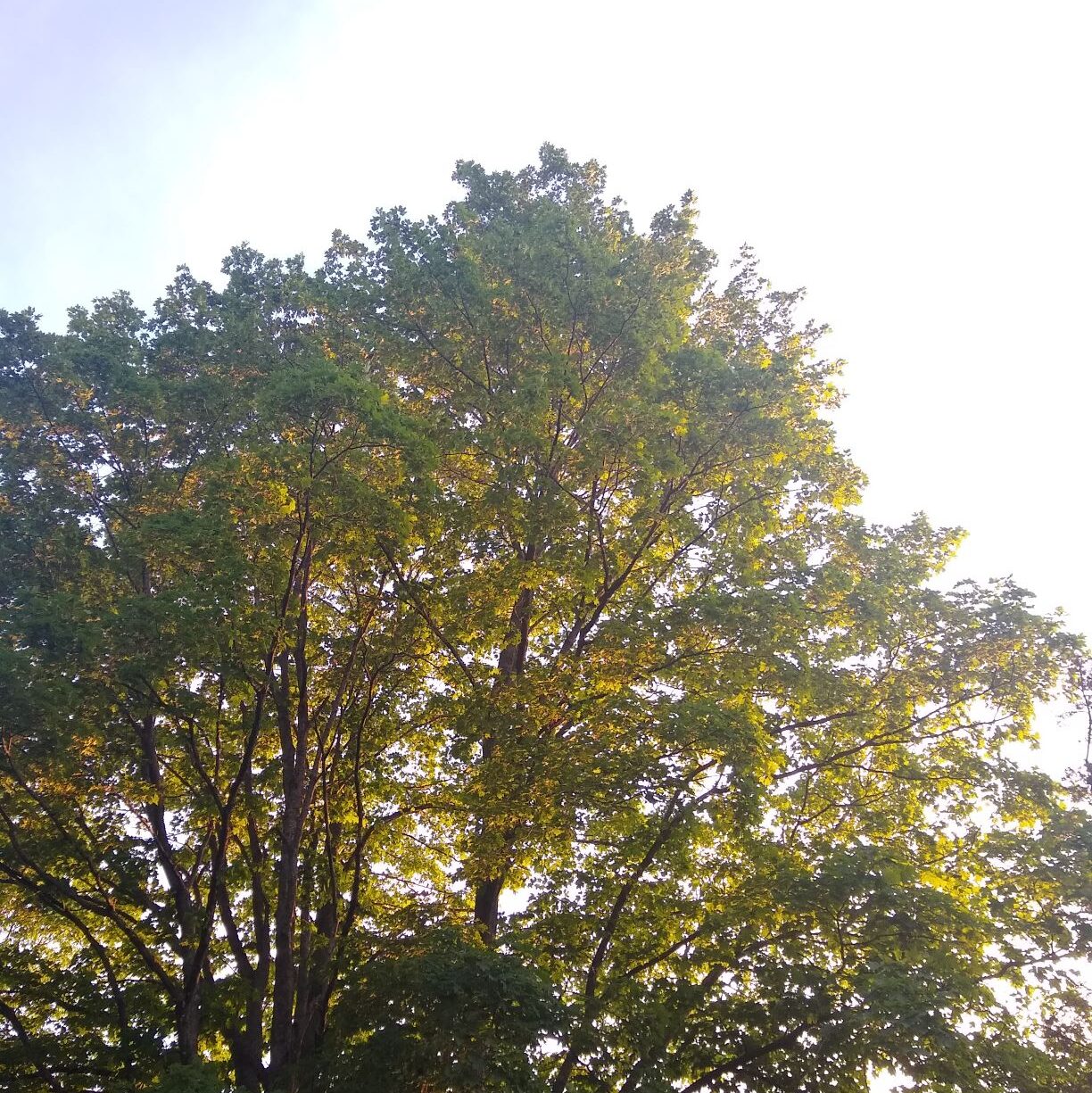
This evening we were having dinner when the character of the birdsong out the window suddenly changed, like someone had abruptly clicked to the next song, mid-track. I looked out the window and saw a fine feathered kerfuffle unfolding in the large maple in our yard. A sizeable hawk was perched on a branch, but not for long. It was being pelted at all angles by tiny birds. A variety of tiny birds it seemed. Nearby nesting moms and pops and various bystanders were having none of this large predator in their midst.
It is not uncommon to see a group of blackbirds or swallows chasing a hawk or eagle, or a group of songbirds fluttering and calling around a perched owl. Such “mobbing” behavior is probably the most frequently observed overt antipredator strategy. Nevertheless, the exact purpose of such noisy group demonstrations remains a matter of some debate.
…one function of mobbing may be educational–to teach young birds… Another may be to alert other birds to the presence of the predator, either getting them to join in the mobbing or protecting them, since a predator is unlikely to be able to sneak up on an alert victim.
Much is lacking in our understanding of mobbing. It is not clear why predators don’t simply turn on their tormentors and snatch up one or two of the mobbing birds. If they did, presumably mobbing would quickly disappear; that it persists suggests that surprise is an essential element in raptor hunting.
The Birder’s Handbook by Paul R. Ehrlich, David S. Dobkin, and Darryl Wheye
I won’t end here though on the victory of the tiny birds over the big mean hawk. Though David and Goliath stories stir the soul, no one is the villain in their own story, and the tale is of course different from Goliath’s perspective. A “predator” has its own beautiful babies to feed. Its own soaring life to support. Life-Death-Life, around and around we go. The fierce and the delicate, wrapped up in one package.
A world without good and bad guys, without roaring bears and ever-sweet bunnies is a confusing place to be. Up is down, down is up and your generalizations won’t save you now. But the truth, it turns out, is so much stranger than fiction. So much more interesting. So much more beautiful and compelling and frightening and hopeful. Look look look, and begin to see.
~Kate
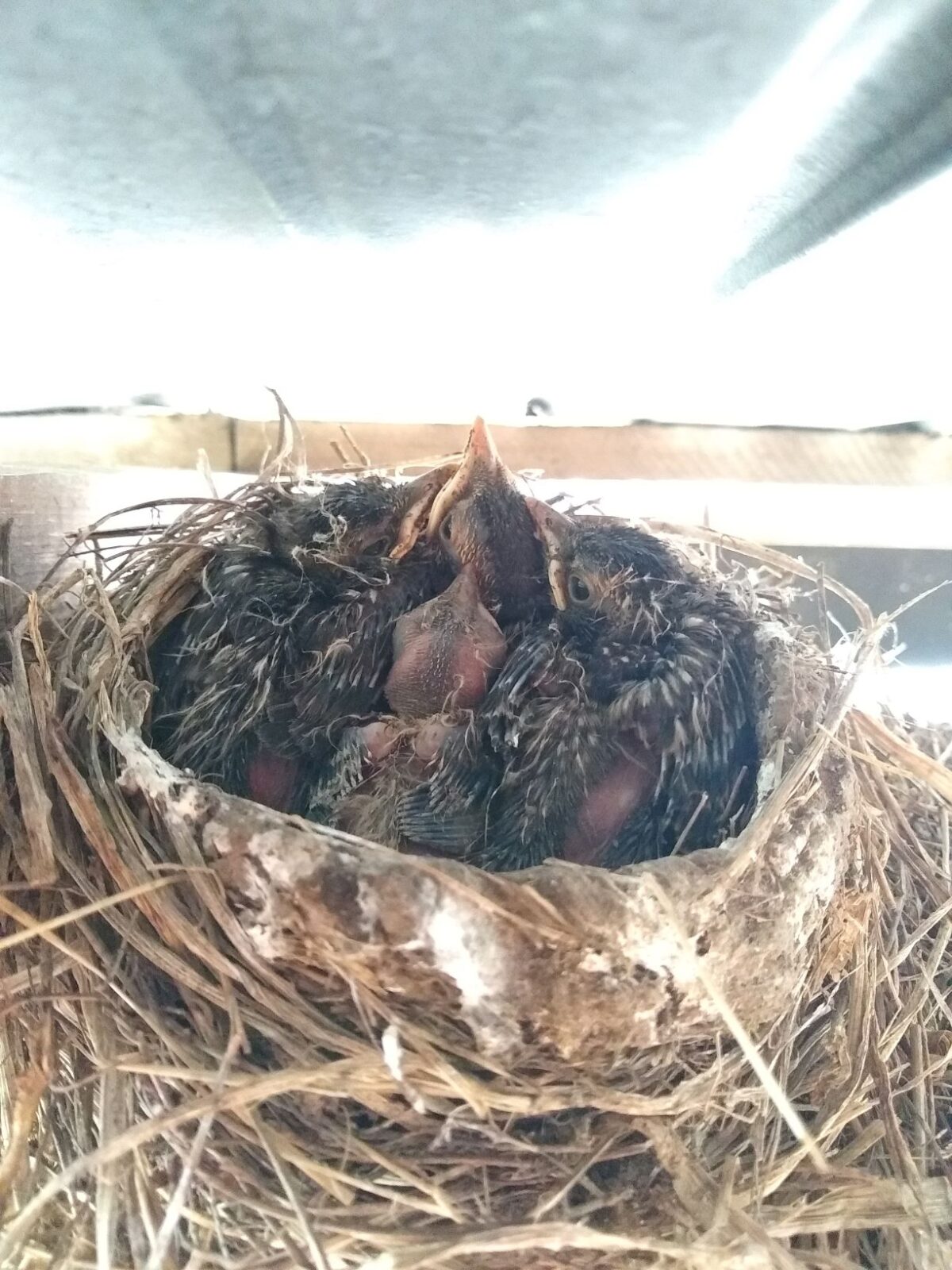

Fledgling birds can really worry us humans when we encounter them. Young birds are often “rescued” by humans when found out of the nest, even when they’re exactly where they’re supposed to be.
Little birds will often pop out of the nest once they’re fully feathered but before they’re ready to like, fly fly. They’re like “Let’s do this! I’m ready!” and then *boop* they’re on the ground. Their parents know about this and will continue looking after them down there: “Great job Tim! Now let’s work on that ‘flying’ thing…” The parents keep feeding and protecting them when they’re out of the nest, including scooting them to safer locations as needed. When we move fledgling babies, the parents may not be able to find them again — “where’s Tim?” — or we inadvertently put them somewhere that’s actually more risky to them. No human knows the threats to a robin like a robin does. In this case, a bird brain is the best brain.
I knew this intellectually, but was very relieved when I actually saw it happen a couple of years ago. A wee little robin was out of the nest on the ground. You do not look like that is a good place for you little friend! But I just watched it over the course of the day, heard the parents coming and going, and by nightfall its folks had done such a good job camouflaging it in a pile of leaves that I initially thought it was gone. And Tim was still there, safe and sound, in the morning.
It happened again this year. Every year we seem to get one or two robin’s nests, so most of our springs include fledgling robins. We’ve had so many robins’ nests appear on and around the house since we moved in that I suggested to Neil we could use them to count our years here, like the rings of a tree.

One of this year’s nests was in the rafters right above where we park our electric 4×4. We’ve been careful with our comings-and-goings since the nest appeared, and try to time things so we’re not interrupting feeding time. Today, it seems, was fledging day. By late afternoon, there was only one baby robin in the nest, and it was clear they were thinking about leaving. By evening, there were zero robins in the nest.
Just to be sure though, I checked the ground carefully around the 4×4. Nothing there. So I started unloading bits and pieces from the 4×4 bed. And whoop! Out flew a baby robin! I definitely didn’t put that there. I guess the little one’s flight path had parabola-d up up, out of the nest, and down down into the bed of the truck. Fortunately it was a very mobile little nugget, so when I disturbed them it just flew up and out of the bed and down to the ground. It stayed there for a little while, cheeping indignantly for a parent to come sort this out. I left, to give the feathered family plenty of space. I came back again later and found the fledgling on a different perch, tucked on the logs we keep behind the house. It kept cheeping and a parent kept cheeping back from somewhere up the hill for another hour or two, until Neil and I eventually noticed we were no longer hearing either the big or little cheeps behind the house. Up and into the woods you go little one.
And you ask, “What if I fall?” Oh, but my darling, “What if you fly?”
~Erin Hanson
If you find a baby bird on the ground, it is good to ask for advice to help ensure you’re seeing what you think you’re seeing before intervening. If you phone a wildlife centre (SPWC; Toronto Wildlife Centre) they will help you assess the situation and give the little ones their best shot at life — nearly always in the continued care of the parents, if at all possible.
See you next year Tim!
~Kate