Categories
insects and arachnids

Oil Beetles, They’re Pretty Slick

https://soundcloud.com/user-235666142/oil-beetles-theyre-pretty-slick
Prefer to listen to the story? Click the image above to hear the narrated version of this blog entry.

It’s quite easy to walk our woods and see “nothing”. There are many months when the trees are bare and the ground is brown. Our walking trail is a loop, and it is not difficult for a human to walk in a circle and not see a deer. But that is only when we are chasing our (or their) tails, looking for what we know we might see, not what is there.

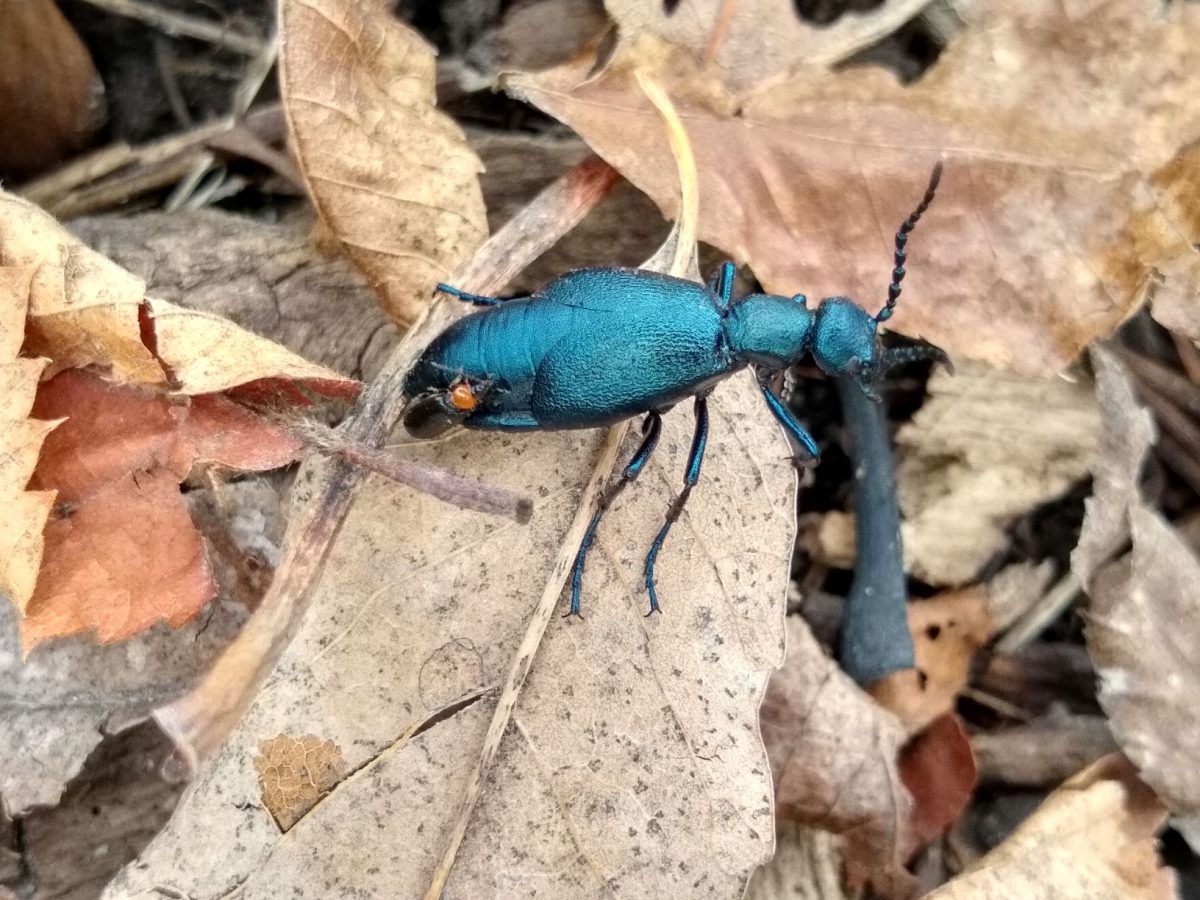
I was out on a brown dry leafy walk a few days ago when I came across this. A startlingly shiny large blue-teal beetle walking amongst the leaves at my feet. I recognized it from other encounters, but couldn’t remember the ID.

This is a Meloe — an “oil beetle”. Sometimes called a “blister beetle”. So called because it can release oily droplets that contain the chemical cantharidin. Cantharidin, on contact with skin, can cause swelling and painful blisters. Another critter best filed not under “handle with care”, but rather “do not disturb”.

But, on closer inspection, I noticed that something was in the middle of disturbing this Meloe. On its rumpside was another smaller beetle. You can see it in the photo below. That bitty black and orange bug on the backside appears to be biting the big’un.

Nibble nibble nibble

I am not certain what kind of bug this little one is, though it may be an Oedemeridae, or false blister beetle. Apparently some bugs have been found parasitizing Meloe beetles in order to harvest their cantharidin and make use of it for themselves. But interestingly, if this is an Oedemeridae, it already produces cantharidin all on its own. I would say that perhaps that means it is just being a little jerk, but I have not found that to be nature’s way. There is nearly always a will, a purpose, even if we or I don’t know what it is yet. And don’t feel too bad for the Meloe beetle either — they are themselves parasites of solitary bees. An integral part of their life cycle is to have their larva catch a ride on an adult bee back to its nest, where the Meloe larva consumes the larval bees and/or their food stores.

As Annie Dillard put it so marvelously in her book, Pilgrim at Tinker Creek:

“Fish gotta swim and bird gotta fly; insects, it seems, gotta do one horrible thing after another. I never ask why of a vulture or shark, but I ask why of almost every insect I see. More than one insect–the possibility of fertile reproduction–is an assault on all human value, all hope of a reasonable god.”

~Annie Dillard

I don’t feel the same way as Annie does about the situation, but what a colourful slice of language pie.

One of the reasons I think this may be a false blister beetle is that apparently they are big fans of trout lilies, which are currently out in force, so it does fit that I would be noticing these wee fellas on the ground (or on beetles on the ground) this time of year.
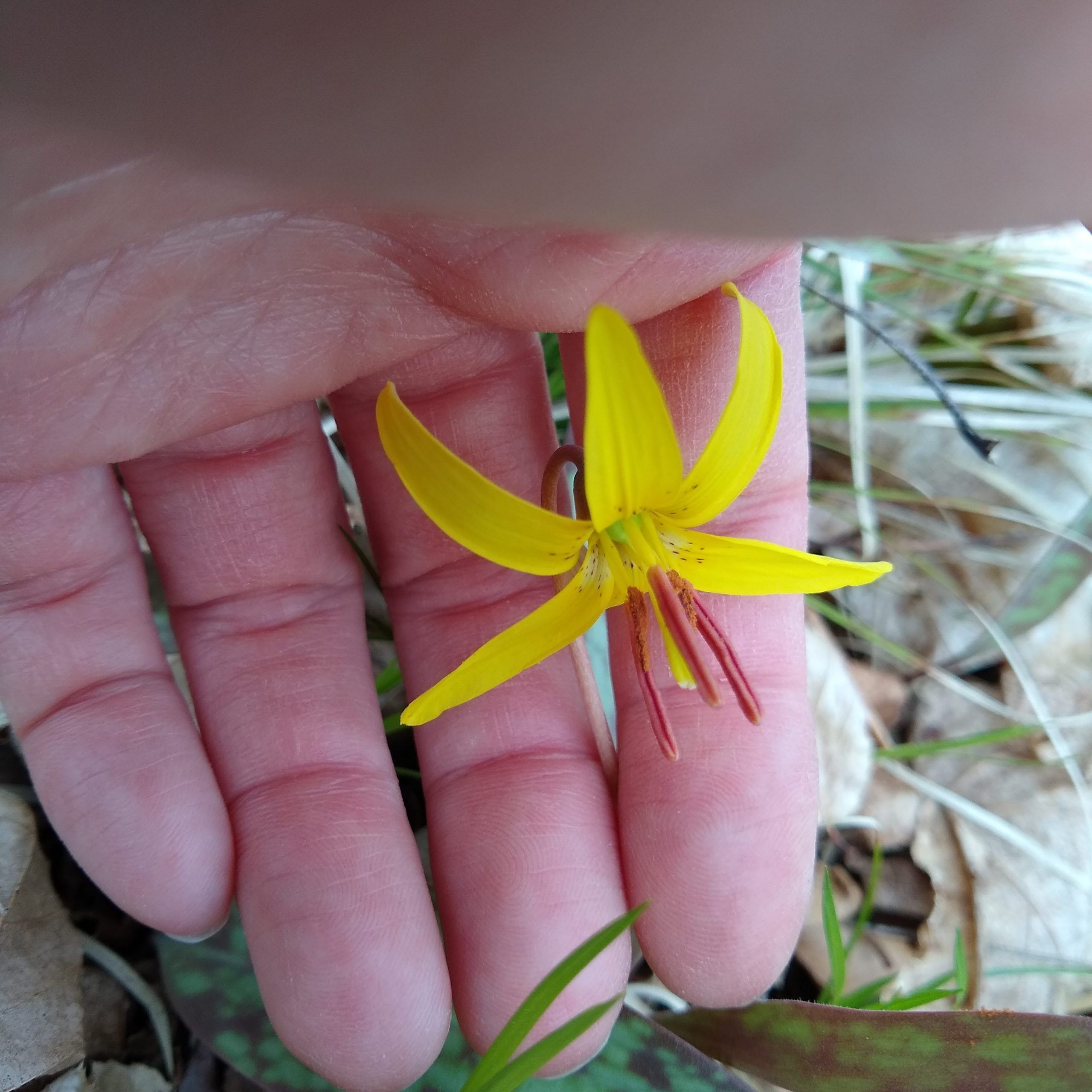
Trout lily with the red-orange anther colour morph (but that is a story for another day…)

If the false blister beetle is trying to obtain cantharidin, there may have been better candidates. The Meloe oil beetle in this photo is a female. Apparently you can tell by looking at the antenna — in females the antenna are relatively straight, whereas male antenna have a noticeable crook at the end. They use it to help hang on to females while mating.

Female Meloe beetles do not continue to generate cantharidin during their lives. Whatever they have as adults is leftover from their larval stages of development. But! They can refuel — thanks to the male Meloes. During mating, a male Meloe beetle will transfer more cantharidin to the female, and top up her reserves. She’ll saunter away from their tryst fully recharged with all that toxic goodness.

How cool is that??

…And you thought you wanted to see a deer. 😉

~Kate

Categories
thinking big

How ’bout Yours?

“…And then — this is the real trick in living on a planet that contains many other human souls that are as valuable and multitudinous as your own — you must find a way to really listen to this other person’s answer, and to believe in their experience as fully as we believe in our own.”

~John Green

Categories
insects and arachnids thinking big

Barefoot with the Singing Spiders

https://soundcloud.com/user-235666142/barefoot-with-the-singing-spiders
Prefer to listen to the story? Click the image above to hear the audio version of this blog entry.

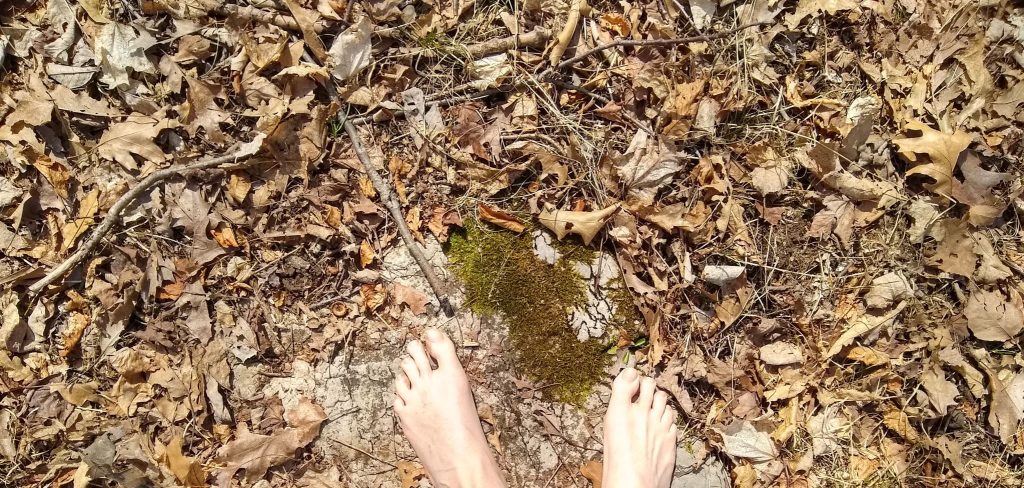
I went for a barefoot walk of the woods yesterday. A thing to be savoured before the bitey bugs wake up. Sleep tight mosquitos…

One of many many things I like about walking barefoot is the quiet. I’m certain that to the critters in the woods I still sound like a bipedal animal (tripedal if you count my walking stick). And I certainly still have human scent and shape about me. But even my human ears can tell that my footfalls are not the same, when my feet are out. The leaves rustle instead of compress. The sound is more of foraging chipmunks than clomping shopping malls.

When you walk barefoot, you notice your steps. Shoes steamroller. They walk over, on top of, and through. When you can step straight onto any and every little thing, you tend to. Shoes make your feet callous to the world, while ironically your foot’s calluses let you feel it.

In bared feet, where your foot falls is part of your walk. The ground under your skin is a part of your moment. I pay more attention to what is coming just ahead, and what is directly beneath me right now. Where I am. This mud is soft, when that mud was firm. This moss is plush, that moss was crunchy. These leaves rustle, others were silent. There are many sticks here, when a few steps ago there were none. The ground here is cool, the ground there was warm. Hmmm this stone is chilly underfoot… ah, it’s light-coloured, and not absorbing the day’s heat. The last one was dark and toasty. That soft moss covered stone… how could I not divert my path, to go feel it underfoot?

One woman, who did not wear shoes until she was 20, said that having shoes on felt like walking “con los ojos vendados”, with blindfolds on her feet. Taking your shoes off is like peeling the blindfold back. Allowing your feet to see the ground. To simply chuck off your shoes and go walk the woods is not advised — it is too much too fast too blinding too sharp. I have a good sense now of what grows and scuttles in our woods, and there is no trash here, no broken glass. I have grown familiar with what I am likely to find where, and almost none of it is truly hazardous to me, though I show respect to the unknown by stepping mindfully.

I am also a practical lady who lives in a northern climate, and I have many pairs of practical shoes. There is a time and a place, and my steel-toed boots are best when, say, splitting wood. But if you are outside and you find a good spot, a bit of soft moss, or a smooth log, why not take the blindfold off for a few moments at least, and let your toes see the earth.

I went for a gentle jog in the woods the other day, barefoot. I saw two deer, two turkeys, two ruffed grouse, and a bluebird. Some of that is chance, each day in the woods is different, but I can’t help but notice that the days when my footfalls are softer, I often see more and from closer than the days I am shod.

But you want to know about the spiders. 🙂

Again yesterday, I walked a gentle lap of the woods. This time a slow walk. Slow enough and quiet enough that my ears eventually noticed that underneath the spring bird song was another sound. Or sounds. A sound I didn’t recognize, but that was persistent, and all around. A sort of … crickety noise? Like the leaves were… humming?

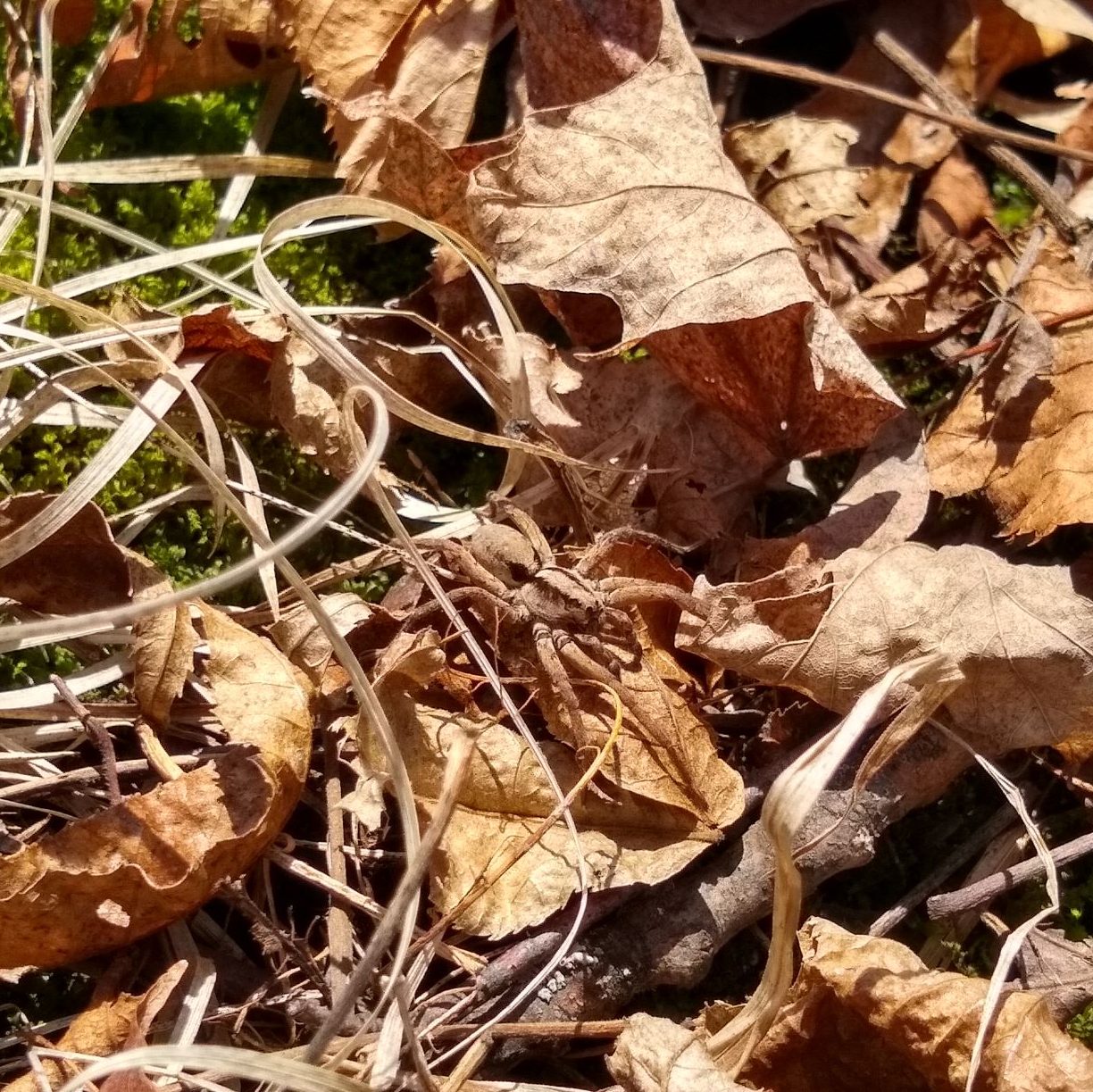
I looked closer, and saw some familiar shapes skittering around in the leaves. Wolf spiders. These jewel-eyed beauties are all over our woods. We sometimes see them scooting around, but most often notice them when the reflection of their eyes catches the light of our headlamps, when out for a walk after dark. A quick dazzle of sparkle on the ground.

Could this sound be coming from… the spiders?

Wolf spider right in the centre of the leaves. Hey there little buddy.

I got closer and watched one of our fuzzy friends in his fast skittering path across the leaves. Sure enough, the sound was coming from him! A sort of humming, vibrating sound. From him, and from many many many others nearby.

I say “him” with confidence only now — having untangled this mystery once I got back home. This was the song of the wolf spider — a mating “call” played on the forest floor.

Male spiders actually produce vibrations, which hit surrounding dried leaves and cause them to vibrate. The vibrating leaf produces a low “purring” sound audible to humans, and that sound travels. If it hits leaves near a female spider, causing them to vibrate, she can pick up on the vibrations.

For this to work, male and female spiders need to be on a good surface that can vibrate. Dead leaves, in particular, are ideal. Leaves serve as a sort of telephone line or radio wave through which the spiders call females, and they’re essential to the wolf spider communication system…

~”Listen to the Dulcet Purr of a Wolf Spider”, SmithsonianMag.com
Wolf spider vibrating the leaves in our woods… Be sure to turn your volume right up to hear the purrs!

And if you missed it in that video — here is the sound thanks to SmithsonianMag. I don’t know about you, but when I woke up today, I didn’t even know that “purring spiders” was a thing in the world. And now, here we are. I for one now feel that much closer to these little leaf kittens.

~Kate

Categories
poetry thinking big

A Poem for April

A Poem, for April

by Morgan Harper Nichols

Let this be the April you always remember.
The April where you chose to believe
there was more to the future
beyond what you could see.
The April where you learned to trust:
no matter the unknowns before you,
the sun would still rise and you would still find:
you still grew how you were meant to.
Let this be the April where everything changed,
for you decided you were free to heal and move on
and never be the same.


With much thanks to ReWild Wellness for sharing it.

Categories
insects and arachnids

Look Comma Again

https://soundcloud.com/user-235666142/look-comma-again
Prefer to listen to the story? Click the image above to hear the audio version of this blog entry.

The little Eastern Comma (Polygonia comma) butterfly I mentioned the other day took up residence on our porch under Sherman, our potted solstice shrubbery who was sitting there waiting to be planted. Though Sherman was in a pretty awkward spot for us, I decided to leave him where he was, until the Comma moved out.

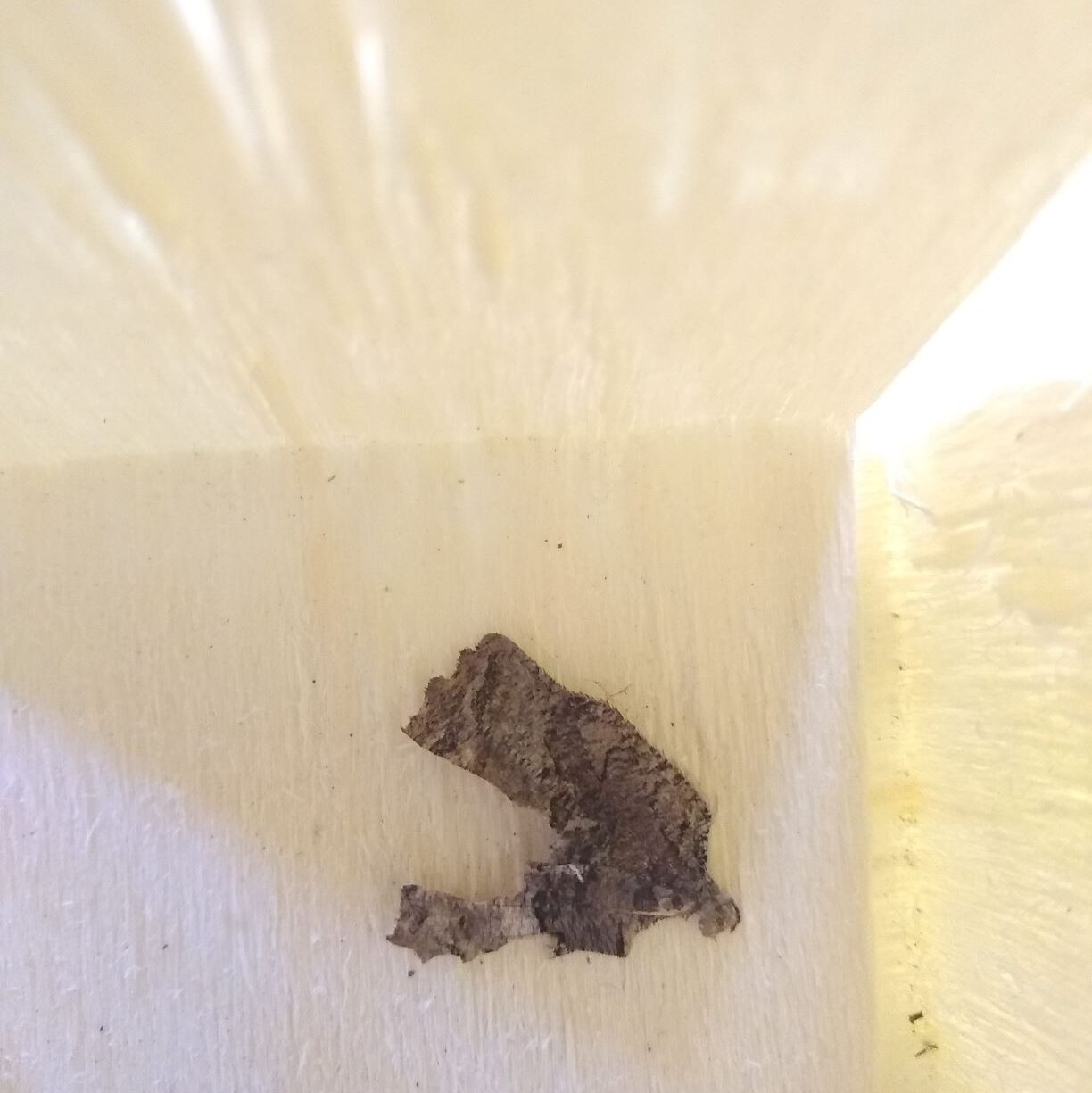
However something else moved in — for the kill — before the Comma was finished hibernating. The other day I found just its wings left behind, its body becoming springtime sustenance for a different critter. I’m looking at you, chipmunks.

The wings being separated from its body was a perfect time to confirm the ID. An “Eastern Comma” is called that because of a white mark on the middle of its hindwing. Though the wing is quite tattered, you can see it in the photo below: the small white-ish “comma” mark in the centre of the image.

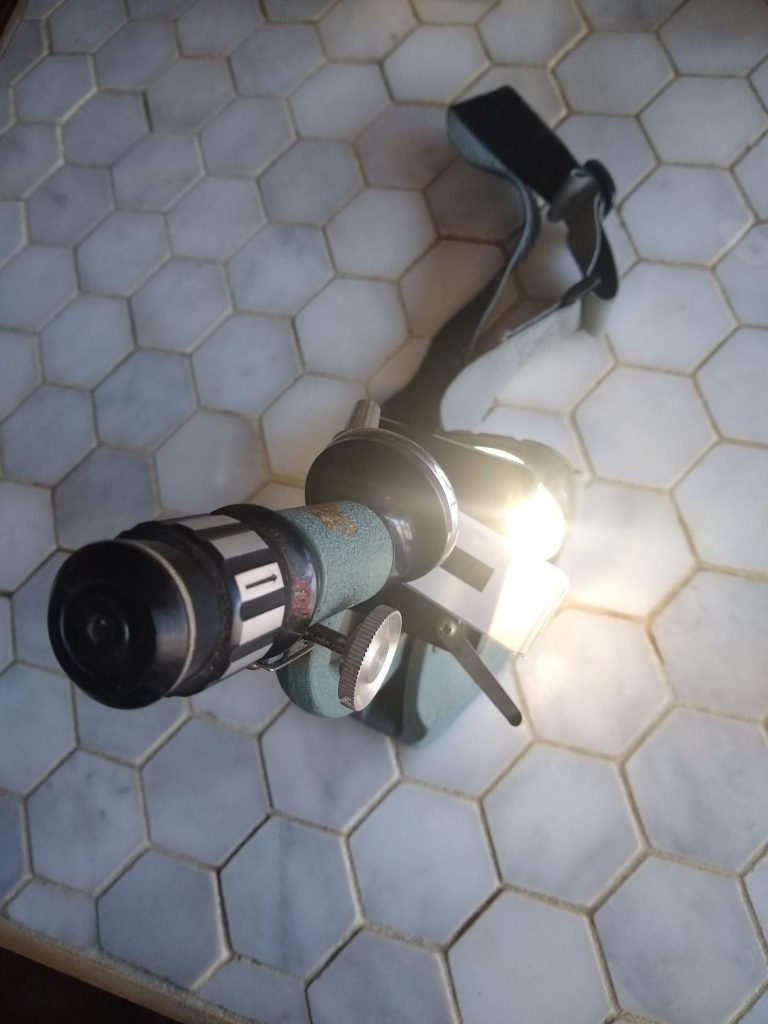
It was also a perfect time to try out a new-to-me toy. A literal toy in fact — a vintage children’s microscope. I had bought it a few months back from Weekender’s Vintage, a vintage seller in Warkworth, but had not yet taken it for a spin. The microscope was missing one magnification and a light, but was also sturdy and well-made, and a steal for what the lovely lady was asking for it. Two magnificatons is still lots more than none, and for a gal who is rarely far from her headlamp, supplying a replacement light is no problem.

There are some problems that can’t be fixed by a headlamp, but not many.

The image below is what we see through our franken-scope: the beautiful layered scales that make up a butterfly’s wing. Though they have a reputation of being delicate, and in many ways they are, a decent argument could be made that butterflies and moths — these scale-winged critters — are miniature modern day dragons.

Some butterflies, like the Eastern Comma and the Mourning Cloak (Nymphalis antiopa), are so tough they don’t even leave Canada over winter. They just tuck themselves under a bit of bark or in a crevice and wait it out. So the next time you feel an Ontario winter is too long or too cold for you, just think — are you as tough as a butterfly?

I added the flying butterflies in post. But the rest is real. 🙂
Categories
baking

Recipe: “Trompe l’oeuf”

The sneaky rabbit that is Easter is hiding just around the corner. And if you’re going to sugar out — why not go homemade! Here is a recipe for fondant easter eggs that is jam packed with so much sugar you will be dashing around like a cottontail in no time.

Recipe: Homemade Easter Eggs
Categories
thinking big

“Go. And if you are scared, go scared.”

“Vai. E, se der medo, vai com medo mesmo.”

Brazilian motto
Categories
tracks & scat

In/visible Animals

https://soundcloud.com/user-235666142/invisible-animals
Prefer to listen to the story? Click the image above to hear the audio version of this blog entry.

“Did you see anything cool?”, asked usually moments after the front door closes, if we hear someone is back home again, after a walk in the woods.

What we’re usually hoping is that the other person caught a glimpse of a wild thing. A critter — fur, feathers, skin or scales — usually being top of the wishlist.

Of course seeing a wild thing is wildly exciting. Seeing a deer or an owl or a porcupine or a fox. We hope for it of course. We like when our stories overlap theirs. When they join us on our walk.

If something four-legged or flighted or slithery crossed our paths, the answer is an enthusiastic and quick “yes!” But the answer is almost never “no”.

The list of what is “cool” one might see in the woods is expansive…. perhaps endless? Fungi and saplings, flowers and insects. Buds and bark. Animate, if possible, not-currently-animate understandable.

Our eyes are still learning how to see here. When we arrived, we could barely tell an oak from an ash. But over the past days and weeks and months and years, we have been studying. We have been learning. Our vision is getting better.

Perhaps what has most changed the character of our walks is our study of signs. Most critters, quite rightly, prefer to give us humans a wide berth. More than once I have only spotted a wild animal because I turn around periodically to “check my six”. On one walk, as I was headed south, I turned around to look behind me, and crossing the woods perpendicular to my path was a coyote, trying to sneak away without my glimpsing. But whether we see them “in person” or not, critters’ comings and goings are recorded in the woods. Sometimes the signs are bold and loud, and sometimes they are barely whispers. They are quiet. Be slow. Look.

I walked the woods today. I saw nothing and everything. On the path up the hill, a bit of white on the ground caught my eye. Looking closer, I saw it was the fur of a dead mouse. And now that I was looking, I saw that what appeared to be a pile of muddy leaves, was in fact two more dead mice.

There are three mice in this photo.

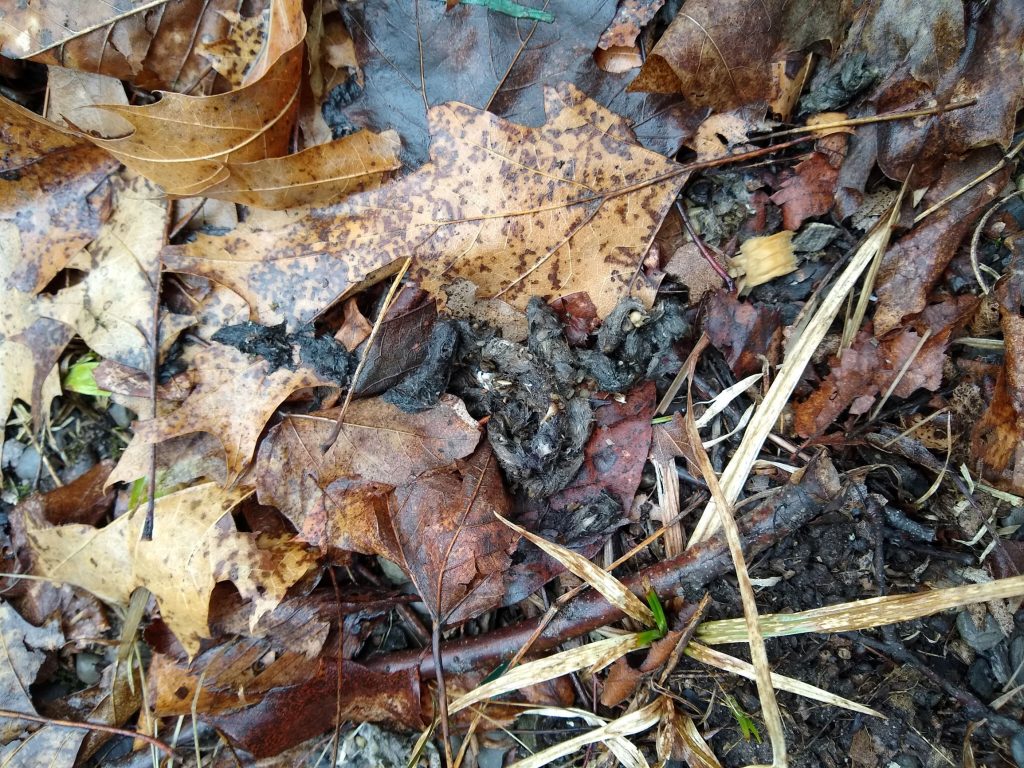
Curious. Nearby, I found this. Mustelid scat.

Weasel poop

Perhaps the mice were from a disturbed mustelid cache? Weasels will kill more than they can eat at once, and store the rest for later. There were some dug up areas nearby. Could it be the mice were either being put in to or taken out of a cache? Or perhaps it was coincidence, and the mice met their end for reasons other than death-by-weasel. Someone intent on reading this particular story could examine the mice to try and determine cause of death — weasels tend to kill by biting the back of the head — but I wasn’t in the mood for necropsy today, so I walked on, content to let it lie at theory.

Baby oak

Sometimes the landscape is added to, sometimes things go missing. Bark nibbled off a branch, berries secreted away. On this particular day, all along the walking path were these little pock marks of popped out acorns. Freed in the sudden thaw, they have been excavated by our local rodent work crew. A squirrel perhaps, or one of the approximately eleventy billion chipmunks here who have awoken from their winter slumbers and are making up for lost time and calories. Scurrying sciuridae.

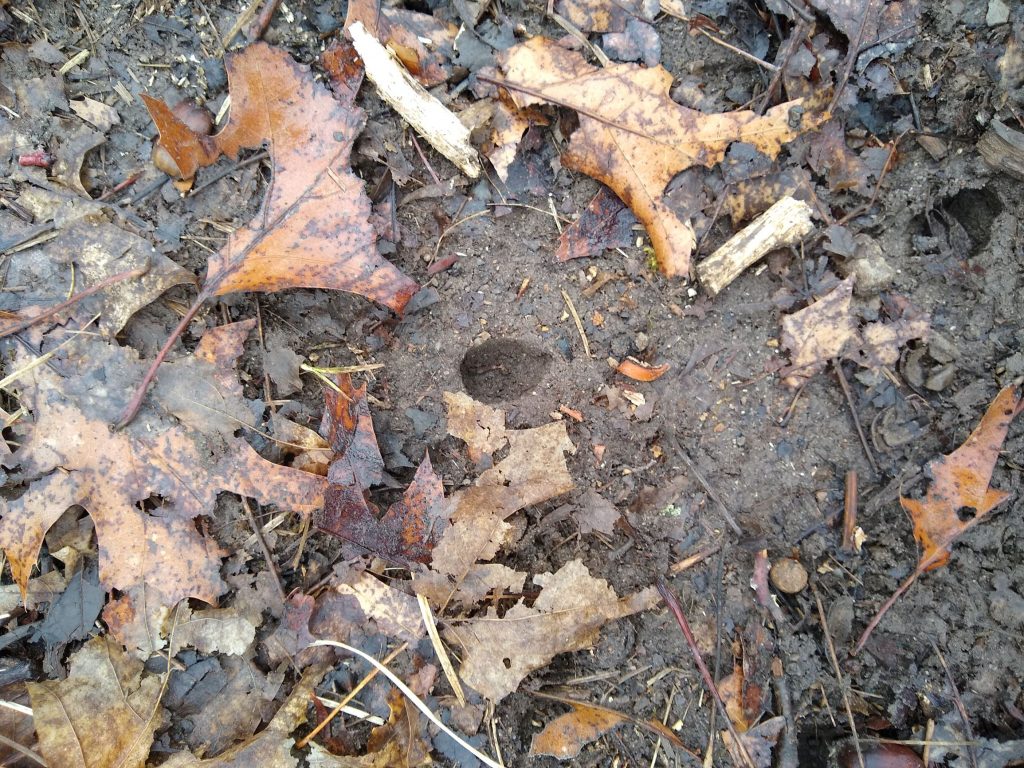
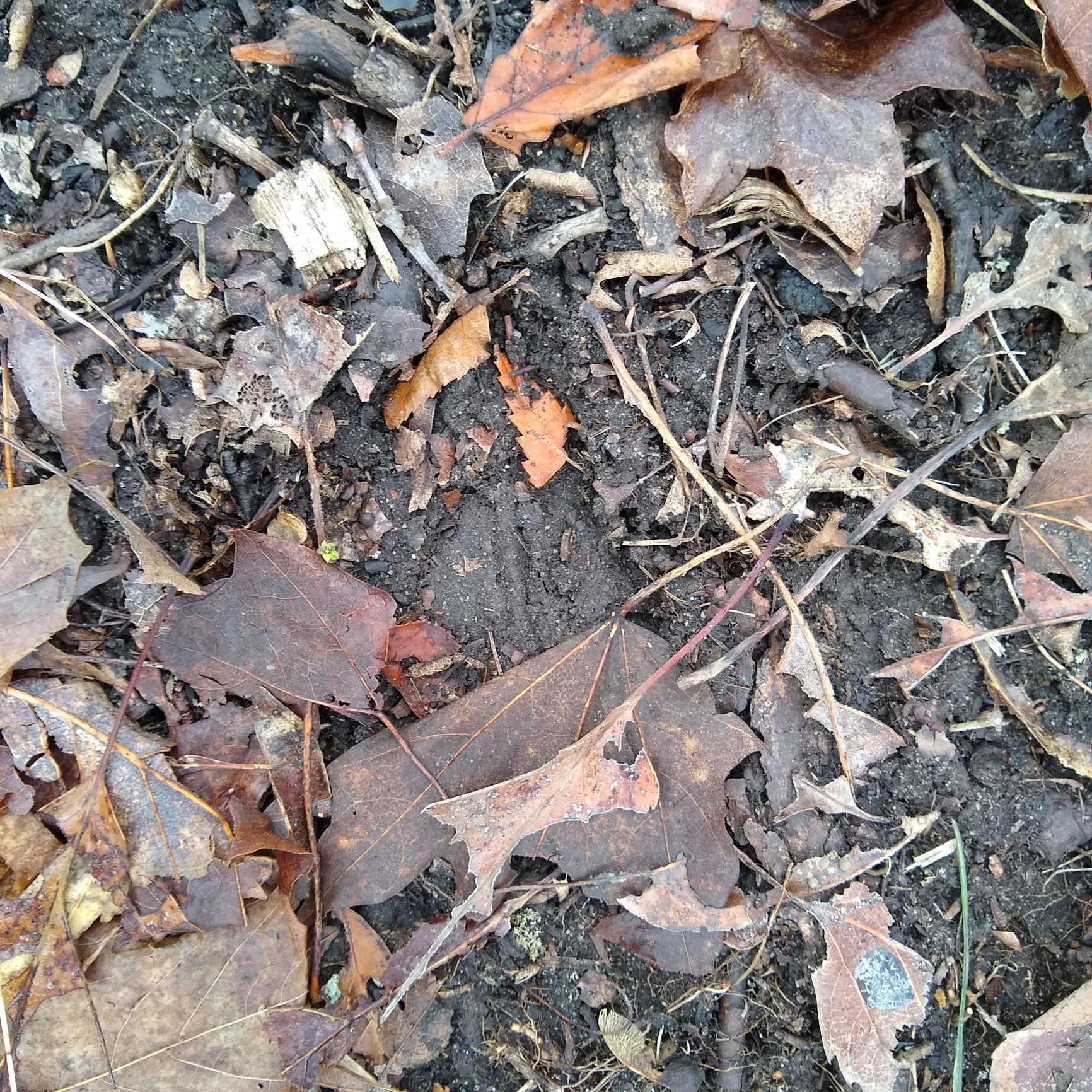
I’d hoped the soft muddy ground would also yield a print or two. And the woods obliged with one. This little deer hoof, trod mostly on a leaf, but just enough denting the soft ground to be unmistakable. “I was here.”

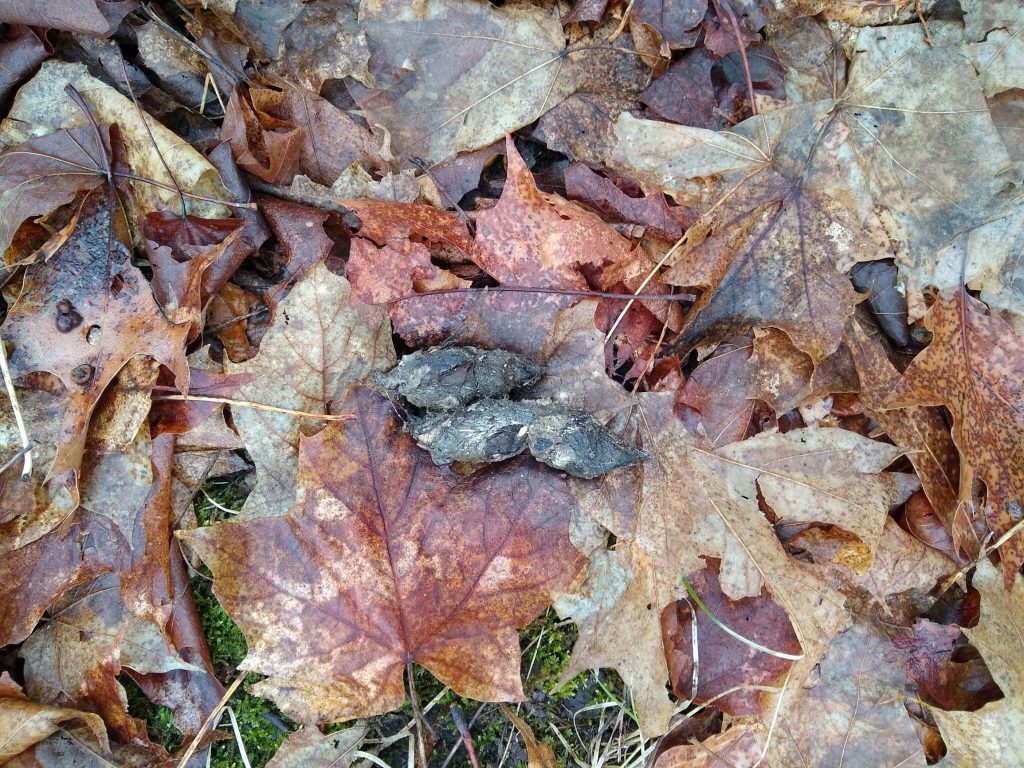
Though we can learn to see shades of mud, and parse the brown, our other senses come out to play on a walk as well. I walked through two columns of air thick with fox smell. Someone orange and furry had been by, not so long ago… And higher up in the canopy, the bashing sound of woodpeckers, harvesting the spring bugs from the trees.

Canid scat. Likely fox.

And elsewhere, the promise of fungi to come. This bird’s nest fungus, currently “empty nesting”, the spores long ago released, but a tiny reminder that the days of bright luscious fungi are getting ever closer.

So what did I see, on my walk of the woods? Mice, mustelid, sciuridae, fox, and deer… The same place, just not the same time.

“Did you see anything cool?”

Always.

~Kate

Categories
thinking big

“Keeping Quiet”

Prefer to listen to the poem? Press play to hear the audio version of this blog entry.


Keeping Quiet
~Pablo Neruda

Now we will count to twelve
and we will all keep still
for once on the face of the earth,
let’s not speak in any language;
let’s stop for a second,
and not move our arms so much.

It would be an exotic moment
without rush, without engines;
we would all be together
in a sudden strangeness.

Fishermen in the cold sea
would not harm whales
and the man gathering salt
would not look at his hurt hands.

Those who prepare green wars,
wars with gas, wars with fire,
victories with no survivors,
would put on clean clothes
and walk about with their brothers
in the shade, doing nothing.

What I want should not be confused
with total inactivity.

Life is what it is about…

If we were not so single-minded
about keeping our lives moving,
and for once could do nothing,
perhaps a huge silence
might interrupt this sadness
of never understanding ourselves
and of threatening ourselves with
death.

Now I’ll count up to twelve
and you keep quiet and I will go.

Categories
thinking big wild inklings

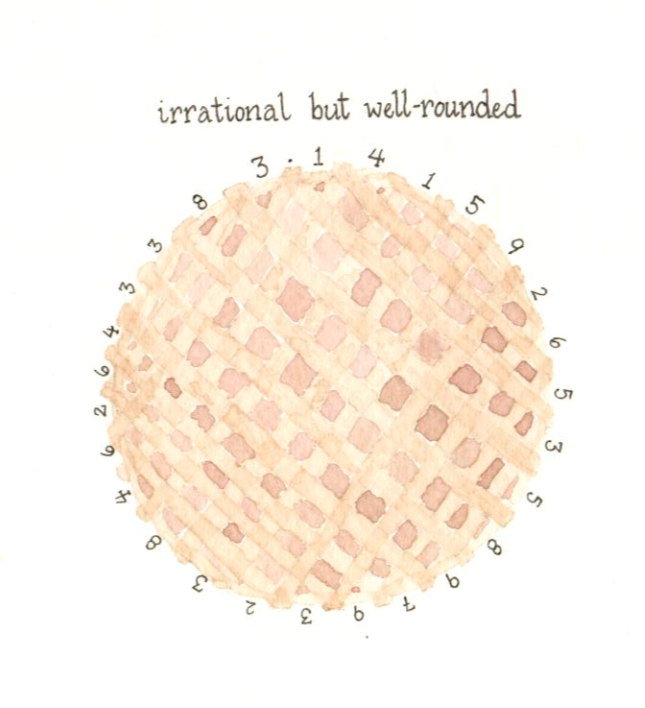
Happy Pi Day!

Pi/e painted with homemade inks.

~Kate