Categories
fauna thinking big

The Art of Caring For Other Creatures

Yes, this is a little bit about Covid. It’s also a little bit about wetlands and a little bit about snakes and a little bit about a dead rabbit in the road.

I have two bumper stickers on my car. One says “Please Brake For Turtles” and one says “Please Brake For Snakes”. While strangers often ask me about my turtle sticker — where did I get it, how they move turtles off the road, etc — the snake sticker gets no such love. Occassionally, it gets hate.

The other day, I had to pick up a package at the post office. When I came back to my car, there was an older woman standing at my bumper, shaking her head. She had come to the post office to pick up her mail. She went to get into her car, but as I went to get into mine, she stopped to call out, “The only good snake is a dead snake!”

It’s not the first time. I was still wearing my mask so I made sure my smile reached my eyes as I said, “Well I like’em.” She was not finished though. She explained that while she can see that I am a snake lover, she has a friend who has a snake and her friend is forever trying to get this lady to come over and see it. The woman was quite clearly afraid of snakes. But all she could express with that fear was snakes bad. I suggested that perhaps we could agree that snakes belong in the wild. Yes, she said. Snakes in the wild is okay.

The problem with this knee-jerk response, this good/bad animal dividing line, is that it ultimately threatens all animals, and especially there being any sort of “wild” left for any animal to be in. Grasslands with boardwalks on a sunny day are “good”, but not those muddy yucky wetlands in the rain. What animals know, what we humans seem perpetually unable to grasp, is that we are all of us wildly and deeply connected. On good days and bad. The aesthetically pleasing, and the challenging. Scavengers and carnivores and omnivores and carrion-eaters, up and down and side to side in nature’s intricate webs. In woods and wetlands and hills and grasses and streams and cities. It all exists together. We exist together. Or we don’t exist at all.

Covid has reminded us that our fate as humans is primally, internationally, inextricably, bound up in each other. That our choices can endanger or protect. It has also reminded us that we are a part of nature, and that we release our worries and soothe our stress by spending time in it.

Yet right in the middle of Covid, in the middle of one of the most stressful life events many Ontarians have experienced, Ford’s provincial government snuck through law that took away the ‘authority’ part of Conservation Authorities.

They literally made it easier to pave paradise and put up a parking lot.

“As one example of the consequence of this change, it is now expected that a development company whose owner donated thousands of dollars to the Ontario PC Party will be able to pave over a 57-acre lot in the Toronto suburb of Pickering that is under protection as a ‘provincially significant wetland,’ and build a distribution centre.”

~ Globe and Mail Editorial

Poor Conservation Authorities. On top of everything, they really suffer from a branding problem. Neither of the words that make up their name sounds appealing. While “conservation” is admirable, the word itself has strong conservative connotations. A sense of holding on to something, a stubborn unwillingness to move forward. With something good like, say, “development”. “Authority” is even worse. Humans have a natural resistance to too much authority. It sounds like the worst kind of unneccesary red-tape. Ugh, more authorities to go through!

(It’s an inverse case to how “landfill” uses its name to sneak under the radar as a not-really-so-bad a thing. It sounds like something that needs doing, doesn’t it? It was empty, and so we filled it. Well done us. Pass the disposable everythings.)

What Conservation Authorities do in practice is safeguard both the now and the future of our water, woods and wetlands — for you, for me, and for everyone yet to come. The habitat for both the turtles and the snakes. And the humans.

“While Canada holds 25% of the world’s wetlands, we have already lost 70% of them over the last century, due to human development. Often turtles are the biggest biomass in these wetland ecosystems. The loss of biodiversity and degradation of ecosystems has unpredictable effects, but they are always negative. The web of life depends on all components, and just like in the game ‘Jenga’, a loss of a critical mass will lead to complete collapse. Why should we care about wetlands? Wetlands are essential for us as humans too! Wetlands act as the ‘kidneys’ or the filtration system of our water source- unhealthy wetlands means an unhealthy water source.”

~ Ontario Turtle Conservation Centre

It is not just the cute and the beloved that needs care, that matters. Just as it is not only the beloved grandmother we are trying to get safely to the other side of our tangles with this virus. It is also the vulnerable we see and don’t see. It is also the lady who wants to argue with me about snakes. The stranger I do not know may be the person who makes life worth living for someone else. I try hard to notice what I don’t see. To care about not only what is in front of me, what is easy. Out of sight out of mind. I succeed and I fail, but I try.
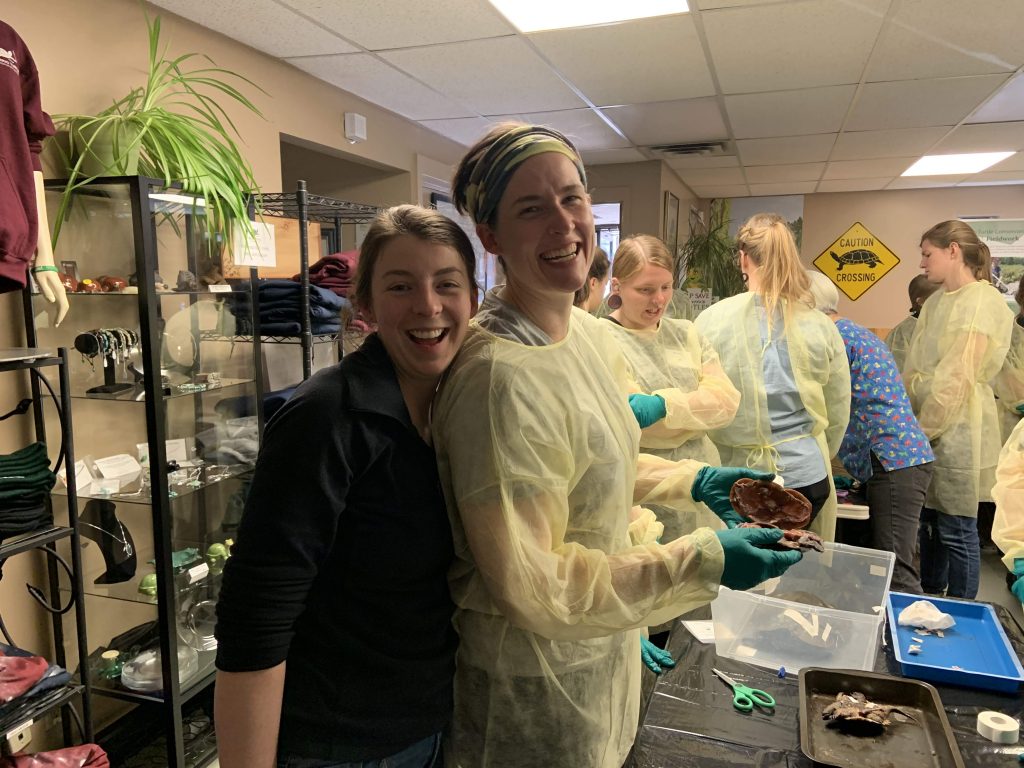
With the lovely and talented Tess Miller, at a Turtle Trauma Workshop at OTCC in 2019.

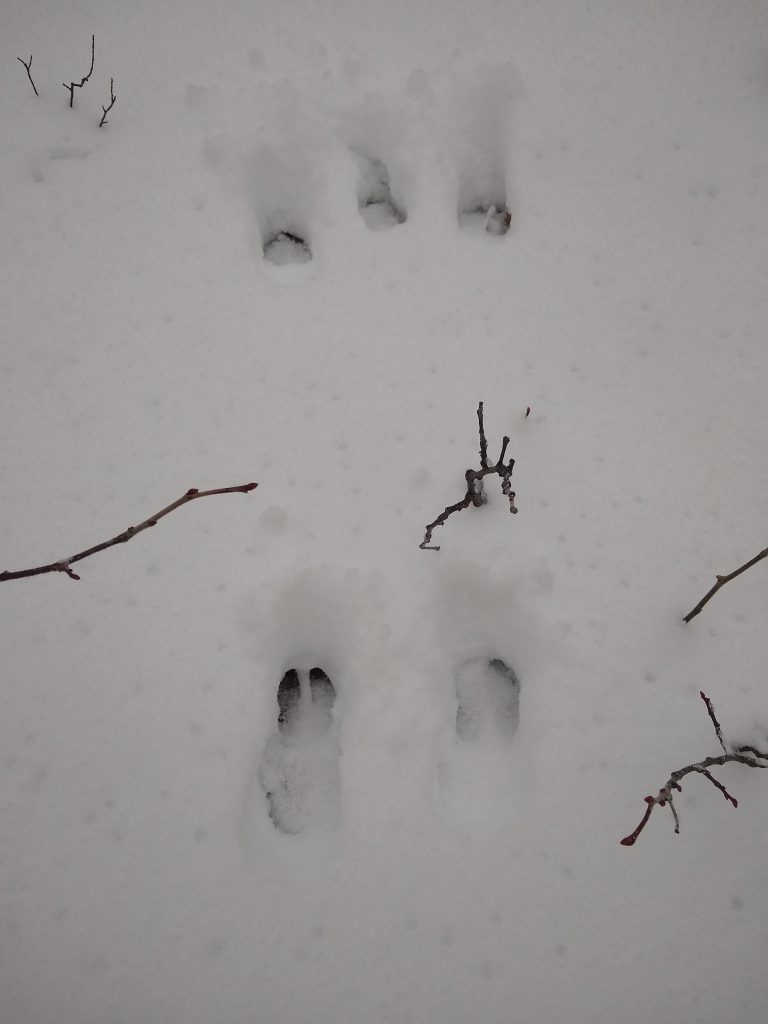
Leaving the post office, I took a quiet road home. Coming over a rise in the road, I saw a dead rabbit in the road. It had been hit by a car and was very dead. It was also very much in the road. Though being in the road was no further danger to the rabbit, it was not safe to leave it there. It can lead to future drivers feeling they need to swerve, uncertain what they are seeing. Tire tracks in the snow showed this was already the case. But it also poses a danger to the wildlife who will inevitably come to feed on it. The scavengers and carrion-eaters who each play their own role in nature’s web — not least of which, cleaning up our messes.

I found a safe spot to pull over, stopped, and moved the bunny off the road. Though that seems gruesome to some, it is a last act of caring. Both to show respect for the life that was lost, and giving a greater chance to the other creatures. The unseen creatures. The life in front of me, and the lives I don’t see. Snakes and turtles. The beloved and the stranger. It all matters.

~Kate
Categories
thinking big

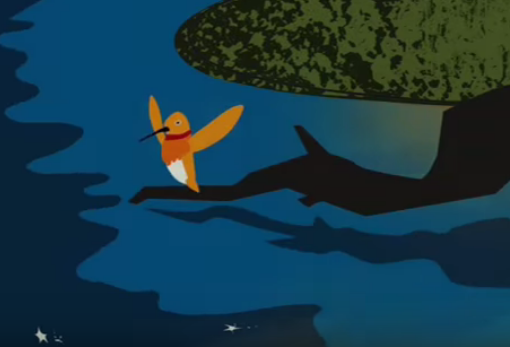
“I will be a hummingbird”

Categories
fauna tracks & scat

Snow Stories: “Gone Fisher-ing”

Well who is this friend?

The tracks I see most often in our woods are canid. A mix of fox and coyote. Well, the tracks I see most often are probably squirrels (eastern grey). But sorry little guys, while I enjoy observing your trails, I rarely spend much time trying to parse them. Rarely… though not never. As we’ll get to in a moment…

The outlier I’m always delighted to see are the mustelids: the weasel family. In particular, fishers. The mega-weasel. I see their tracks infrequently, and it is such a treat when I do. I love that there are fishers on our property.

This is a wildly unpopular opinion. But popularity is rarely my litmus test for worthiness.

My full rant is too long and too, well, rant-y, to insert here, but let’s just say there is no animal I give people a pass to villanize. It is too flat a vision of the world, too often rooted in a mix of ignorance, hearsay, and assumptions. There is no animal that deserves to be outright demonized for being destructive or taking more than it needs — and as humans we better take a dang hard at ourselves before laying down that judgement.

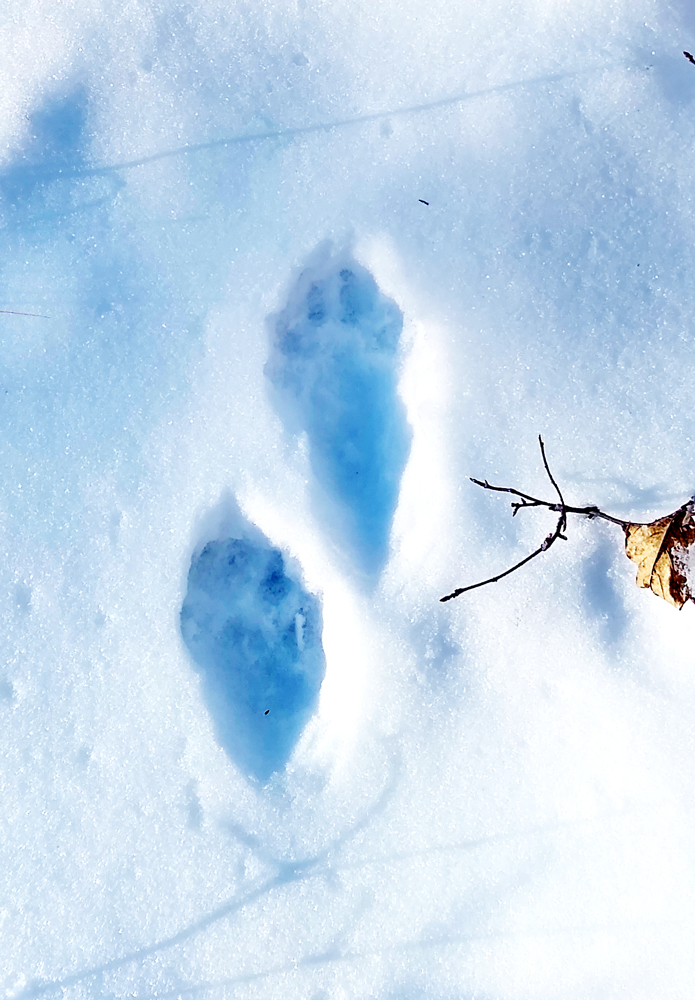
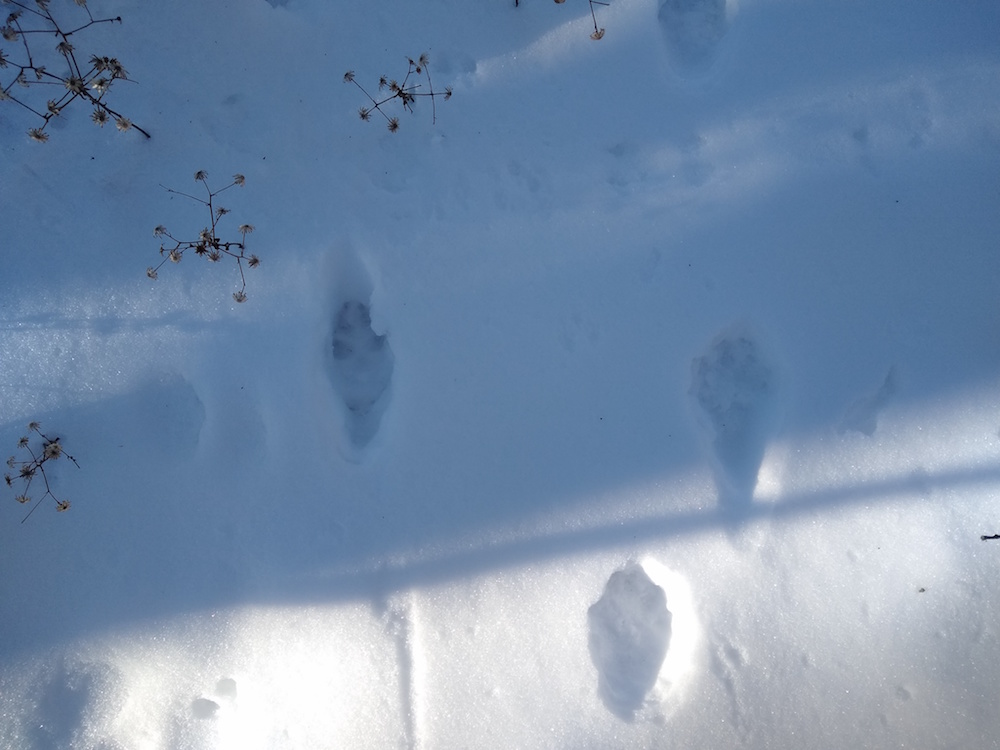
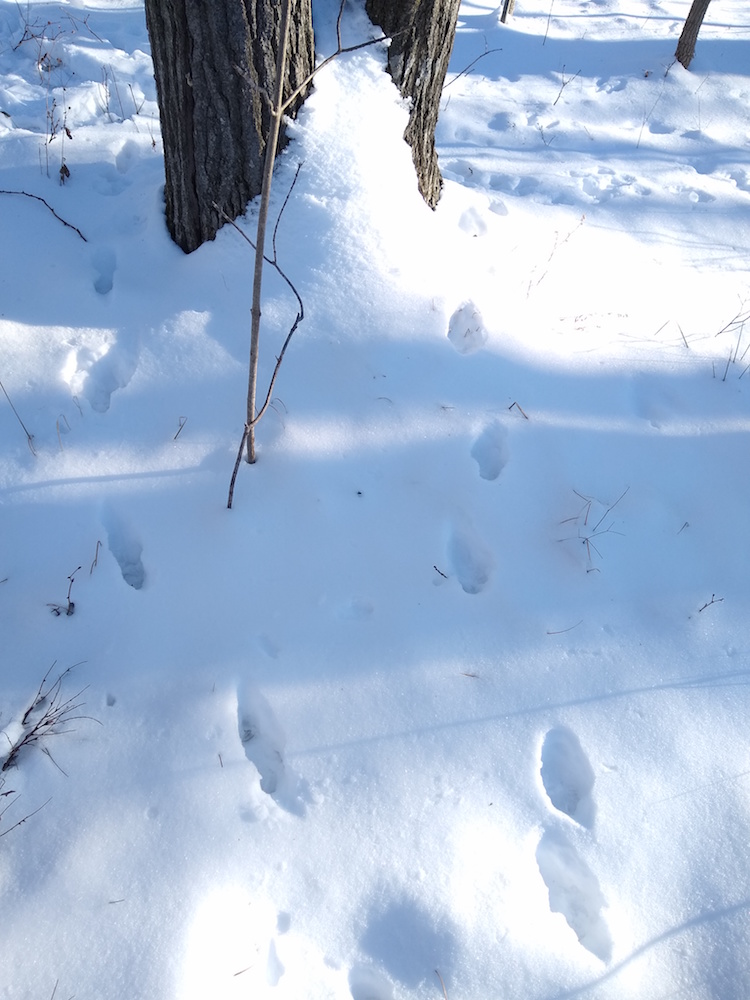
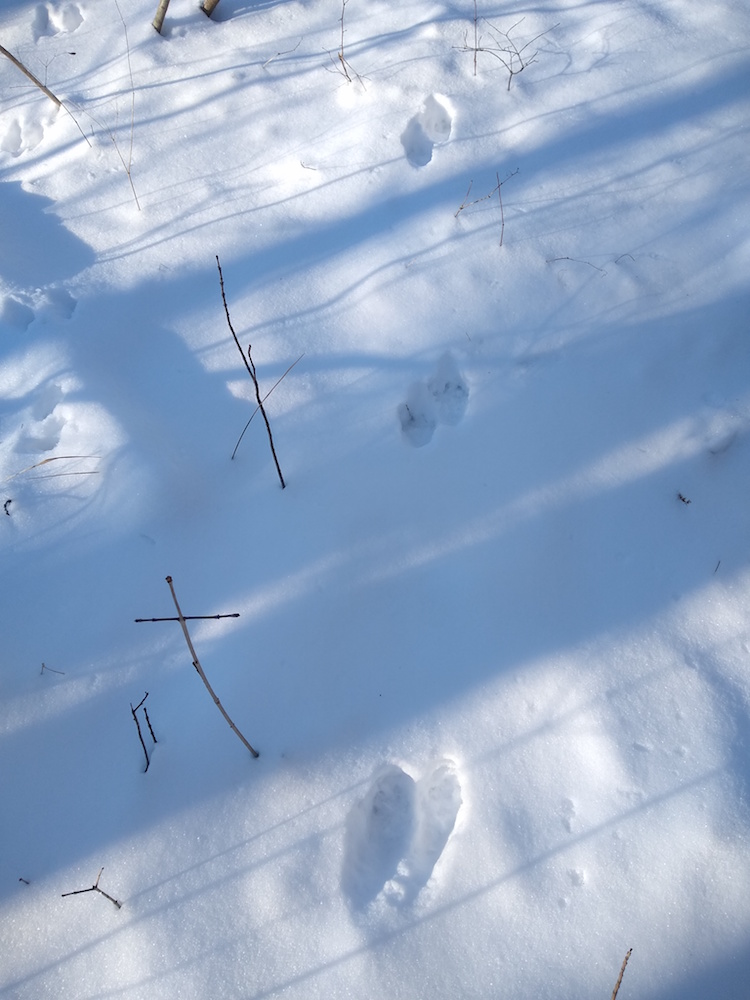
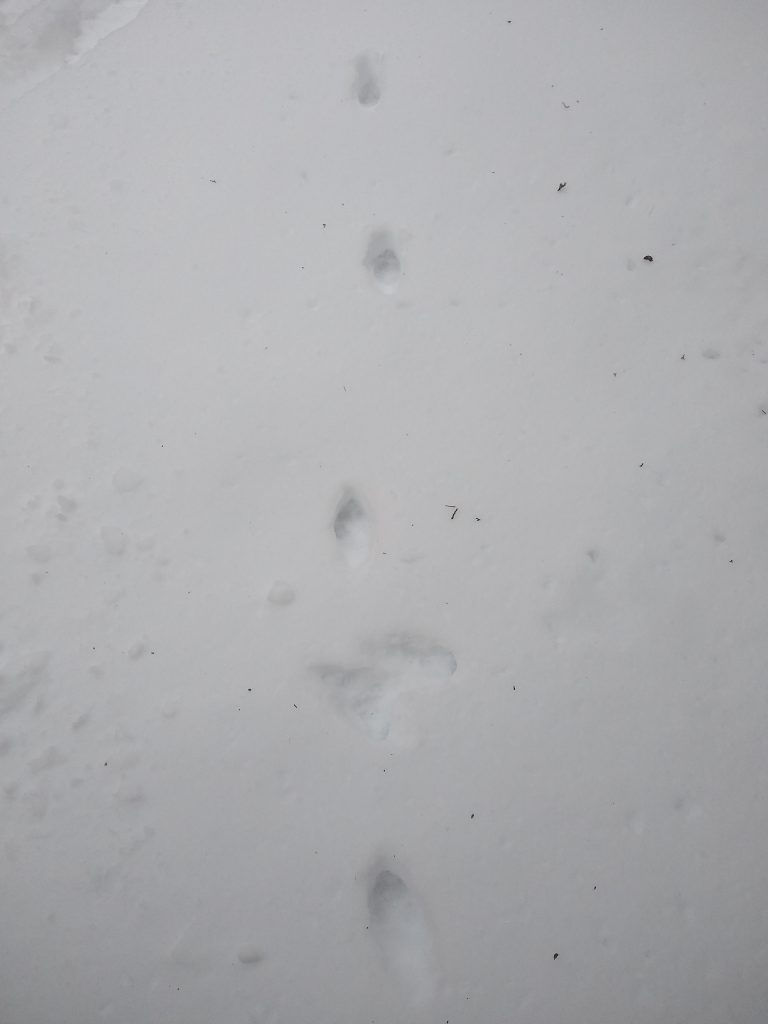
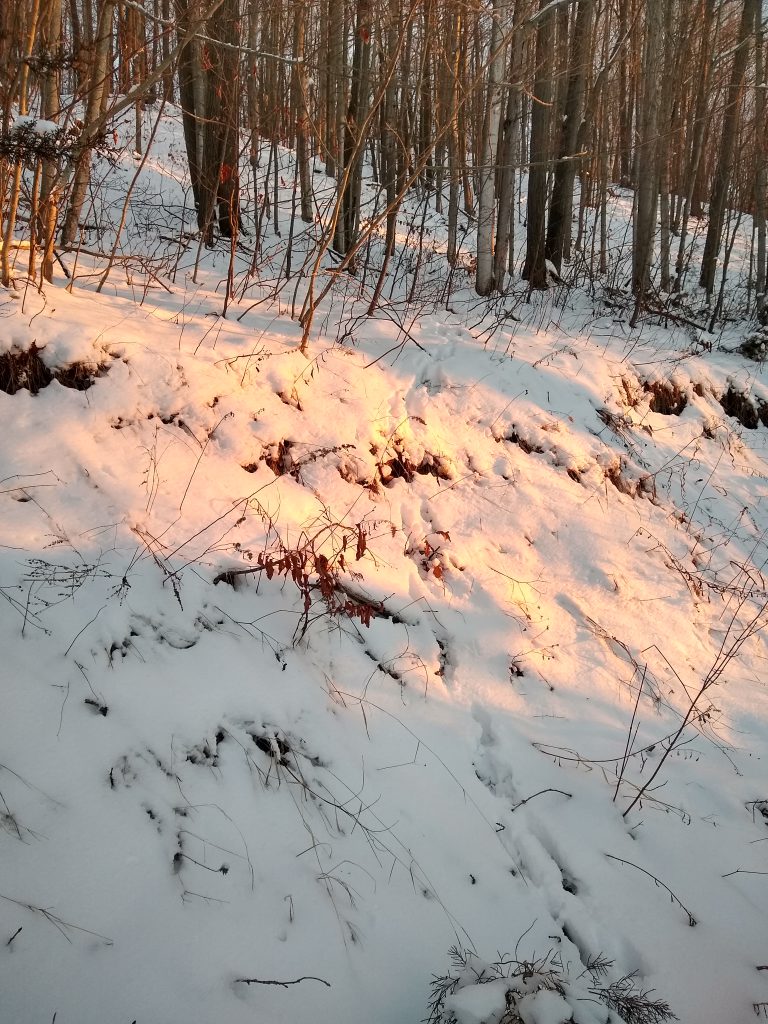
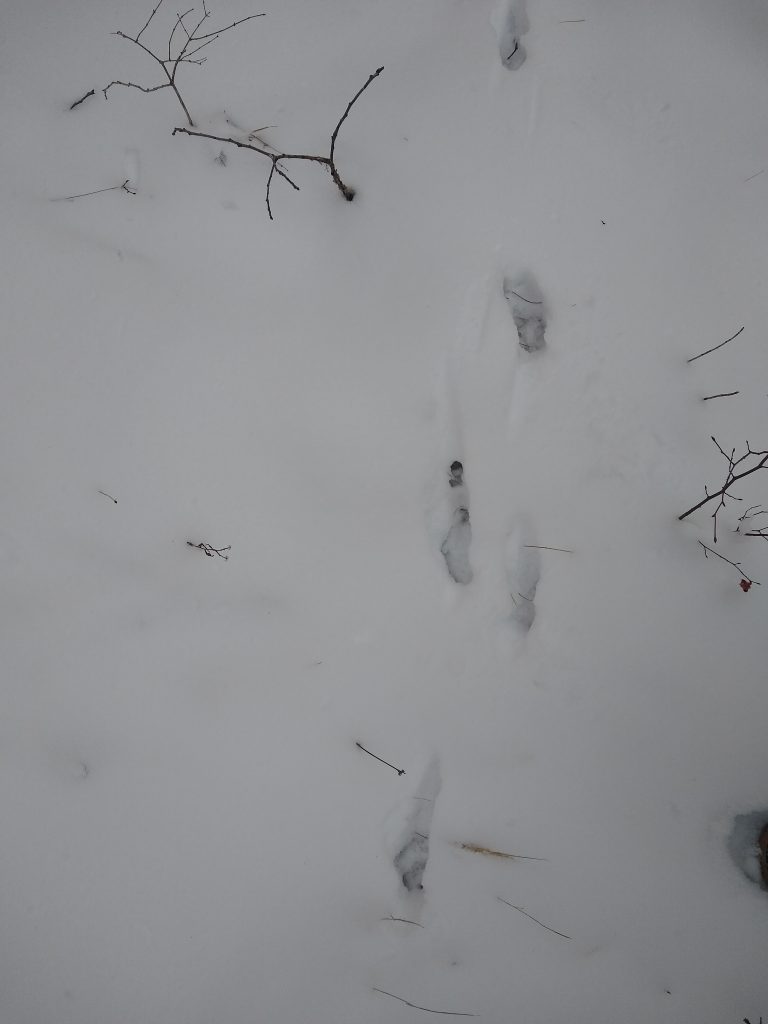
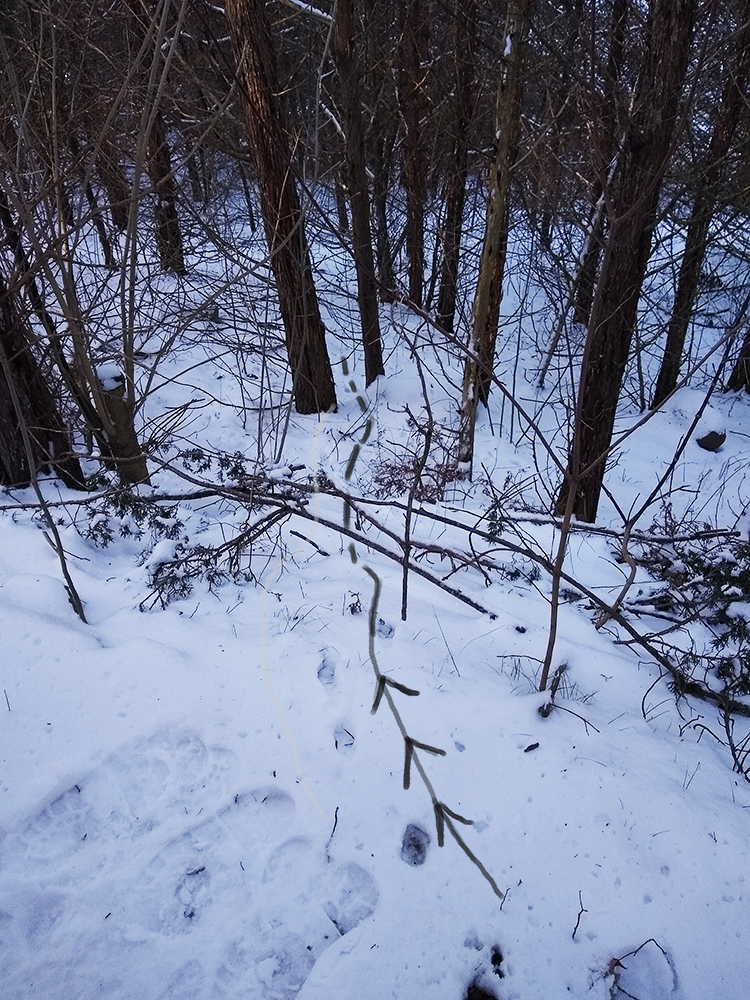
I nearly missed the fisher tracks this time — even though the fisher crossed the full width of the woods… twice. It was only in half-noticing that one of the squirrel tracks intersecting our main trail looked a bit extra “busy” that I discovered there was a fisher track mixed in. (See above: Ignore the squirrel tracks at your peril.) Larger five-toed* prints mixed in with the little squirrel ones. It was a galloping fisher! (*Note: the littlest toe often does not show up in fisher tracks.) Since I was sticking to our trail, and the fisher wasn’t, I nearly missed it.

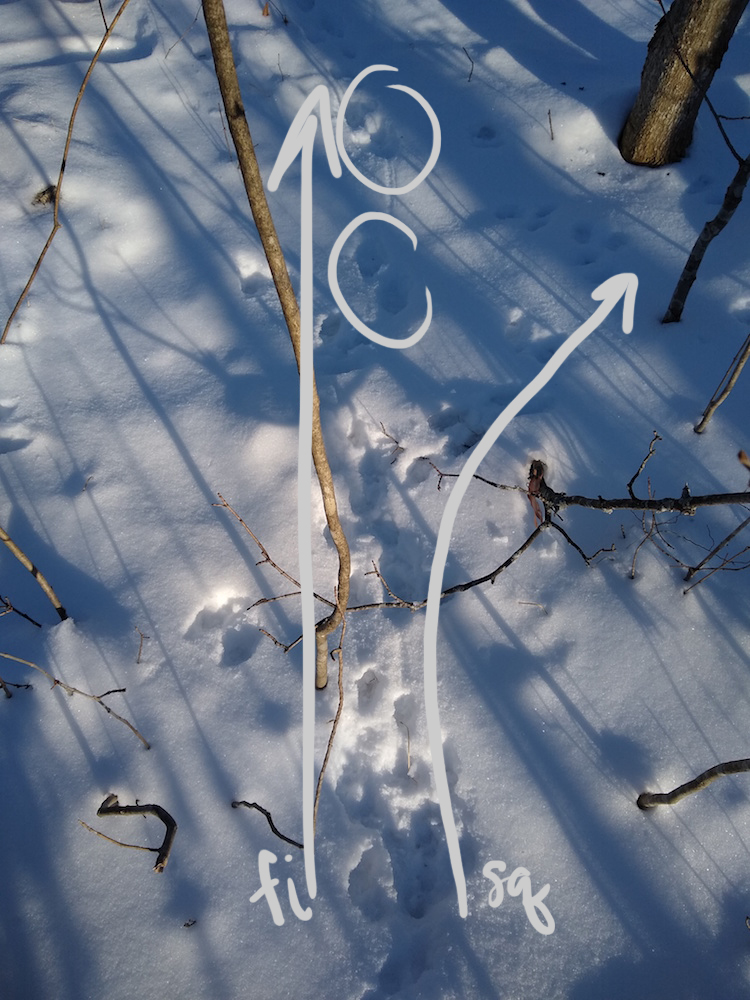
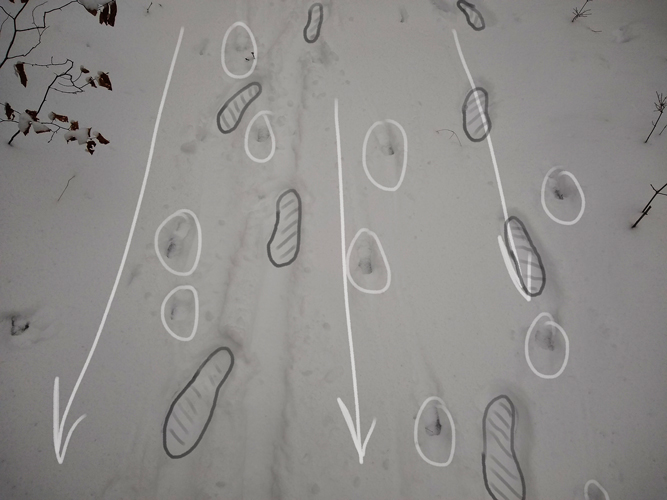
Though I am not very good at working out the timing of a track, I still enjoy seeing the synchronicities. Below you see two visitors to our woods walking in parallel. I don’t yet know enough to know how long ago the tracks were made, or who walked through first, but side-by-side is how they lie now: a fox and a fisher, walking the woods together.

Here’s more of an aerial view so you can see everyone’s toes.

Fox at left, fisher at right.

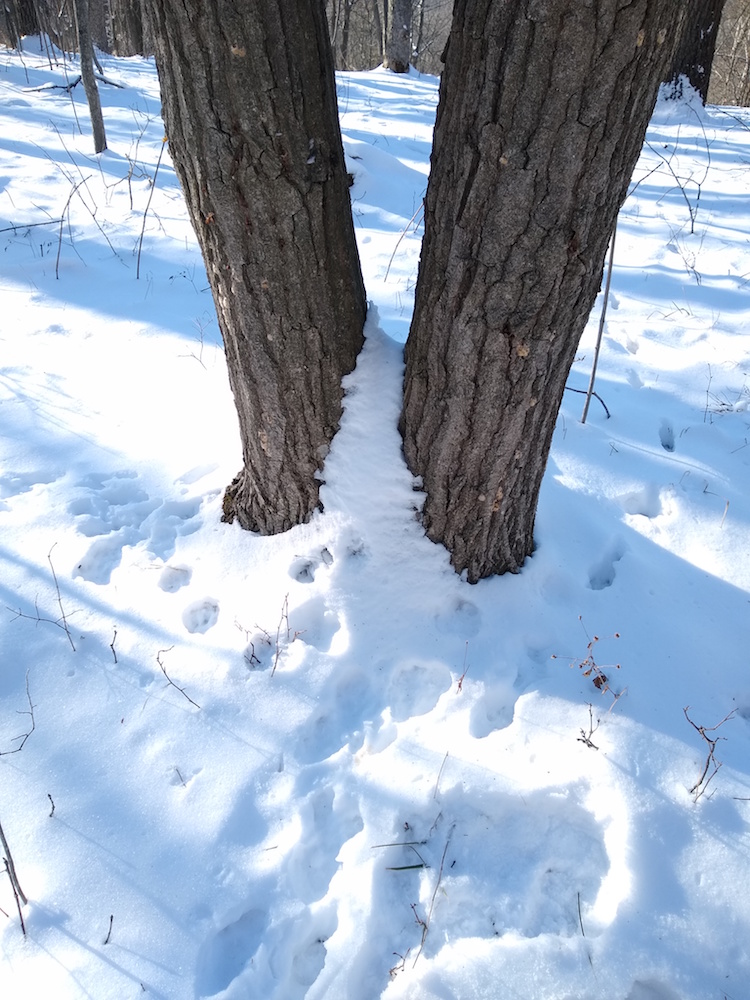
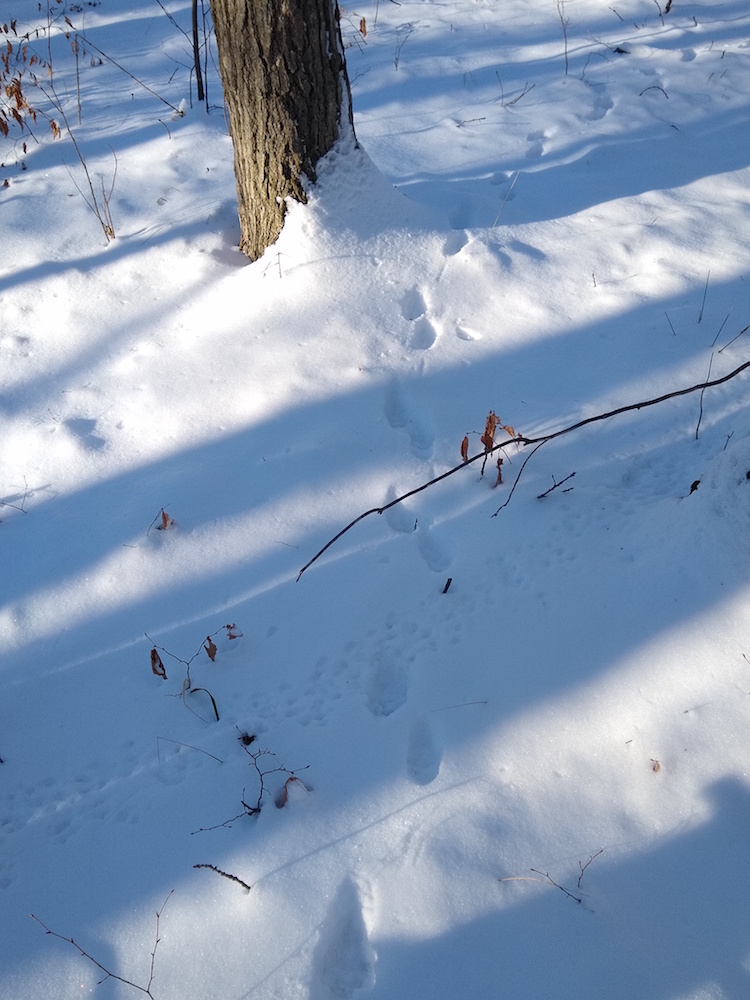
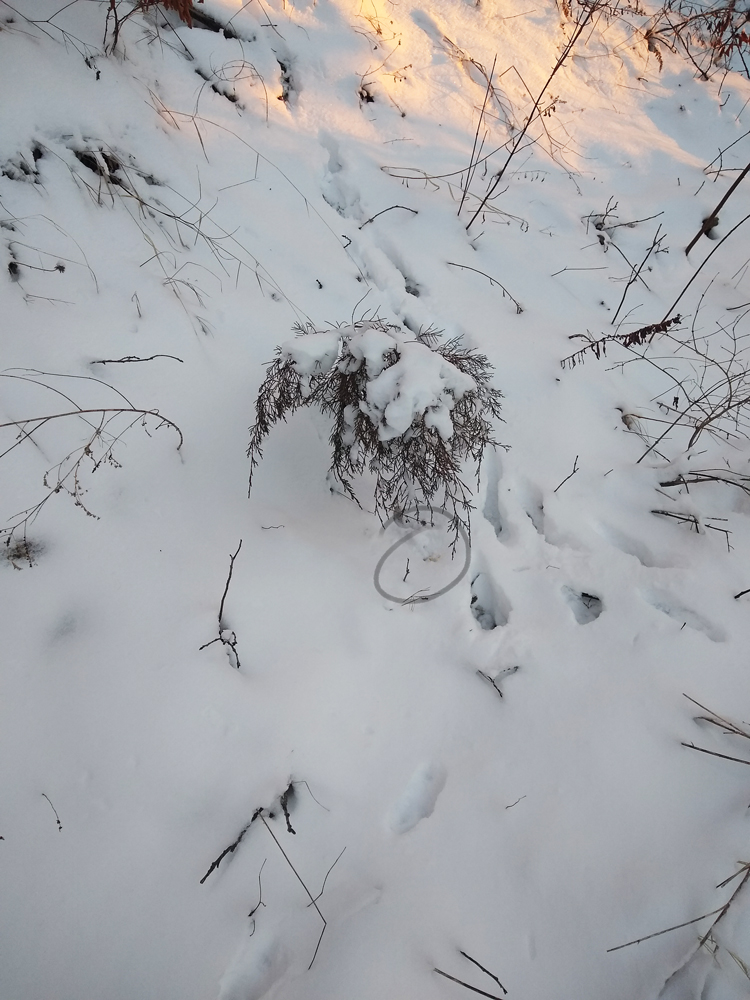
And here, in one of my favourite bits of the track, a single tree is encircled — initially walking in the same path towards it, the fox goes around to one side, and the fisher to the other. Two roads diverged.

Fisher at left, fox at right.

Only to meet up again on the other side.

Fox at left, fisher at right.

Fishers are a good size, and have some fairly distinct gaits that show up pretty clearly in our woods. But in addition to the tracks themselves, there are the other cues to watch for. There is what the track looks like, its dimensions and spacings etc, but also where it’s going, and how it’s going there.

Galloping fisher

Following coyote here, I most often find they cross the property in fairly straight lines — often with another coyote a little ways off, walking roughly in parallel. The foxes go reasonably straight, but are also pretty likely to go exploring. Their trails wander more than the coyotes, the trail is often marked with their distinct scent, and I’ve found sign of them “tightrope walking” on fallen logs a number of times.

Check out that busy little rodent highway crossing the fisher tracks (the stippled snow on a diagonal)

As for fisher, I (literally) feel the pattern before I notice it — walking with my head down, I keep bumping my shoulders on trees. What seems to be a reasonably direct path is actually playing connect-the-dots: the fisher is choosing a path that moves from tree to tree. Fishers are great climbers, and squirrels are a major part of their diet. The fisher version of checking the fridge…

Take life one tree at a time fisher friend. See you again sometime.

Categories
fauna tracks & scat

Snow Stories: “You’re Invisible, But I’ll Eat You Anyway.”

I went for a walk with a fox yesterday.

Not at the same time of course. He* was long gone by the time I followed in his footsteps. (*I am calling the fox “he” for a reason, which I will get to.) But Neil and I often chat about how spending time with animal sign feels like time with the animal. Perhaps because you are so focused on its fox-ness. Everything but this fox is quiet. You are tracking this fox’s steps. Wondering what this fox was doing. When was he here and where was he going. Okay, he went here, and then here, but then where…. a-ha! over here.

It is a tremendous thrill for me to see the animals who live in or pass through our woods while they are actually in front of me. But what I love about tracks and sign is that I truly feel like I can take a lot of time “with” an animal, without disrupting it. I am not spooking its prey, or jeopardizing its chance at dinner. I am not causing it to waste precious foraged energy running from or avoiding me. It doesn’t need to worry about protecting its young from me. We can be together, apart. A healthy respect for the wild-ness of both its life, and mine.

They are not brethren, they are not underlings: they are other nations, caught with ourselves in the net of life and time, fellow prisoners of the splendour and travail of the earth.”

~Henry Breston

This fox started his visit to our home with a stop for a snack. He came down from the woods via a slope behind our house. The slope is a sort of overgrown garden that we still haven’t fully figured out. Perhaps it once had more form, but I believe it is mostly there as a berm, defending the house from the pressure of the hillside — being situated on a wooded hillside can put an awful lot of (literal) pressure on a house.

The “garden” slope has lots of brush and grasses, which I’m sure are full of all manner of things for a fox to munch on.

The fox, I believe, agreed.

Below is his first stop. A depression in the snow beside a grassy opening makes me think he stopped for awhile to hunt a mouse. Which is the inspiration for this post’s title — lifted from this fasinating article by NPR, exploring how foxes hunt (hint: it may have something to do with magnetics!), which is well worth a read.

Based on an extra footfall, and the indistinct shapes within the prints, I believe the fox then retraced his steps a bit, before continuing on.

Either just before or just after his meal, the fox marked his trail. Under this little cedar was a splash of pee. Usually it is not until I find urine with this distinct foxy scent, that I will confidently switch from “canid” to fox. As is often the case, I was initially following these tracks in roughly reverse order. So I was following “canid” tracks for quite awhile.

After the shrubbery was good and marked, the fox was off again.

From the “garden”, the fox moved on towards the driveway, making another marking pitstop along the way. Here is where I decided the fox was likely a “he”, based on the position of the feet and urine. Both male (dog) and female (vixen) fox will scent mark, though males are much more likely to cock their leg when they do so.

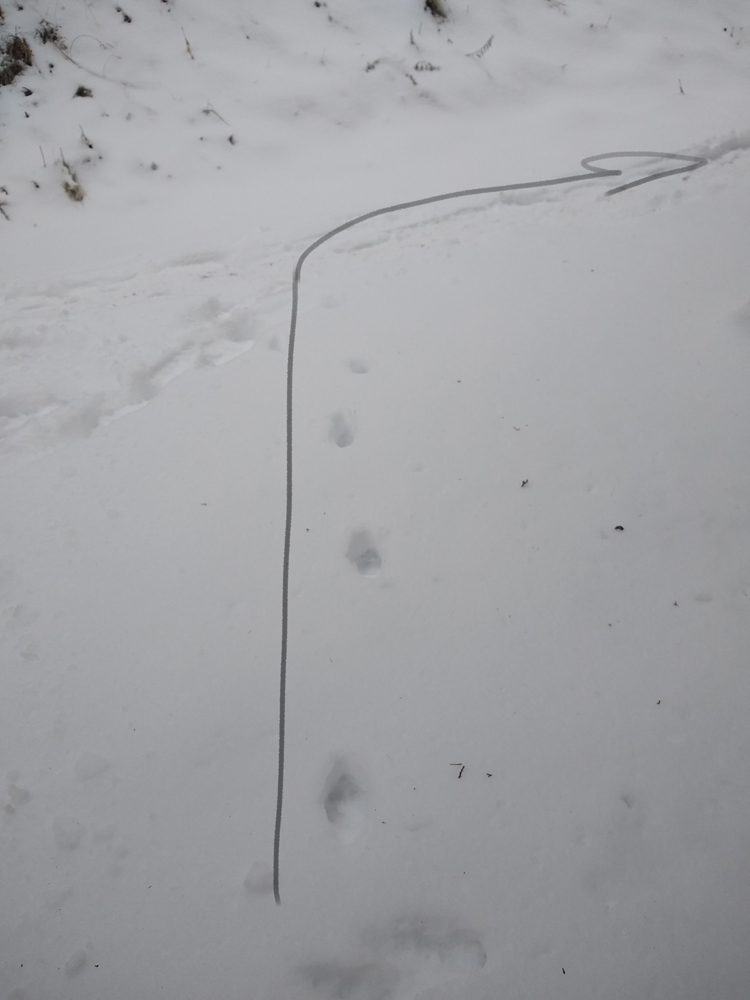
The fox went down our driveway a little ways, before I lost the trail. I then picked up a trail coming back up our driveway, on the other side. I believe this to be the same fox, based in part that we have seen fox do this in real time — they seem to think of “partway down our driveway” as some sort of boundary line …or at least as far as they get before they remember they wanted to check out our yard as well.

Some of the tracks coming back up the driveway were harder to find. There is a lot of “noise” at the top of the driveway. Plow marks, tire tracks, bootprints, and all the various activity under the birdfeeders. Can you spot the fox track in the bootprint below?

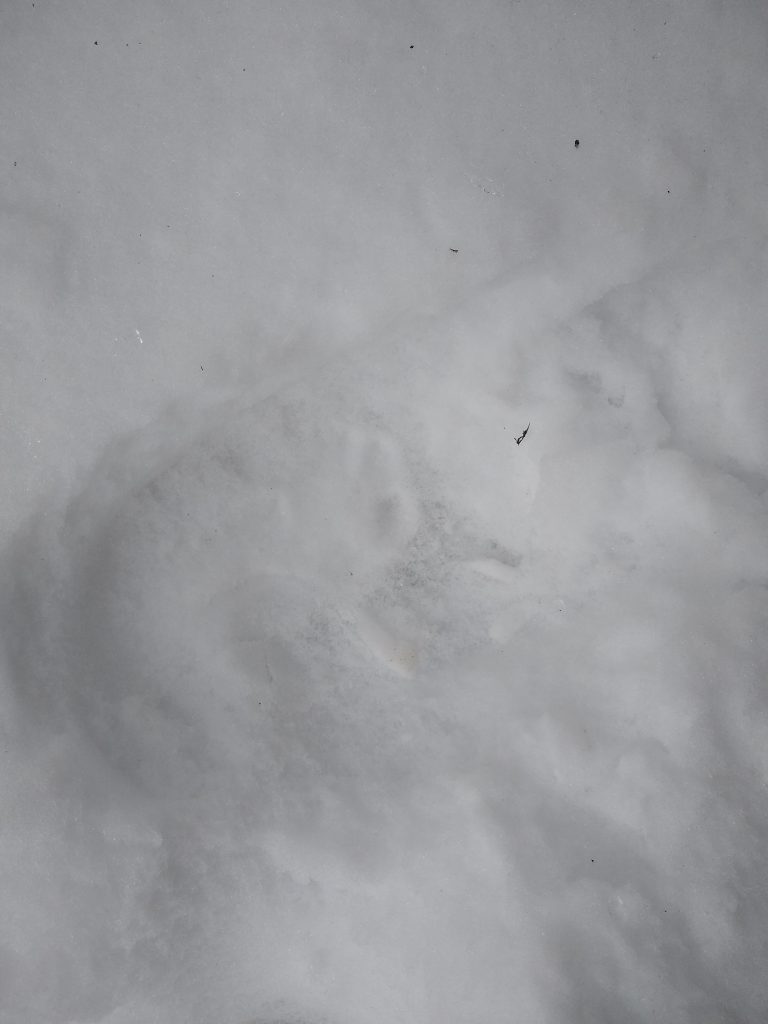
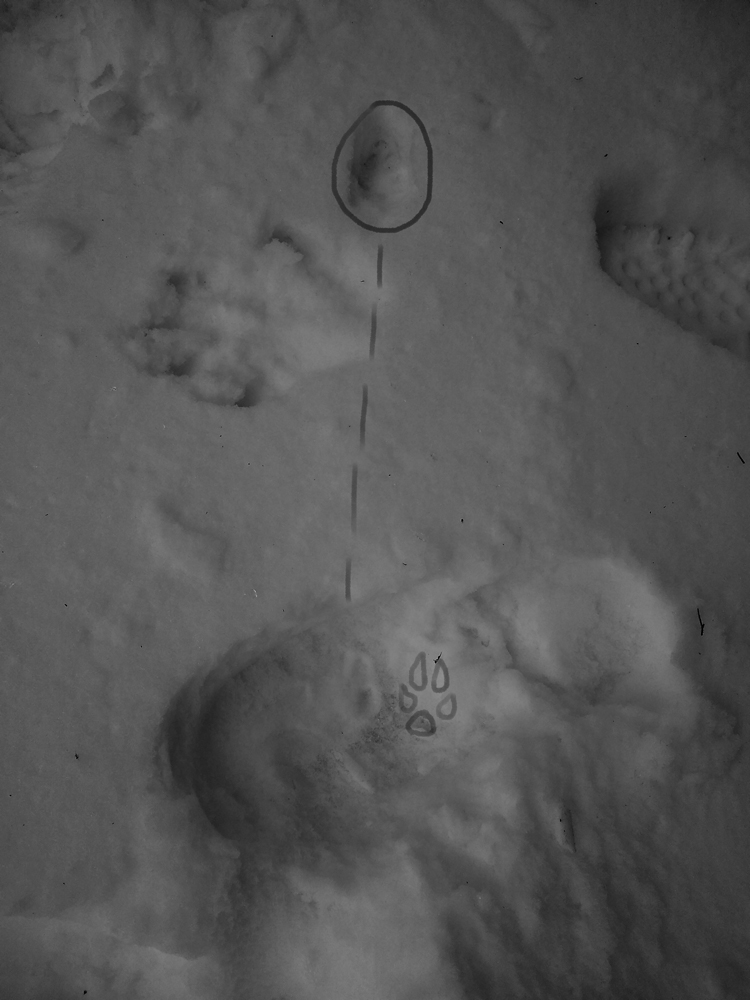
It’s right in the centre of the bootprint, with the toes aiming at the top of the image.

How about now? Sometimes using the spacing from a nearby track can help you find a hard to see print.

Enhancing the photograph to make the print more visible helps as well. 😉 But that’s not really an in-field tool (though I guess it could be…).

The fox then went behind the front garden, around the car tent, over to our walking path through the backyard. When they come through the yard, animals often follow our bootprints, and it’s a bit incredible how well their tracks can disappear into our trail.

Finally the fox went behind the chicken run (note: the chickens are just fine), before trotting away down the lower hillside, into the coniferous woods. There look to be many tracks down there, and perhaps I will go read some of those stories another day.

I hope you got your invisible mouse, little fox. And I hope to see you again soon.

Categories
fauna tracks & scat

Snow Stories: Just the tracks, deer.

The first of the real snowfalls last week. Which means the official start of one of my favourite seasons — tracking! When I get to go read the stories left behind in the snow, from all the critters who wander in the woods, while I’m being a human in our house.

While I can be a patient person, it would be a stretch to say it’s my default setting. Though I am reasonably good at waiting until the snow has actually finished falling before I go looking for tracks. Reasonably.

Worth the wait.

Not far along our main walking loop, I found deer tracks intersecting the trail.

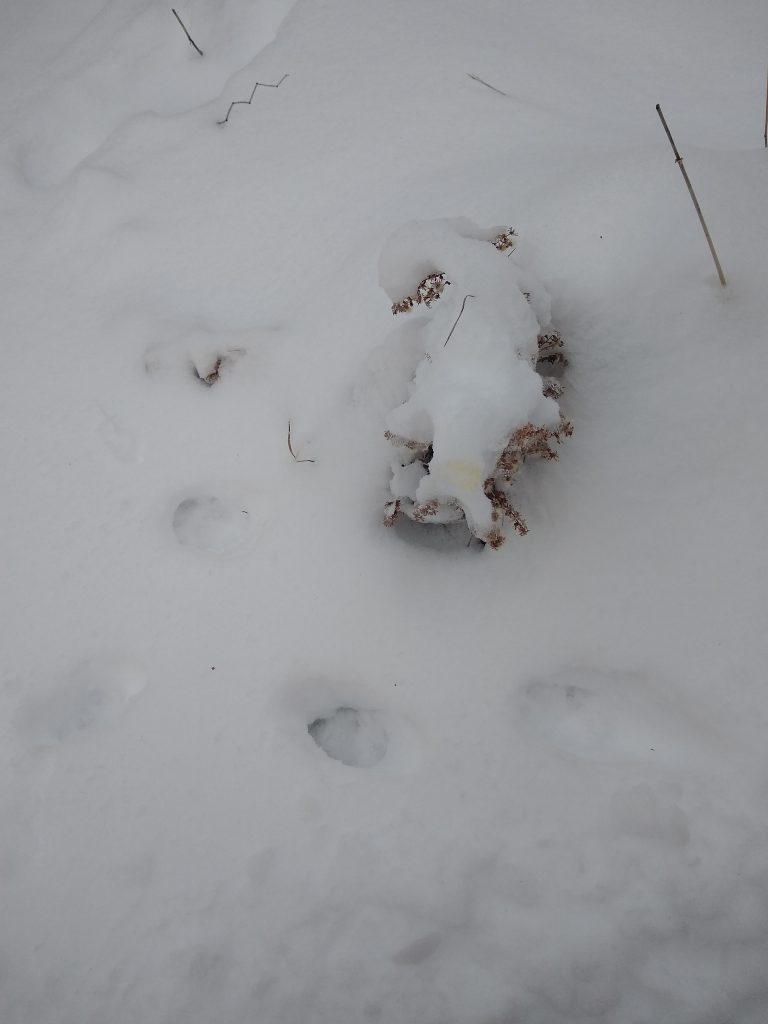
How many deer do you see?

I love animal tracking for a host of reasons, but one is that it can be an exercise in reason. I once received a good piece of advice for drawing, which has proven useful in many areas of life: “Try to see what is there, not what you want to be there.”

I visit the woods to try and read the stories that are held by the snow, but I want to practice seeing what is actually there, not what I expect to find. That said, creativity and empathy are very useful tools in the tracking toolkit. Imagining what an animal might be experiencing, how it thinks, and what its motivations are, may help you follow its path.

While my brain might leap to all sorts of conclusions about what’s in front of it, I am most effective when I stop to separate the idea wheat from the chaff. I can form theories about the tracks I find, but I won’t hold on to them too tightly until I see corroborating sign.

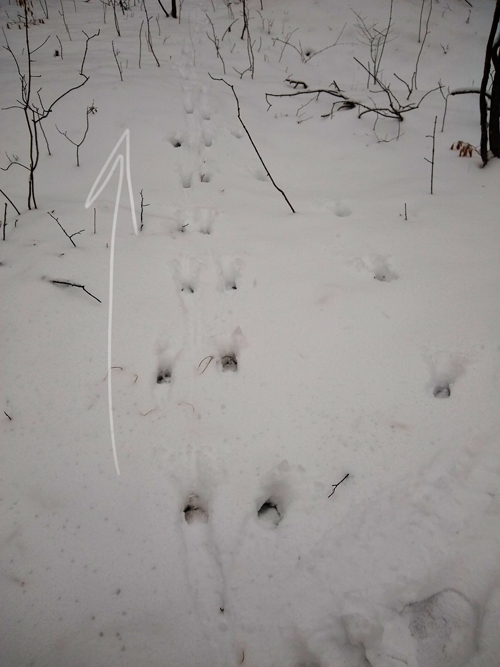
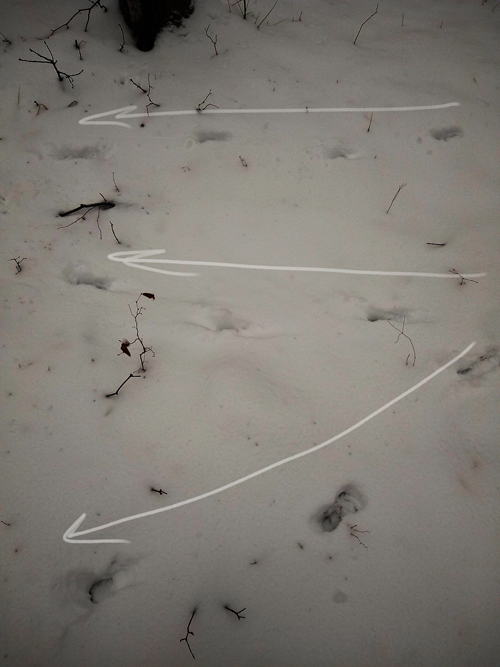
In the photo above, there are tracks from three separate deer. There is a deer gait called a “pronk” or “stot” which results in a 2×2 pattern, which could theoretically explain the tracks on the left. But the spacing is wrong, and it also wouldn’t fit with the rest of the “story” — the tracks at right appear to have been made around the same time, but with a very different gait. I followed the tracks though until I found more clear sign that this was the story of not two but three deer.

Three tracks running parallel, travelling R to L — you can see the middle and lowest tracks diverging at the right of the photo.

I was nearly at the other end of our property when I found the first split, but there it was — the tracks separated out and divided clearly into three separate paths.

Here is what I feel pretty confident I read in the snow that day:

  • I was following the tracks of 3 deer, one notably larger than the other two.
  • The deer travelled through our woods sometime after 1:30PM on Saturday Jan 2nd, and before ~12PM on Sunday Jan 3. I based this on having walked the same area on the Saturday without seeing tracks, and that the tracks I found on Sunday early afternoon were partially filled with the snowfall that began midday. (Meaning the tracks had been made before the new snow began falling.)
  • The larger deer was much more likely to walk a little apart from the other two, which stuck very close to each other’s path.
  • The deer were aware of the route Neil and I had taken the day before, often following our steps. We often joke that we have to go up to the woods and do a lap after a snowfall, to open the trail up for the wildlife.
  • The deer entered our property from our neighbour to the east. They roughly followed the path on the southern edge of our woods, but they turned off the path to follow Neil’s trail — where he went the day before, to go look closer at the bark of a tree.
  • They traversed diagonally from Neil’s tree bark pitstop over to the western walking path, where they followed our footsteps until nearly back up at the north edge, when they turned and headed back east — crossing back into the neighbour’s woods.
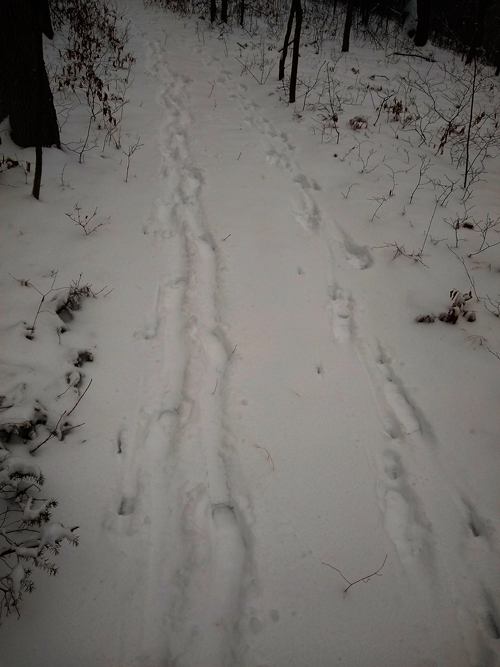
Above are my tracks on the left, and Neil’s on the right. I am a little shorter than Neil, and scuff more. There are deer tracks mixed in.

For a long section, the deer followed the footprints on the western trail which Neil and I had left the day before. The deer occassionally switched sides, moving between my (left) and Neil’s (right) footprints. The two smaller deer mostly walked together. Below you can see one of the spots where the three distinct tracks separate, as they switch between which of our footprints they will follow.

Five tracks diverged in a snowy woods

Below is where the deer left our property, to go back into the woods of our neighbour to the east. This was actually where I began tracking, I followed the deer’s trail opposite to the direction they had been walking.

You can also see “neighbour sign” here — he has driven a lap of his woods since the last snowfall.

In collecting data, you see what you see, but you can also see what you don’t see. And what is in the negative space may be as interesting and informative as what’s in front of you.

Here are a few of the things I saw that I did not see:

  • The deer did not stop moving while on our property. They appeared to walk continuously without pausing to eat, rest, or investigate while they were here.
  • The deer were not “spooked” during their walk. Their gait did not change; they maintained a steady walk the entire time.
  • The deer did not appear to urinate or defecate while on the property.
  • The deer did not continue to follow the trail for its full loop. They turned relatively abruptly off the open double-wide walking trail to cut through the woods instead, and cross back over to our eastern neighbour’s property. They were very near the top of the hill when they turned, which is probably the area in the woods which smells the most like us — it’s where we arrive when we drive up in Evie, the EV.

Each walk when I see tracks is many walks in one. My own, and those of each of the animals I am following. The walks that preceded mine, though sometimes literally following in my footsteps. Stories all around. It can have quite a lot to say up there, even when it’s quiet.

There is a phrase — “soft fascination” — to describe the particular restful state we experience when we observe nature. My mind is more active while tracking than it is while softly fascinated by birds in the trees, or summertime ants busily doing ant things. Perhaps it is “actively quiet”.

How long was I up in the woods? I don’t know, I tend to lose track of time in my active quietness… but perhaps I could measure the depth of snowfall on my hat to find out. 🙂

Happy trails folks!

Categories
thinking big

We’re here because we’re here


AuldLangSyne-sm.png
AuldLangSyne-sm.png

Categories
repair

Watch, closely.

My post-holiday internet rabbithole: watching watch restoration videos.

So tiny. So satisfying.

~Kate
Categories
mushrooms

Aw Shucks, We Found Oysters!

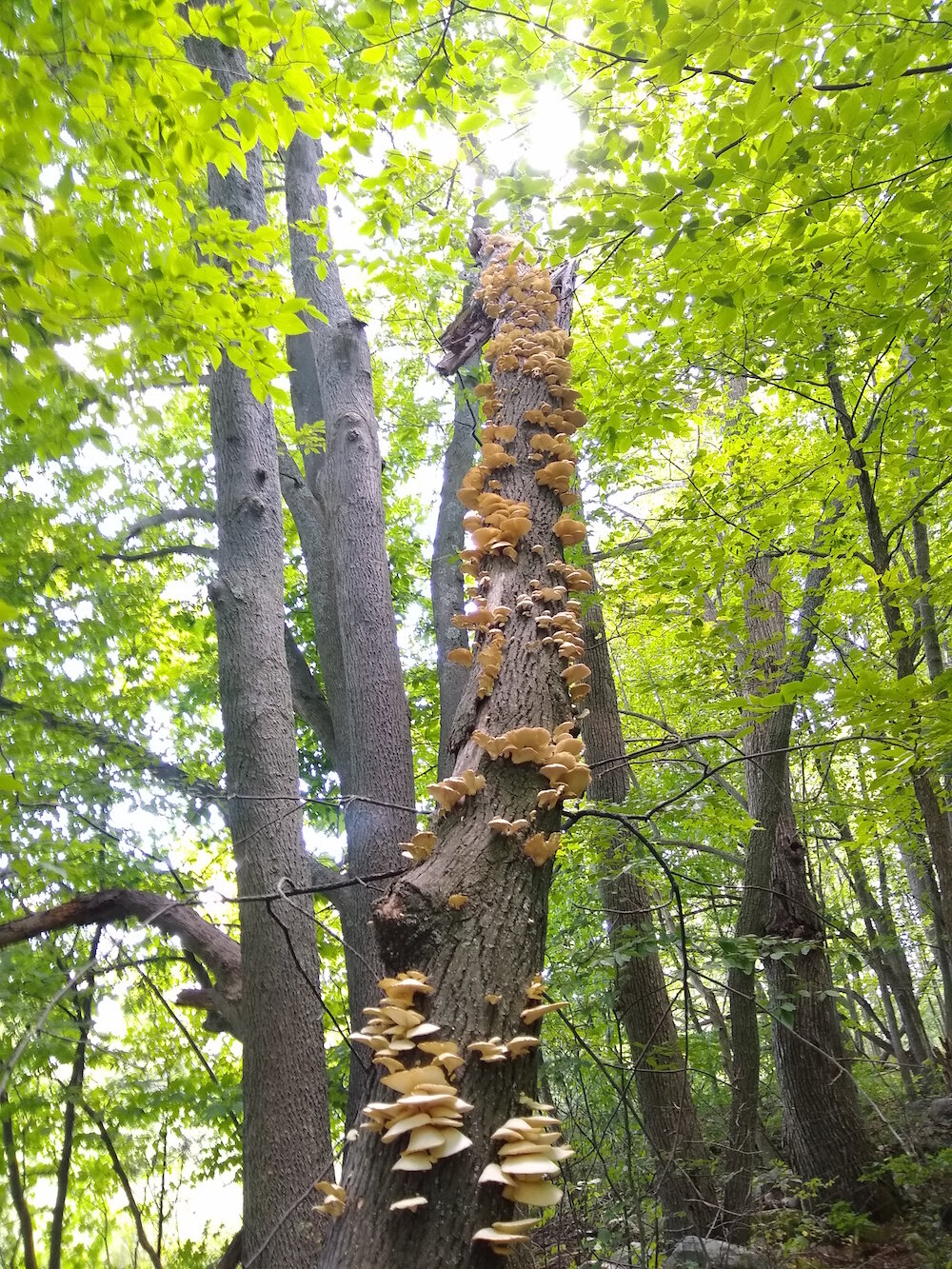
With the cooler temperatures and some rain lately, I thought there might be some mushrooms fruiting in the woods, so I went to take a look.

OysterTree.jpgOh… Oh my.

I sent this photo to my friend Miles (okay I sent it to a whole lot of people immediately) who asked if this is normal for our woods, such magical appearances.

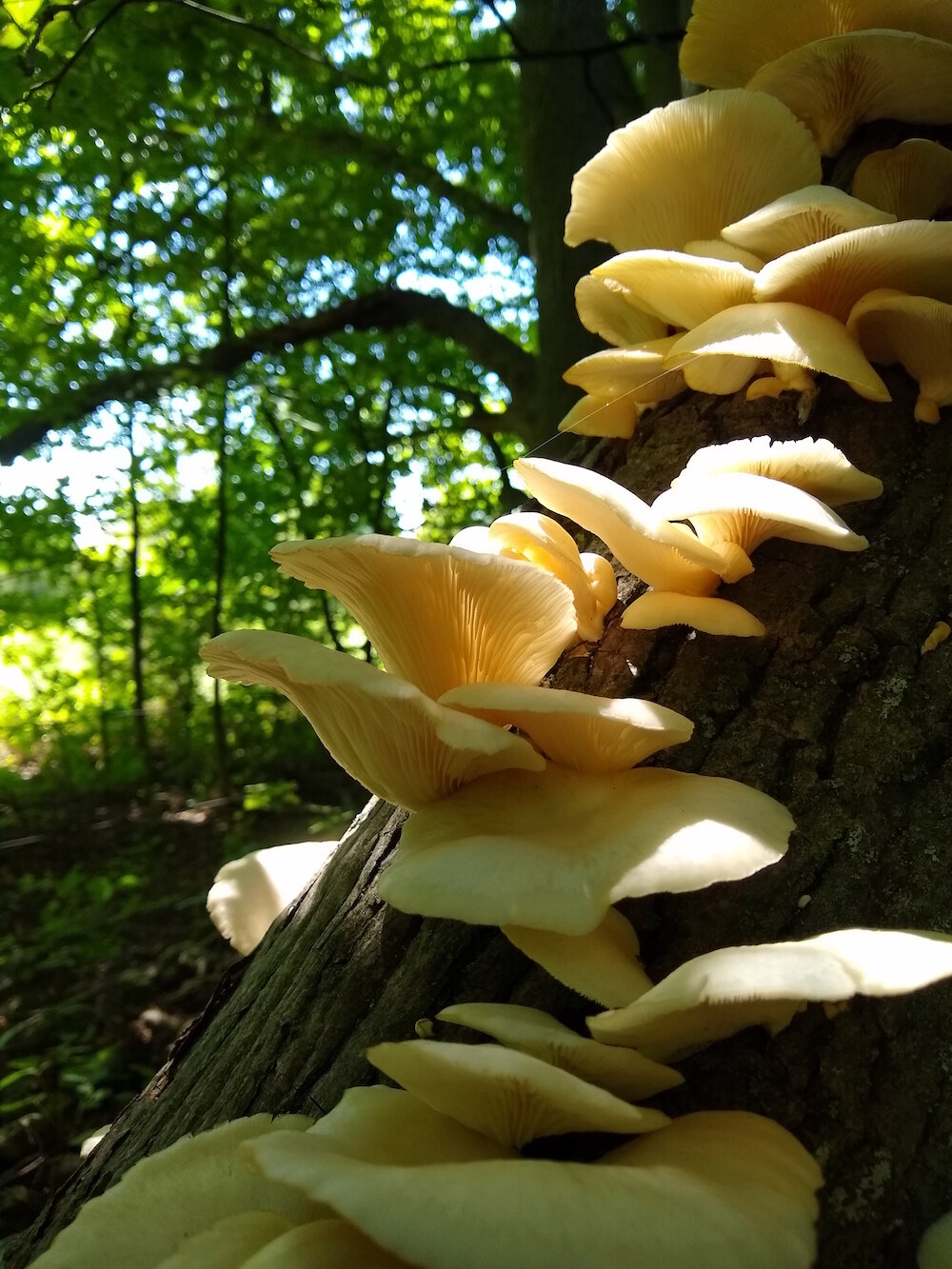
No sir, it is not. Magic yes. The woods are full of wonder, always. But this is the first time I have seen such a fruiting of mushrooms! Most of the fungi I find are one or two offs. If they are gregarious or abundant like this, they are usually not one of the edible species. I have spotted oyster mushrooms here before once or twice, but never in such abundance. Never like this.

BetterBringingASampleHome.jpg

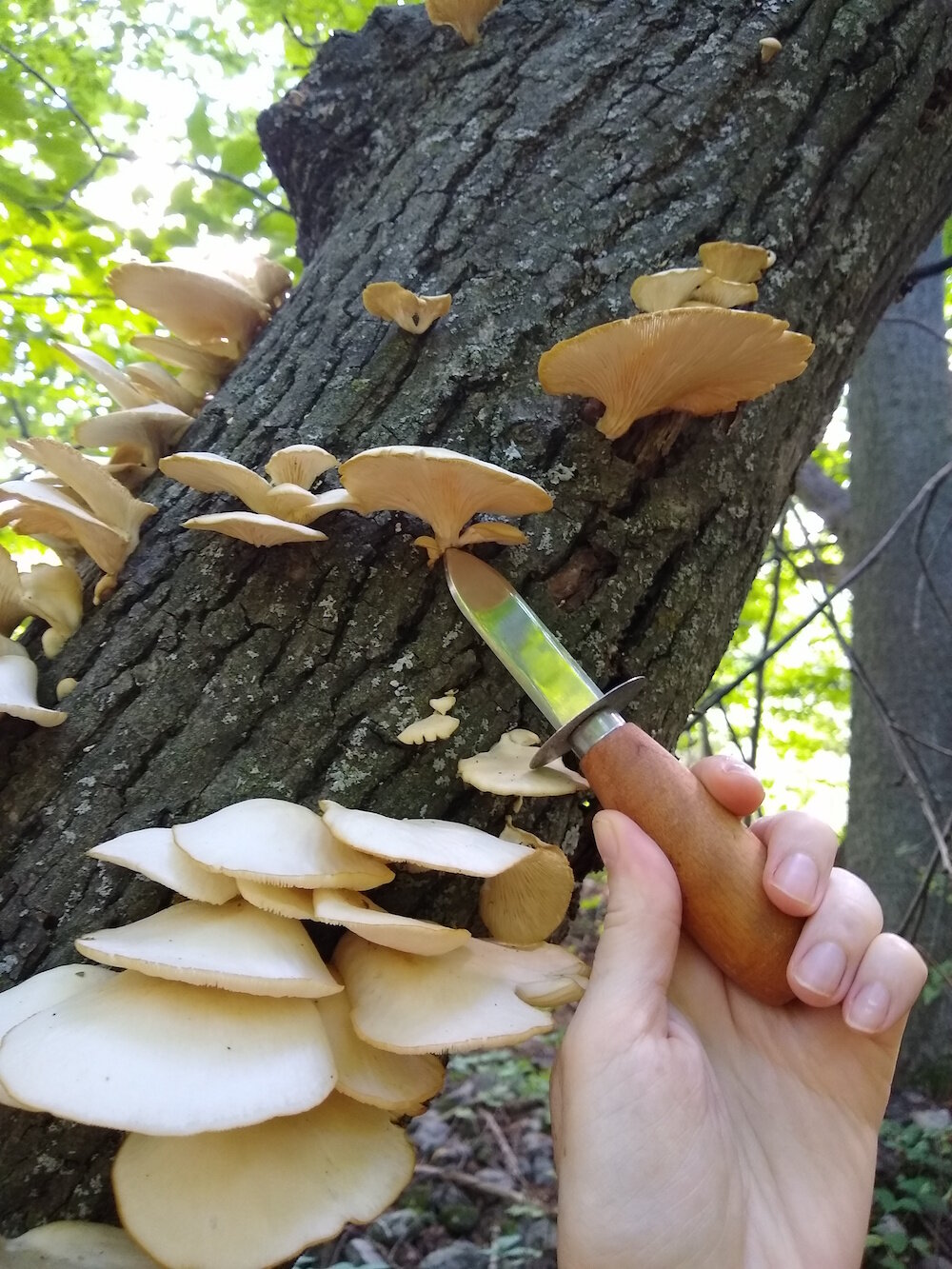
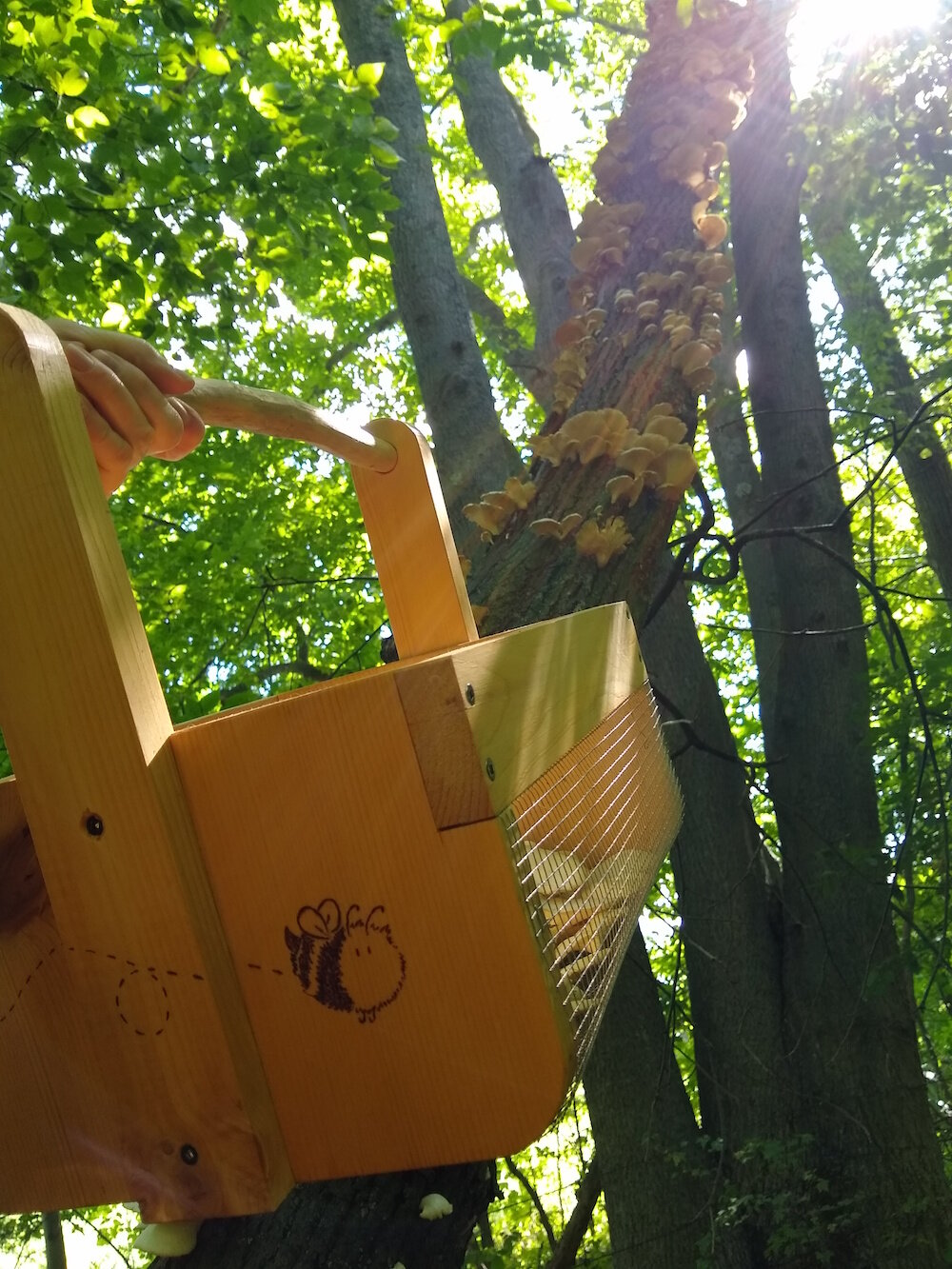
Here are a few of the field ID characteristics that led me to ID this as an oyster mushroom (Pleurotus ostreatus). Oyster mushrooms are saprotrophic — they’re decomposers, fruiting on dead or decaying matter. It’s a little hard to tell from the photos here, but the tree these are fruiting on is a broken hickory. The tree snapped in half in a storm ages ago, and the top of the tree now hangs inverted from the trunk. It hasn’t quite broken free and fallen to the ground, but instead hangs on tenaciously by a few twisted strands of trunk. We often check after windstorms to see if it’s finally let go and dropped to the forest floor, but nope. Still hanging there. I guess the fungi respect that tenacity, and thought such a stalwart spirit would make a good home.

The cap and gills of these mushrooms are light in colour, the cap is moist, smooth, offset from the stem, and the fruits are attached in clusters by stumpy stalks (where there are any stalks to speak of). Very importantly for oyster mushrooms too is the gill attachment — instead of ending at the stalk, they are “decurrent”, which means they continue right on down the stem, not ending at the cap.

It’s well known amongst my pals that I am a real boring stick-in-the-mud about mushrooms. I loooove mushrooms, but I don’t nibble, I don’t dabble… I have a very short list of fungi I am confident enough that I can ID correctly (and which don’t have toxic lookalikes) that I am willing to forage and eat them.

It’s about respect not confidence. In mushrooming you go quickly from ‘knowing nothing’ to ‘thinking you know quite a bit’ to ‘realizing you definitely know almost nothing’. Fungi are endlessly fascinating and wonderful and complex. I went to a mushroom course where we spent a week harvesting and IDing fungi, and witnessed many very experienced mushroomers — including our two instructors — struggle to identify some of the mushrooms we found down to species. Respect the ‘shroom.

We’re going for a ride in the (electric) car little buddy.

We’re going for a ride in the (electric) car little buddy.

I’ll explain in a sec…

I’ll explain in a sec…

So in addition to a field ID, I brought a sample mushroom back to my “lab” (aka the workbench, with constructions projects hastily shoved to one side). Spore prints are incredibly useful to identify mushrooms. If this is an oyster mushroom, the spores it releases should be very pale — somewhere in a white-violet range.

To take a spore print, you remove the cap of the mushroom and place it overtop of a piece of paper, so the spores will fall from the gills/pores onto the paper where you can look at them. It works best if the cap is fresh and not too young, not too old. It can also jumpstart things to sprinkle a little water on the cap, before covering it with a container (I usually use a plastic yogurt container turned upside down).

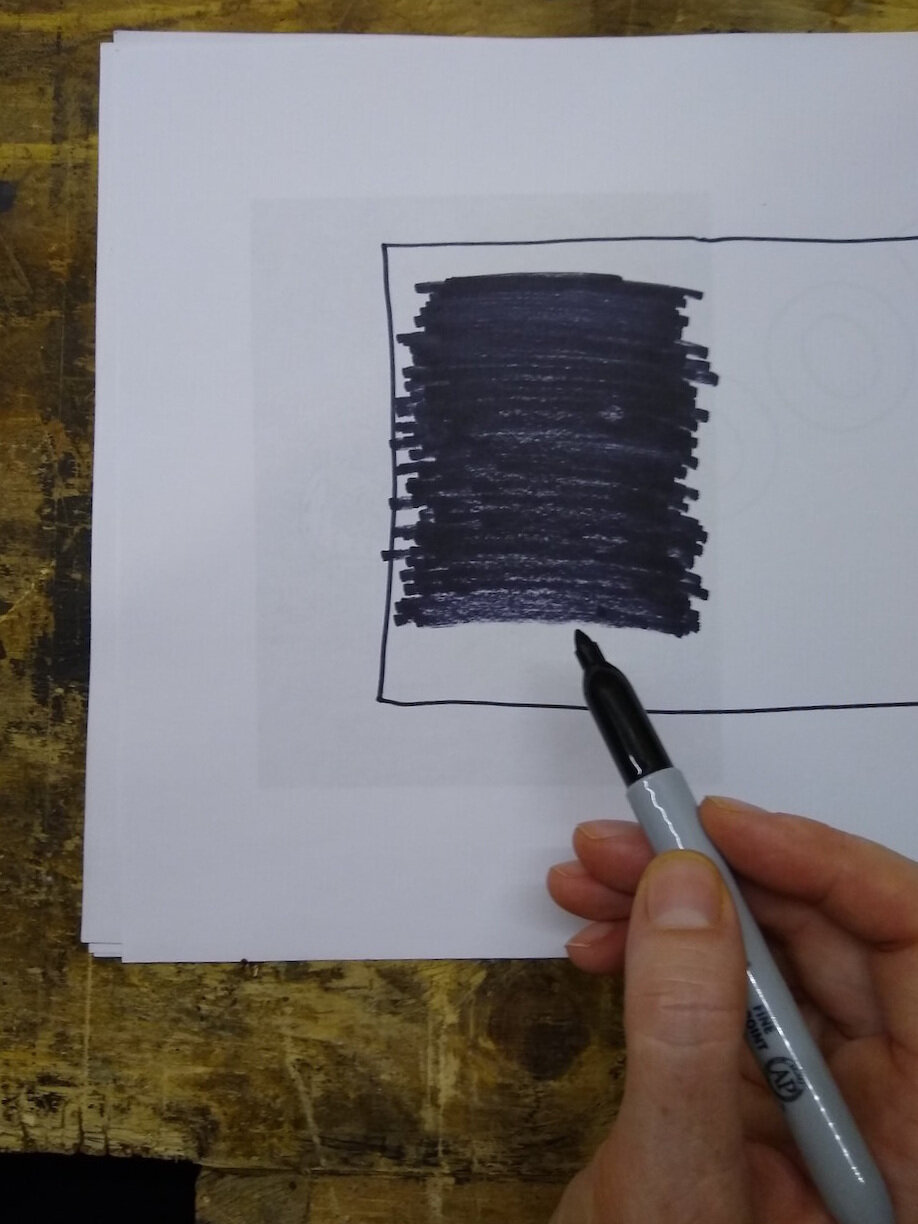
The colour of mushroom spores can range from extremely dark, to extremely light. So you need to place any cap you’re checking on a material where either extreme will show up. You can of course buy “special” pieces of paper to rest your mushroom on that are half black/half white. Or you can get black and white cardstock and lie them beside each other (to reuse them, rest your cap on a piece of glass or plexiglass you place over the papers). Or, for a quick’n’dirty hack, you can do what I do when I’m in a rush, and just colour a section of white scrap paper with a black sharpie.

Now we play the waiting game. Patiently, cuz peeking might screw up the print. Go read your mushroom book for a bit.Now we play the waiting game. Patiently, cuz peeking might screw up the print. Go read your mushroom book for a bit.

Now we play the waiting game. Patiently, cuz peeking might screw up the print. Go read your mushroom book for a bit.
A full print can take anywhere from an hour or two to a day. But if the cap is fresh, you may start to see some spores release sooner. I set a timer for half an hour and go do something else before I check at all. Mostly so I don’t sit at the workbench staring at an upside-down yogurt container, waiting for time to pass. Which has definitely actually happened.
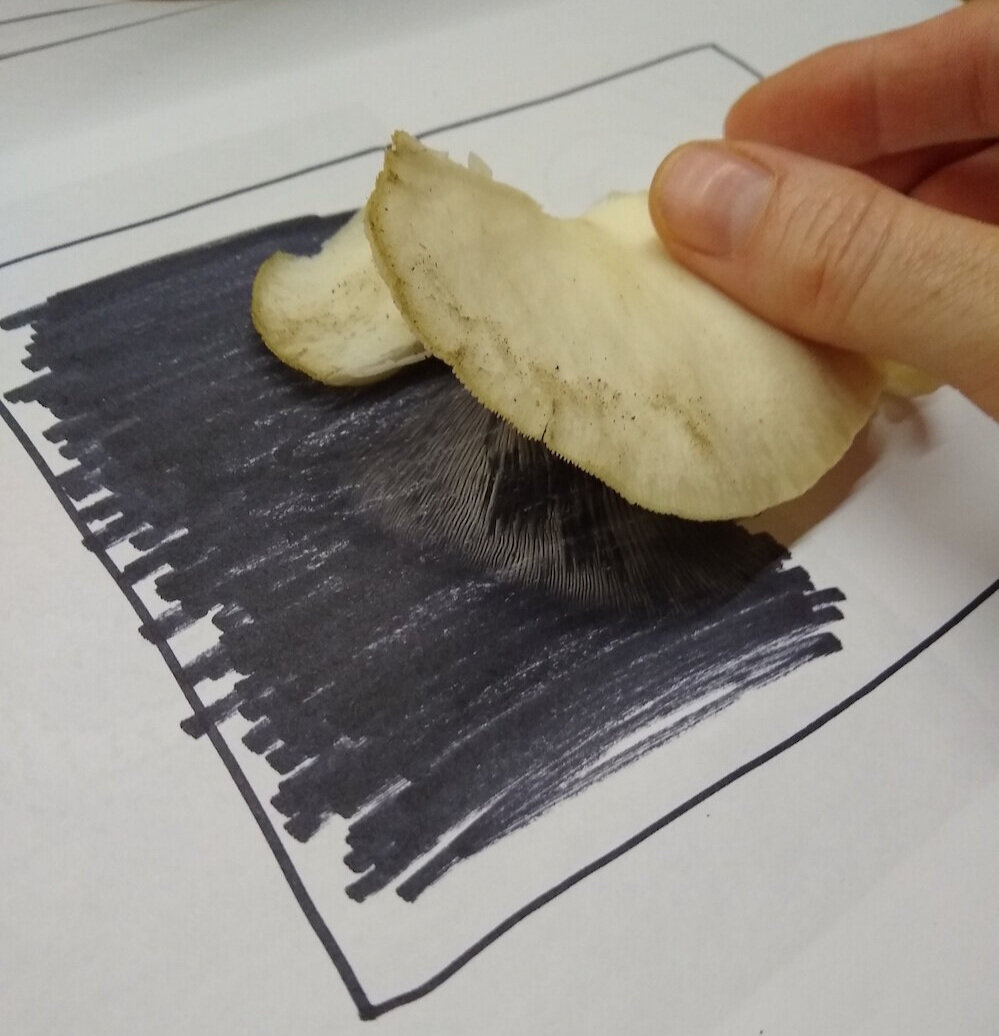
After about an hour, the spores of this sample had begun to release… and they were definitely light!
Time to fetch the basket! And the Neil.

No peeking. Okay a little peeking…No peeking. Okay a little peeking…

No peeking. Okay a little peeking…

Bingo!! What a beauty. This is not a slice of the cap, it is just layers of the spores, fallen from the gills.Bingo!! What a beauty. This is not a slice of the cap, it is just layers of the spores, fallen from the gills.

Bingo!! What a beauty. This is not a slice of the cap, it is just layers of the spores, fallen from the gills.

I’m fine. This is fine. The mushrooms will still be there. I love Neil I love Neil I love Neil…I’m fine. This is fine. The mushrooms will still be there. I love Neil I love Neil I love Neil…I’m fine. This is fine. The mushrooms will still be there. I love Neil I love Neil I love Neil…
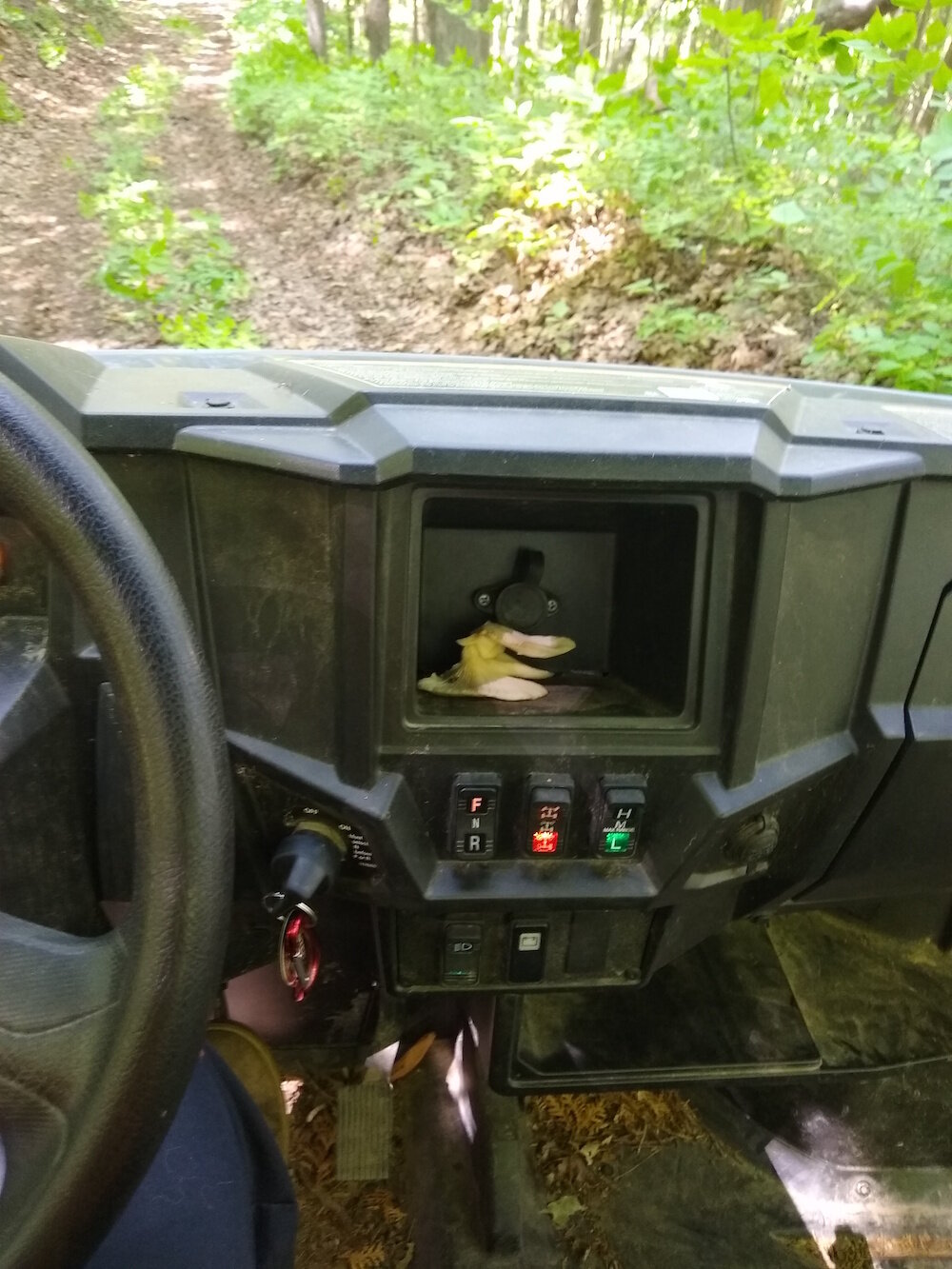
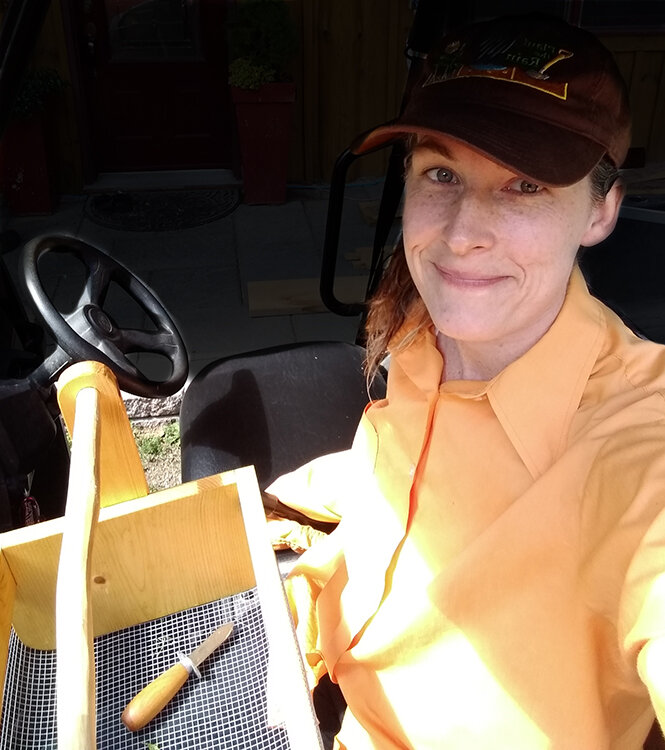
Neil had been up for ages but hadn’t eaten, so he wanted to grab a quick bite before we went to fetch the fungi. He told me I could go ahead without him, he’d be about a half hour. Half an hour?! But something-something-shared-experiences-love-of-my-life-whatever. I could sit and stare at him eating his burger the way I stare at a mushroom cap I’m waiting to drop its spores. But instead I had a shower. Washed some dishes. Answered some emails. It nearly killed me, but I hung back so he could join me for the harvest too. Once I was done some chores, I waited in the UTV with my collection basket, which surprisingly did not help with my ability to be patient.

They were still there. Hadn’t scuttled off.They were still there. Hadn’t scuttled off.
They were still there. Hadn’t scuttled off.

Yes that is an oyster knife. I think I’m funny. ;) Buck-a-shuck.Yes that is an oyster knife. I think I’m funny. ;) Buck-a-shuck.Yes that is an oyster knife. I think I’m funny. 😉 Buck-a-shuck.

Now’s the part where I make it super-duper clear that I’m not advocating you eat mushrooms that you think look like this. Even if a mushroom you find matches all the descriptions I’ve mentioned, you may still have an adverse reaction. Your body, your biome. I am an enthusiast, but an amateur. I only risk myself — and apparently Neil, who for some reason trusts me with his life. Even so, even with a confident ID of a mushroom without toxic lookalikes, we still only start by eating one. Then we wait a day to make sure we’re a-okay before eating more. Your risks of any major issues with mushrooms are way lower if you don’t pig out. We fried a couple up this morning to test, put some aside for an epic funghi pizza on Friday, and dried the rest for another day. (If we die, we’ll let you know.)

“…many people are armed with more enthusiasm than knowledge, so there is always a risk of poisoning from mistakes in identification.” ~George Barron, “Mushrooms of Ontario and Eastern Canada”

There absolutely are deadly poisonous mushrooms that grow in Ontario — I have IDd some toxic Amanitas here in our woods. Some toxic mushrooms are widespread, and they are often white and don’t “look” scary at all. Cooking mushrooms doesn’t necessarily make them safe to eat, and some of the most dangerous mushrooms will not make you sick right away. If you feel ill quickly after eating a mushroom, those aren’t even the really dangerous ones. You’ll be uncomfortable for awhile, but you’ll probably live. But mushrooms that have amatotoxins can cause serious and permanent damage to vital organs like your kidney and liver, and you’ll only start to notice the effects from those mushrooms 4 to 24 hours after you eat them. Be humble, be patient. And if you are not 100% sure, don’t eat it.

“Every mushroom is edible, but some are only edible once.””
This is the tree *after* we harvested. Also this might be the most beautiful thing I have ever seen.This is the tree *after* we harvested. Also this might be the most beautiful thing I have ever seen.

This is the tree *after* we harvested. Also this might be the most beautiful thing I have ever seen.

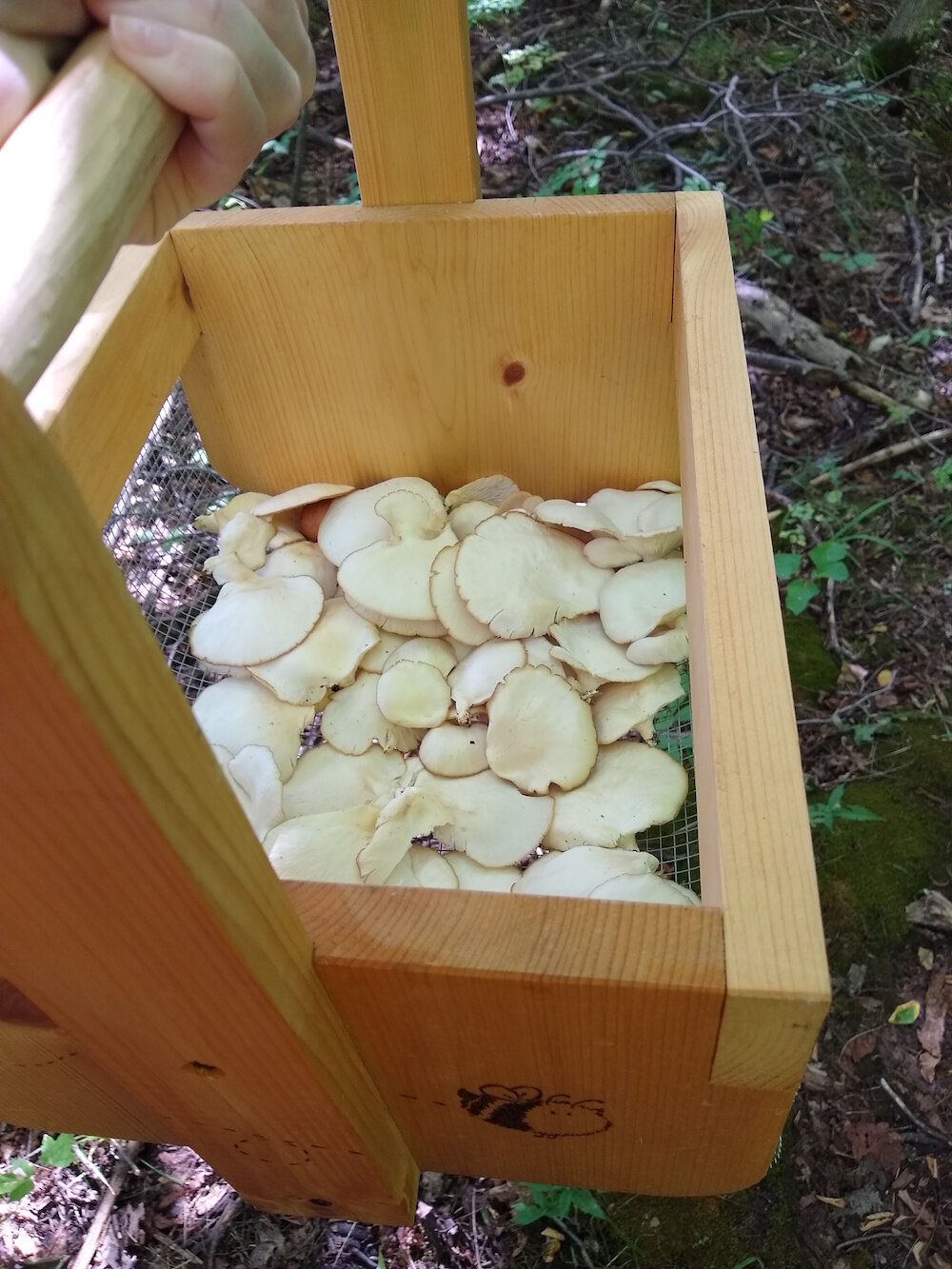
We harvested what felt like a lot, but was just a fraction of what was there. Life wants to be abundant, our only job is to not mess it up. The rise in interest for foraging both delights and makes me nervous. It delights me for humans to reconnect with nature, but not when we’re just taking our overconsumption to the forests. Take a few, leave many. Or take none — also a wonderful choice. It’s always okay to just enjoy with your eyes, not your belly.

Harvesting with mesh and open baskets lets the spores disperse as you walk in the woods, helping ensure there will be more mushrooms in the future.Harvesting with mesh and open baskets lets the spores disperse as you walk in the woods, helping ensure there will be more mushrooms in the future.

Harvesting with mesh and open baskets lets the spores disperse as you walk in the woods, helping ensure there will be more mushrooms in the future.

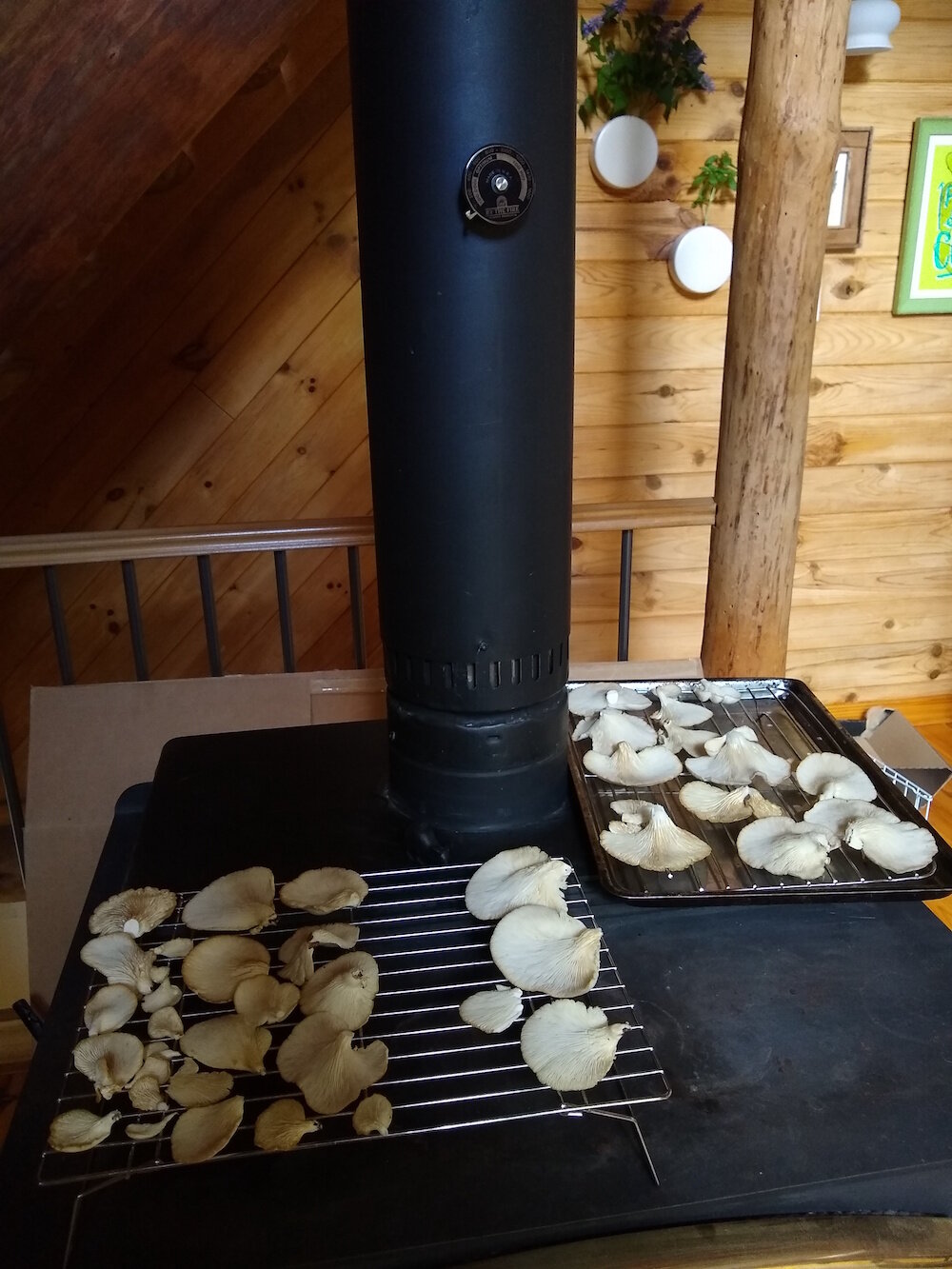
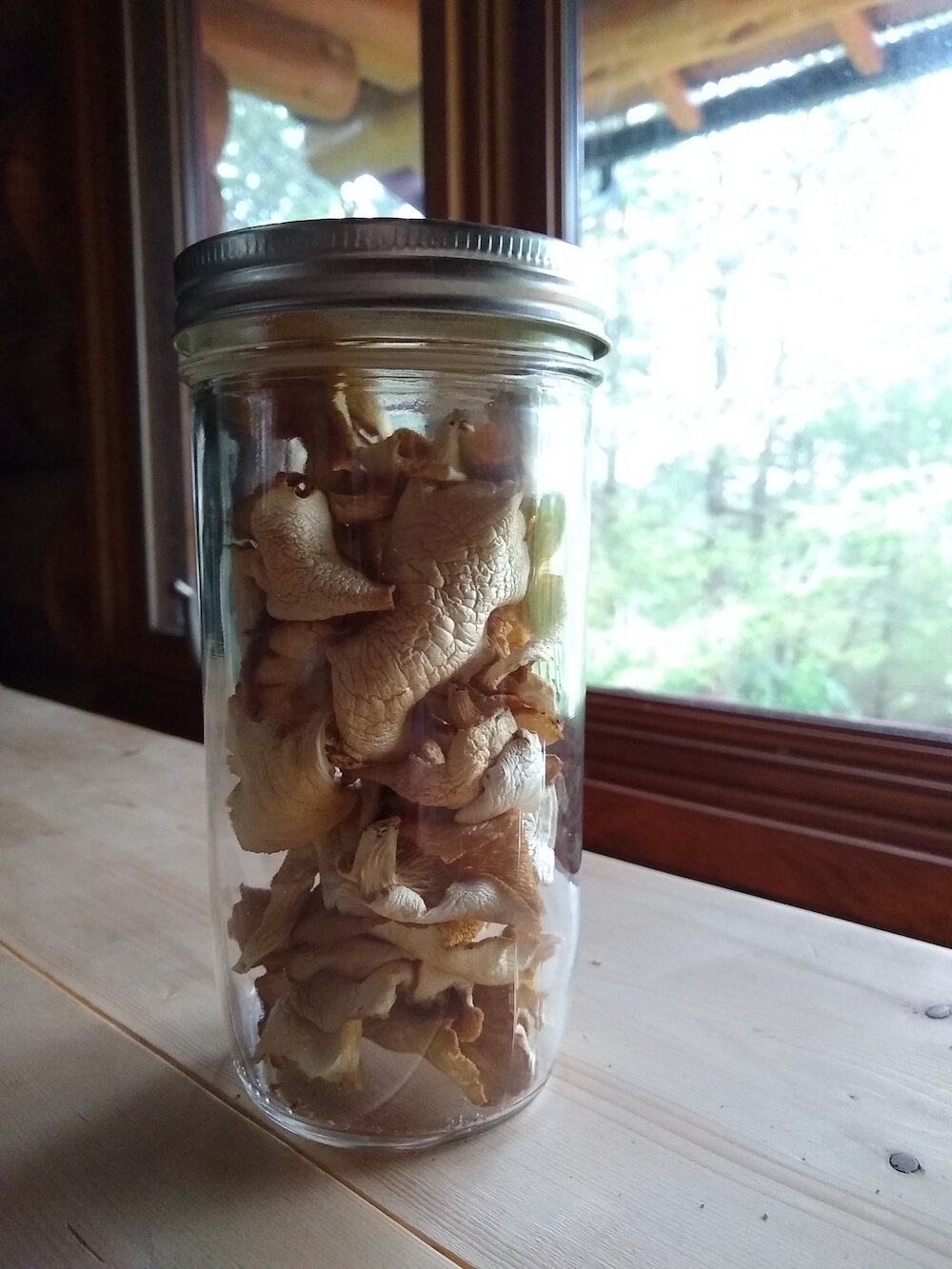
Air drying some of the mushrooms… and giving the bugs a chance to move out.Air drying some of the mushrooms… and giving the bugs a chance to move out.

Air drying some of the mushrooms… and giving the bugs a chance to move out.

Foraging for these mushrooms felt like many bits and pieces of our lives here coming together in a fungal symphony. To know the woods well enough to know good times and locations to look for mushrooms. To ID the tree they’re growing on, and the mushrooms making that tree their home. To harvest wild foods, but not too many, and to dry and store a little wildness for later. We work really hard to learn and learn and learn, and it’s nice sometimes to taste the fruits of our labour (what I did there, you see it).

hanks woods, as always. See you soon.

>~Kate

DriedOysterMushrooms.jpg

Categories
thinking big

The Dawns of a New Day

“Sometimes I get up early and even my soul is wet.”

— Pablo Neruda

MoreSunrise.jpeg

Sometimes I get up early enough to watch the sunrise. Usually deliberately though usually not “naturally” — I will set an alarm so that I can meet the day, literally. Most often I do this during the fall or winter when, not as now in mid-summer, sunrise is at a “reasonable” time. More like 6 or 7AM instead of more like 5AM.

In researching the correct time for this alarm I learned “sunrise” is not what I thought it was. I would check the internet for tomorrow’s sunrise time, get up, and find the sky was already bright. How had I missed it?

It turns out that if I wanted to watch night give way to day, what I was really looking for was one of the dawns. There are three of them, and though I enjoy all three, the time I was looking for was the last: “Civil Dawn”.

Each day begins with three dawns, and three twilights. Astronomical, Nautical and Civil. Each dawn is an exact time. The dawns mark the moments the geometric centre of the sun is a particular number of degrees below the horizon (18°, 12° and 6° respectively). And each dawn is followed by its twilight, again Astronomical, Nautical and Civil. The end of this dance is sunrise. The same twilights happen in reverse order each evening, but beginning with sunset, and with three dusks replacing the three dawns. (To learn more — read here.)

Astronomical twilight is still a dark-dark. Black as night. But it is when the sun is nevertheless too near the horizon for us to see some astronomical features — it’s when the brightness of our sun obscures some of the other stars.

Nautical twilight is the time for sailors. When the sky is bright enough to be able to see where the sea meets the sky, but still dark enough that the stars used for navigation are visible in the night/day sky.

Civil twilight is the time for me. When it is not “bright as day”, but “bright enough” — bright enough that we lunky bi-pedal bi-nocular apes are able to get around without artificial light.

Civil dawn and civil twilight is a fascinating time to have your eyes open, and be navigating the world. As the moments pass, you can nearly feel your irises stretching open to take in each new spec of light. The world brightens around you. The sun is turning on the lights.

~ Kate
IMG_20191029_072638314.jpg

Categories
homestead

Grey Waters: Chicken Gardeners, Roofs for Days, and Planting the Rain

Chicken Gardeners

Chickens: “Thanks Bipedal Female Food-And-Water Dispenser, but do you have anything with more dirt in it? ktks”Chickens: “Thanks Bipedal Female Food-And-Water Dispenser, but do you have anything with more dirt in it? ktks”

Chickens make terrible farmers. They literally live like there’s no tomorrow. See a sprout, eat a sprout. Tomorrow be damned! Live for the now!

Party animals.

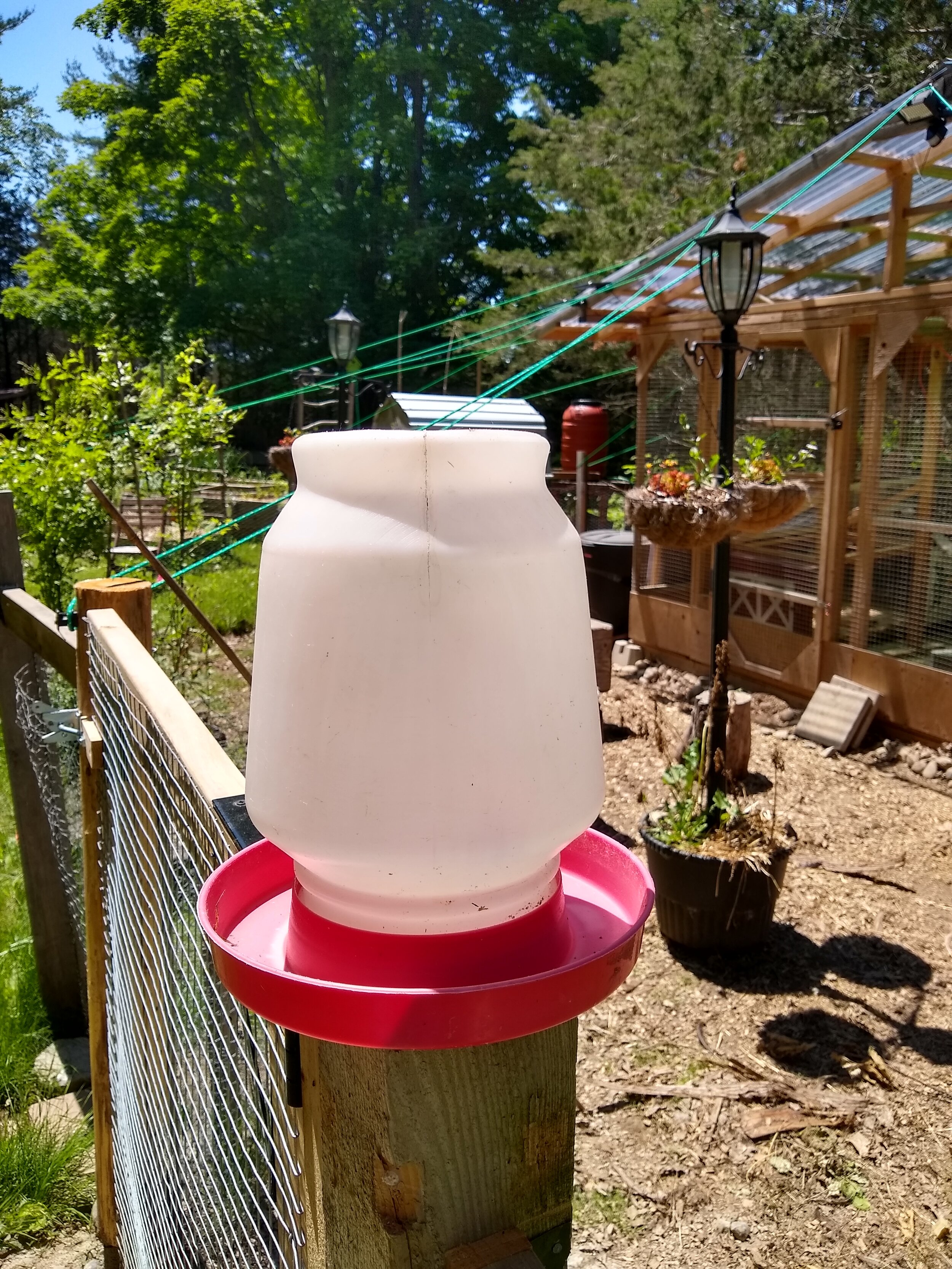
But we’ve managed to turn our chickens into gardening allies, in spite of themselves. We change over our chicken waterers every day or so. Though a chicken’s favourite water is always the grossest, dirtiest, mudpuddliest, most-recently-pooped-in water they can find, we like to feel we’re at least giving them the option of drinking fresh clean water. From there, they can do whatever their little dino hearts desire.

But chickens don’t drink a full waterer every day, so that means we are frequently removing a 2/3rds full waterer from their run. Rather than dumping it down the drain, we either consolidate it into the previously mentioned “ugly flushing buckets”, or use it to feed the gardens. I like to grow a few plants in the chicken run which are safe for them to nibble — assorted herbs, and some leafy greens like kale. I also grow roses in there, which are able to defend themselves against the chickens. Roses provide a nice bit of greenery in the run that can hold up a chicken’s reign of pecking terror. And since they’re out of chicken reach/interest, I’m able to harvest the petals and rosehips. All those plants get watered with the chicken waterers. I will turn you into gardeners yet, you tiny defoliating monsters.
Roofs for Days

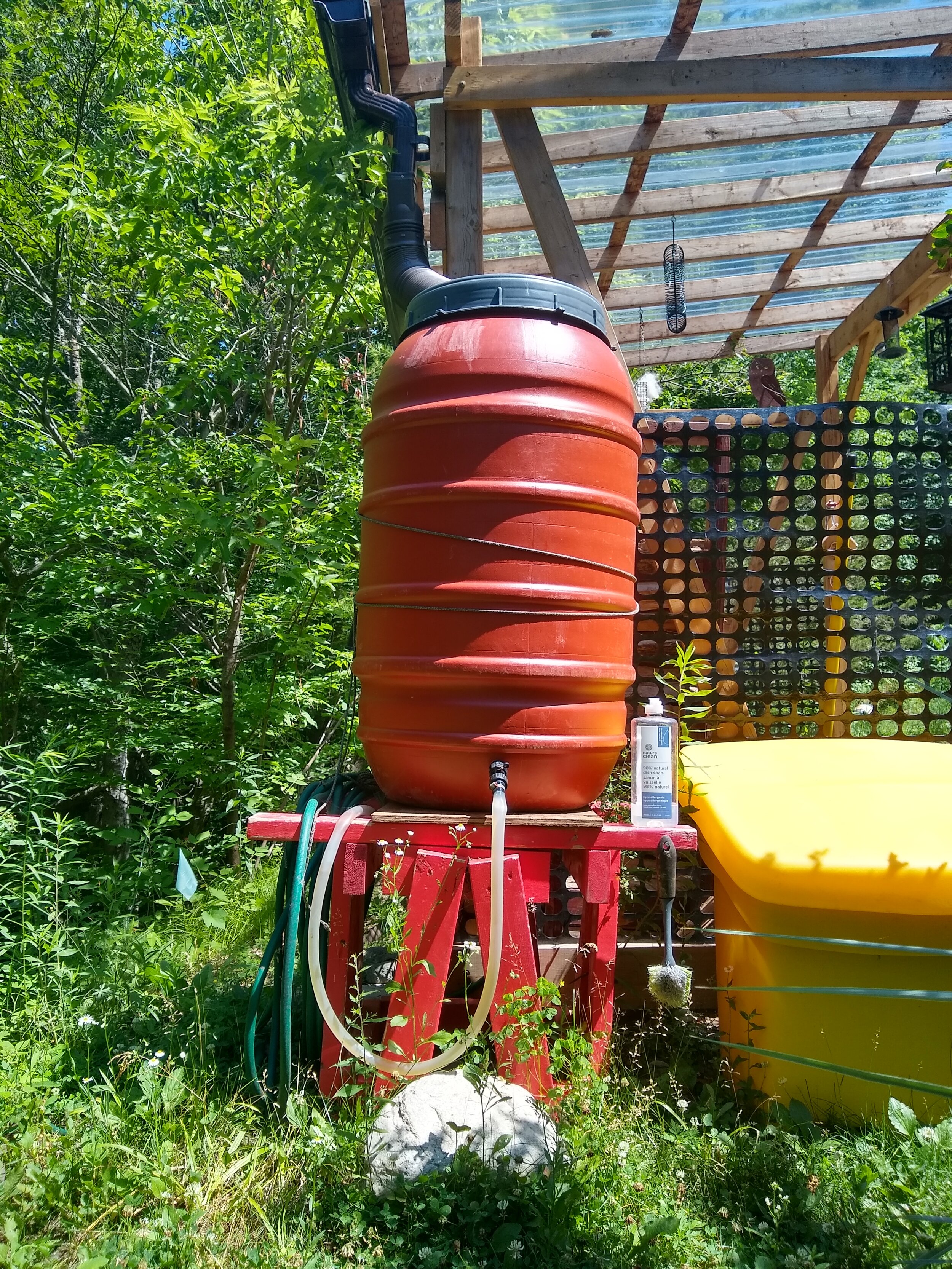
We often joke that we only build structures so we can put rainwater-collecting roofs on them. It’s not “true” but it’s also not-not true. Both our chicken run and our front firewood storage have roofs on them, with the roof water diverted into rainwater barrels. We use this water for outside chores. As-is, it’s not potable (though we have plans…), but it is great for a quick wash of muddy feet, cleaning out the compost bucket before bringing it back inside, or watering the vegetable gardens.

It’s easy enough to pop a gutter on a roof. Instead of ending up with a hard dripline around your structure that messes up the ground around it, all that water become useable, and eventually seeps back to the earth in a more gentle dispersed way.
Just out of frame — the little dish we fill with rainwater on hot days for the birds, chipmunks and other woodland critters.

Just out of frame — the little dish we fill with rainwater on hot days for the birds, chipmunks and other woodland critters.

Plant the Rain

Instead of planting plants and then figuring out where their water will come from, “planting the rain” means to find the water first, and let the plant follow. If you have even the tiniest interest in rainwater, this video of Brad Lancaster in Tuscon, Arizona is a must watch.

Brad’s approach of “planting the rain” transformed the barren streetscape where he lives into a life-giving food-generating oasis, by rethinking what’s possible, and working with his neighbours. Read more and find resources at his website: Harvesting Rainwater.

““One of my primary mentors was an African water farmer, Mr Zephaniah Phiri Maseko. When I spent just one day with him, seeing how he converted a wasteland into an oasis just by planting the rain.

I said “Look, the water situation is so bad in my community I want to leave, where should I go?” And he slapped me on the shoulder and he said “You can’t go. If you run away from your problems, you’ll just plant problems everywhere you go.

You gotta go home, set your roots deeper than you ever thought possible and figure out solutions.” ”