Categories
birbs

Fee-bee! Fee-bee!

Think I heard my first Eastern Phoebe of the year!

Phoebe painted with wild inks

The chickens and I were outside doing our stretches. I was doing physio for my arm (it is possible I overdid it, using a pickaxe to liberate our icy driveway last month), while the chickens were running around looking for slugs and bugs.

I was enjoying listening to the morning birdsong, when a familiar determined trill popped out from the robin-dominant din. A phoebe!

I wasn’t familiar with phoebes before we moved here. They’re adorable little flycatchers, with forked tail feathers that flick distinctively whenever they’re sat on low perches, waiting to snatch their next bug from the air.

A phoebe has nested on our house at least as long as we’ve lived here, and possibly before that. Phoebes will reuse their nests, after doing some refurbishing, so we leave the nests in place and intact year-to-year, snugged up under the roof’s overhang.

Last year the phoebe that usually nested on the back of our house built a new nest on the front instead — possibly a consequence of something-not-us mutilating their nest beyond repair while the phoebes were away for the winter. (I don’t know for certain it is the same phoebe nesting, or at least the same family line. But given that the oldest known phoebe was 10 years and 4 months old, I guess it’s possible!)

The change in nest neighbourhood was wonderful for us though, as the phoebe’s new nest was by a large window, so we were able to watch all their comings and goings — and fledgings! Bird TV. We’d witnessed part of one fledging in a previous year. We were standing by the bedroom window when a very very tiny phoebe (which are already pretty tiny to start with) landed on the little framed edge of our bedroom window, breathing heavy and looking like this whole flying business was quite new, exciting, and scary. A-dorable.

The other birds don’t appreciate the phoebe’s claiming of the front of our house as much as we do. I usually have a window-mounted feeder on that same large window, but we had to take it down last year. The phoebe was very territorial, and took to “giving the bird” — dramatic maverick-style swooping attacks — to any interloper who tried to pop by for a snack. I decided to remove the temptation, and took that feeder down until the phoebes had moved on.

It is very satisfying and exhilarating though to watch these incredibly agile and nimble little fighter pilot birds in action. Their swoops and banks and high speed catches of bugs from the air are spectacular to watch. I mean, they are catching bugs mid-flight! Last year was particularly enjoyable, as the phoebes were at least reasonably happy to include LDD moths on their menu. We had just ridiculous number of caterpillars (until their collapse) last year, so seeing the phoebe munching away on them was a delicious sight.

Sights – and sounds – of spring continue…

~Kate

Categories
birbs fauna

The sweet song of a screech owl

Neil had gone out for a midnight chicken check, as he does sometimes. I was already sound asleep, as I do. But I groggily realized his excited voice was calling to wake me up. There was a screech owl outside! I threw on a pile of clothes and a toque, and crunched outside in the midnight snow. Sure enough, there was a screech owl trilling in the woods!

This is the first year we’ve recognized a screech owl call here. We’ve heard it a few times now, so I was able to record this audio of its sweet song the other night.

Sing on little friend🦉

~Kate


📷: Photograph of a screech owl courtesy the wonderful Tess Miller. Who is the sort of person who has at least 5 photos of screech owls handy at all times, thanks to her years of hard work at an Ontario wildlife centre. Because she is a total boss.

Categories
birbs fauna tracks & scat

A bird in the bush

A couple of Sundays ago, we went for a tromp around our friends’ woods and fields. Leaving our own big snowshoe prints in the snow, we were surrounded too by the tracks of other critters — canids and deer, rodents and rabbits.

While I was stopped to look closer at something on the ground, I heard a noise behind our friend D. Walking in snowshoes can make quite a racket. Bindings squeak and snow squelches. Not to mention how warm wooly hats can muffle sound. But I was sure this funny little rustle from the brush was something “real”. I turned to look, and heard it again. A rabbit perhaps? Or maybe it was just a branch settling in the snow?

The answer revealed itself a moment later, a brown and buff ruffed grouse flushing from the brush nearby. It flew up and away out from the scraggle of growth, briefly earth brown against the blue sky, before its shape was reabsorbed by the trees at the other end of the field.

I took off my snowshoes so I could scramble into the brush where the little grouse had exited. Seeing the spot in the snow where a bird has taken off or landed is a real treat. That’s what you see in the image below. The trail the grouse forged walking through the deep snow, and then a deeper *fwomp* where it decided it had enough of us, and took off for other pastures.

I am sunk in the snow up to my knees, while the light boned bird only sunk a few inches, before escaping the ground altogether. Its lightweight body isn’t the only reason it stays aloft in the snow though…

Apparently we were not the only ones wearing snowshoes that day, as according to Hinterland Who’s Who:

“The Ruffed Grouse is specially adapted to handle winter weather. Where the snow is deep, soft, and persistent, grouse travel over it with the help of their “snowshoes”—lateral extensions of the scales of the toes. They also burrow into the snow, which keeps them warm and protects them from predators.”

https://www.hww.ca/en/wildlife/birds/ruffed-grouse.html

and

Called pectination, the “snowshoes” are a comb-like fringe along the sides of the toes. This increased surface area allows the grouse to stay aloft — accomplishing essentially the same thing as the large, furry feet of snowshoe hares. It also gives them extra grip when they perch on icy branches to eat tree buds. Unlike the shoeshoe hare, however, the grouse grows this special comb each fall and loses it in spring.

https://fmr.org/news/2017/12/27/nature-notes-snowshoeing-grouse

I hang my snowshoes up in the spring too little grouse! We have so much in common.

~Kate

Categories
birbs

Winter Plumage?

Weird bird at the window feeder this morning. Very fuzzy. Long tail. Maybe winter plumage?

If it fits, it sits.

~Kate

Categories
birbs fauna QoTD

Biomimicry for everyday use

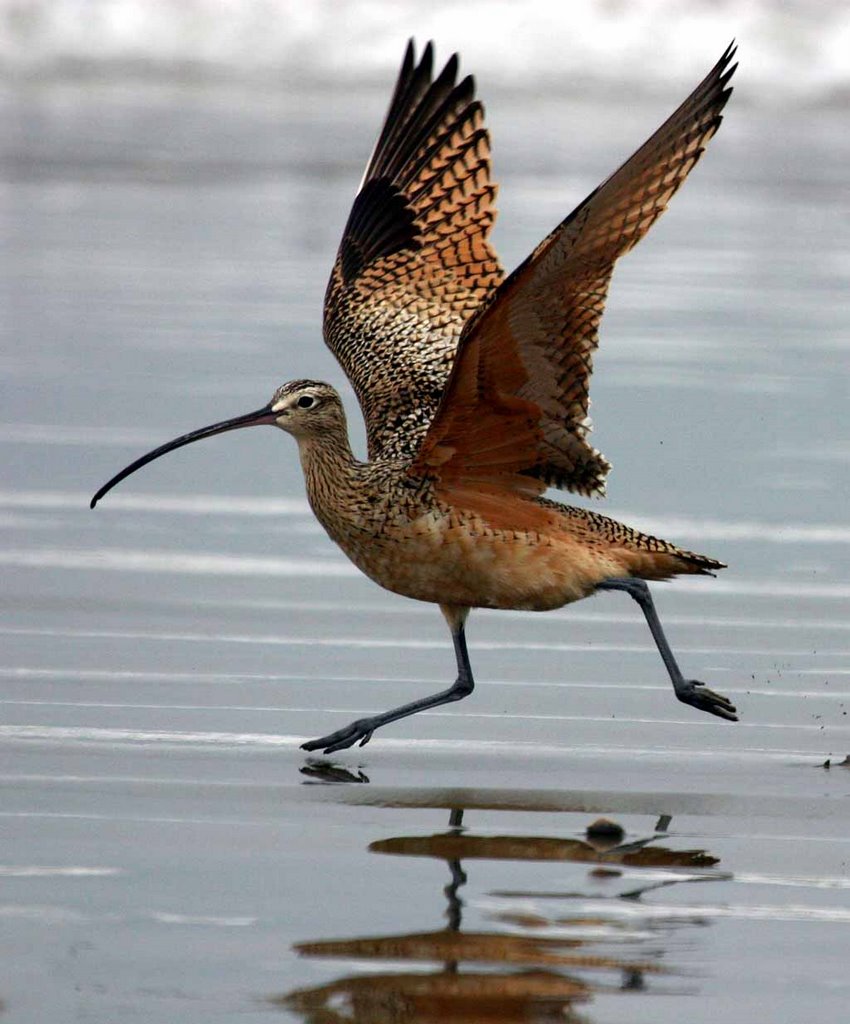
© “Mike” Michael L. Baird / CC BY 2.0

…the Long-billed Curlew protects its territory with a variety of moves, one of which is “Concealment,” in which it runs towards its opponent, then “suddenly flops down in grass, disappearing from view.” The opponent looks around, perplexed, until the defender springs up and advances aggressively, then drops and hides again. I am going to try this on my next zoom meeting.

~Rosemary Mosco. From her excellent newsletter, “Flight Club