Neil had gone out for a midnight chicken check, as he does sometimes. I was already sound asleep, as I do. But I groggily realized his excited voice was calling to wake me up. There was a screech owl outside! I threw on a pile of clothes and a toque, and crunched outside in the midnight snow. Sure enough, there was a screech owl trilling in the woods!
This is the first year we’ve recognized a screech owl call here. We’ve heard it a few times now, so I was able to record this audio of its sweet song the other night.
Sing on little friend🦉
~Kate
📷: Photograph of a screech owl courtesy the wonderful Tess Miller. Who is the sort of person who has at least 5 photos of screech owls handy at all times, thanks to her years of hard work at an Ontario wildlife centre. Because she is a total boss.
If you have even a passing interest in deer, bats, fox, birds, or any other critter that flaps, flies, slithers, lopes, or walks in Ontario (including humans), I highly recommend giving it a watch and a think.
Telling the difference between canid tracks is hard work, and more than a little tricky. I’ll usually decide tracks belong to a wild member of the dog family, and call it there. I used to be more likely to wade in all confident with an ID, but I’ve learnt the importance of a good dose of humility in tracking. At least for excitable folks like me. Mother nature is wiley. Respect.
There is one surefire tell though. One “definitely-for reals-a-fox” sign that even a tracker playing it safe can feel pretty darn good about.
Fox on our property go through periods when they’re kind enough to leave frequent scent markings, by peeing all over the place. So I can sometimes sniff my way to an ID. (Taking me for a walk involves a lot of pit stops wherever the canids have made… pit stops.) Fox urine has a distinctive skunky/musky smell. And fox in our woods do tend to follow the behavioural cues I’ve read about — fox here tend to tightrope walk on fallen logs, and wander more curiously around the woods. Hopping up on to rocks and dilly dallying all over. Whereas the coyote tend to cut straighter and more focused paths. And the neighbours’ domestic dogs stay on their side of the property line, mostly. (Though every once in awhile our trail camera picks up a very cute beagle sniffing the lens.)
But you can’t always be sure you’re catching the scent at a pitstop, and some fox walk in straight lines, while some coyote might decide to wander. There are big fox and small coyotes, so even print size isn’t necessarily that helpful. Fox and coyote prints are not dramatically different in size, and as the snow melts, even a little, accurate measurements can melt right along with it.
But if you are very lucky, you might come across a print which carries the one definitive sign that its a fox track. And not just a fox, but specifically a red fox (even grey fox apparently don’t have this trait)…
A callus ridge.
On the “interdigital pad”, the fleshy bit between the toes, red fox have a “callus ridge”: a hardened bump that runs horizontally in a sort of chevron shape on their paw.
The other day, I found such a print. Apparently it shows up quite well in mud tracks, but less so in snow. This is only the second time I have happened across a very clear callus ridge in a snow track. I was, to put it mildly, excited.
Squee!
Here’s what all three of my tracking books have to say about the callus ridge. I cite, and use, all three because they often don’t totally agree with each other, and more’s the better when it comes to cross-referencing.
“The red fox track has one good characteristic that is distinctive, if you have a track showing details. The heel pad has a chevron-shaped or straight “bar” protruding from the hair of the foot… In mud, shallow snow, or otherwise a firm surface, this bar may show without the rest of the pad.”
~Peterson Field Guide to Animal Tracks
“On firm snow, a transverse bar across the heel pad of the red fox may obscure the print of the pad.”
~Field Guide to Tracking Animals in Snow
“Red Fox….(d)iffers from other canids by having a ridge of callus on the interdigital pad.”
~Scats and Tracks of the Great Lakes
Though scent-sniffin’ already had me convinced that our woods are full of fox tracks at the moment, I still love a “visual” confirmation. And below, a fluffy fox butt seen by our trail camera a couple of days ago. Pictured/not pictured: the callus ridge.
A couple of Sundays ago, we went for a tromp around our friends’ woods and fields. Leaving our own big snowshoe prints in the snow, we were surrounded too by the tracks of other critters — canids and deer, rodents and rabbits.
While I was stopped to look closer at something on the ground, I heard a noise behind our friend D. Walking in snowshoes can make quite a racket. Bindings squeak and snow squelches. Not to mention how warm wooly hats can muffle sound. But I was sure this funny little rustle from the brush was something “real”. I turned to look, and heard it again. A rabbit perhaps? Or maybe it was just a branch settling in the snow?
The answer revealed itself a moment later, a brown and buff ruffed grouse flushing from the brush nearby. It flew up and away out from the scraggle of growth, briefly earth brown against the blue sky, before its shape was reabsorbed by the trees at the other end of the field.
I took off my snowshoes so I could scramble into the brush where the little grouse had exited. Seeing the spot in the snow where a bird has taken off or landed is a real treat. That’s what you see in the image below. The trail the grouse forged walking through the deep snow, and then a deeper *fwomp* where it decided it had enough of us, and took off for other pastures.
I am sunk in the snow up to my knees, while the light boned bird only sunk a few inches, before escaping the ground altogether. Its lightweight body isn’t the only reason it stays aloft in the snow though…
Apparently we were not the only ones wearing snowshoes that day, as according to Hinterland Who’s Who:
“The Ruffed Grouse is specially adapted to handle winter weather. Where the snow is deep, soft, and persistent, grouse travel over it with the help of their “snowshoes”—lateral extensions of the scales of the toes. They also burrow into the snow, which keeps them warm and protects them from predators.”
Called pectination, the “snowshoes” are a comb-like fringe along the sides of the toes. This increased surface area allows the grouse to stay aloft — accomplishing essentially the same thing as the large, furry feet of snowshoe hares. It also gives them extra grip when they perch on icy branches to eat tree buds. Unlike the shoeshoe hare, however, the grouse grows this special comb each fall and loses it in spring.
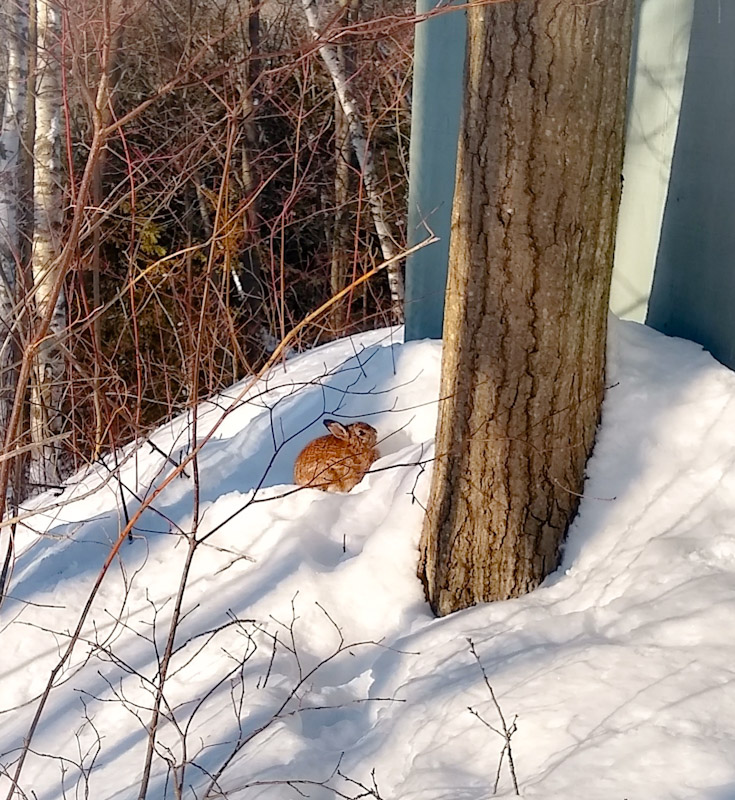
Scrappy is still with us! The little bunny from the summer with the chunk out of his ear. Scrappy has always been a little “off” — perhaps from the scrap when he lost part of his ear? — but he keeps on keeping on. He’s made a snow fort by our shed. There’s a bunny diameter hole in the snow directly ahead of him where he can secret himself away. But during the day he sits out in the sun like a furry stone. Then come evening, he makes bunny runs between the dogwoods.
The other day we had a couple of friends over to snowshoe our woods. As we passed, Scrappy darted into his hole. But when it’s just Neil and I, he stays where he is. Seems like the recognition may run both ways… And if Scrappy feels comfortable staying in stone-mode with us, I am deeply flattered.
~Kate
Footnote: We call Scrappy “he”, though they might well be a she. In the summer Scrappy kept company with another rabbit Neil christened “Scrapulet”. However they roll, they are most welcome here.
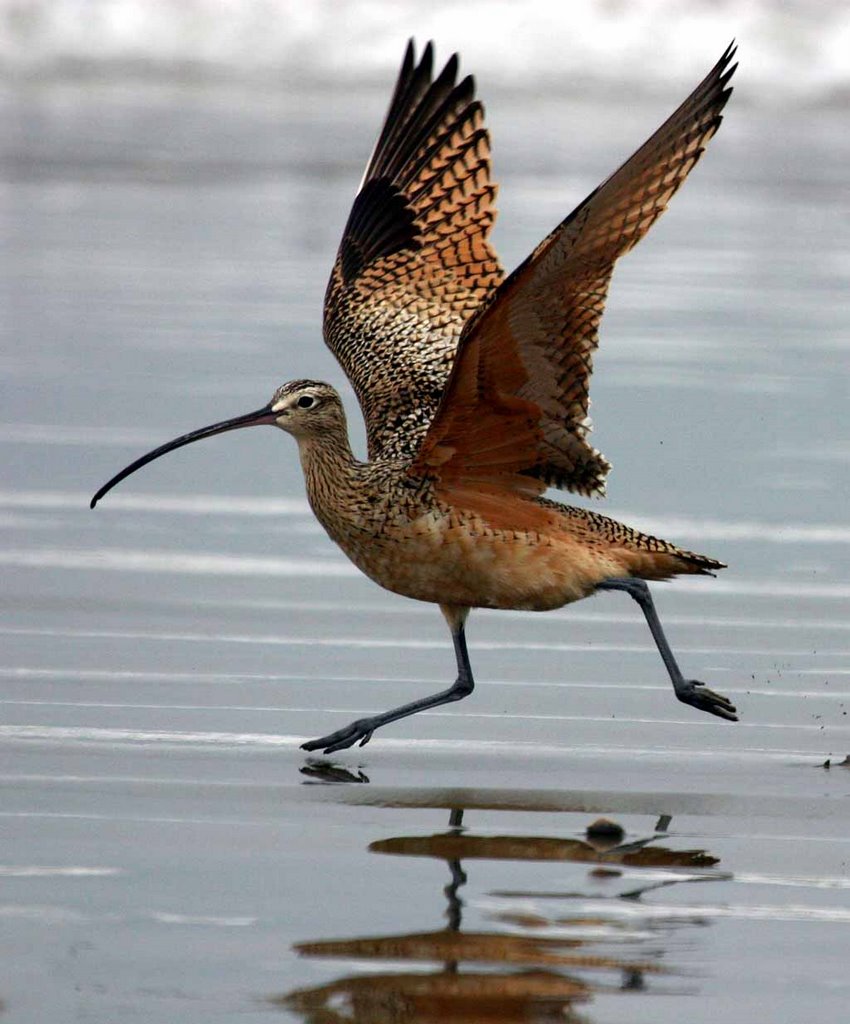
…the Long-billed Curlew protects its territory with a variety of moves, one of which is “Concealment,” in which it runs towards its opponent, then “suddenly flops down in grass, disappearing from view.” The opponent looks around, perplexed, until the defender springs up and advances aggressively, then drops and hides again. I am going to try this on my next zoom meeting.
~Rosemary Mosco. From her excellent newsletter, “Flight Club“
“… It’s here that I’ve begun to feel wonder again. Like when I was a kid. And this makes me deeply happy. I wish I could say ‘Thank You’, just so, straight into the universe.”
Before work this morning, I took a lap of the woods. My thoughts often label a walk like that a “constitutional”. That’s how I think of a walk when I don’t plan to linger, but to clear my head for the rest of the day’s work. Often when I go to the woods, I am happy to fill my mind with new thoughts. But a constitutional is when I am looking to empty it.
I don’t think I’ve heard that word much since childhood, when it was already the language of grandpas, scholars, and other persons sporting leather elbow patches on their jackets, and a smart walking cane. These were people who knew the value of a good constitutional. Keep the joints limber, the air fresh, and the mind open.
My thoughts were definitely elsewhere, my mind open and drifting, when I realized the path I was walking on had fresh prints on it. Fresh prints with five toes!
Perhaps I could let one or two thoughts in… People with leather elbow patches also know the wisdom of not missing out on the present.
I always get a little extra excited when I see prints with five toes, front and back. My heart often wishes to see fishers, or other mustelids. But tracking is all about seeing not what you want to see, but what is there. It’s a good frame of mind to hold on to for the rest of the day.
Most of the tracks were very faint. The ground was “noisy” and there wasn’t much new snow fall. But there was enough to follow for long enough to get a clearer view. My gut had been whispering the tracks were not behaving in a weasely way. And my gut and brain agreed with each other when I came across the clearer tracks. Raccoons walk in a funny gait where their hind feet end up swinging up alongside their front feet. They roll their hips while they walk, so the hind foot leaves a mark beside the opposite front foot. (It’s a fun gait to try and imitate, as a human.) When I came across a set of prints like that, my brain tumbled over to the better ID: I was following raccoon tracks.
These tracks are closer to a gallop than a walk, with the tracks more spread out.
I usually remember raccoon prints best by thinking of the front foot as leaving a mark like a small human hand, and the hind foot as leaving a mark like a small human foot. Not so different you and I, my procyon friend. With your little human-ish tracks, your nimble hands, and your inquisitive nature. Thanks for joining me this morning; I enjoyed following in your footsteps.
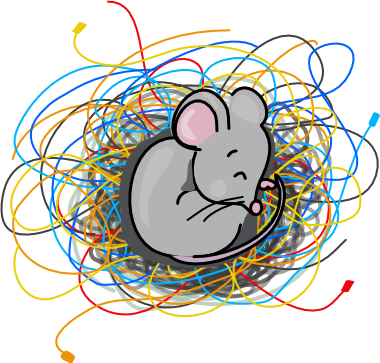
We’ve had no internet for about a week now. The Bell technician who came out today traced the problem to its source – a mouse nest in the cable box. This is not the first time a mouse has made its house somewhere unfortunate. Last year our mechanic made a similar discovery under the hood of our car. Shelter is shelter.
As a little girl, one of my favourite Christmas stories was about a wee churchmouse, retconned into the story of Silent Night. The tale imagined that Silent Night was composed by Franz Gruber on guitar because the organ was broken – its leathers chewed by the hungry mouse.
Mouse nests are part of the texture of our world now, living nestled in the woods. It’s a fluffy ephemeral texture. The nests we find are lightweight and constructed from all sorts of different materials, yet somehow always distinctly mouse-house-ish.
Stacks of firewood make particularly good places to build mouse houses. My winter fuel is your habitat. I can see it. Neatly stacked wood is not so different from my log cabin. I imagine a jumble of telephone wires looks similarly suitable. It’s usually halfway there after all. Even before it’s been rearranged to suit a rodent, we humans call a tangle of wires a “nest”. Its mousey potential is that evident.
It’s inevitable that mice will get into the nooks and crannies of the human-constructed world. Mice are small and they are multiple. But I wouldn’t want to be in a universe without them. They may nibble cables and carry Lyme disease, but mice are also good food for fox. We’ve yet to have a fox try to get into our hen house, but there is lots of evidence that they regularly help themselves to the abundant local mouse population. The mice are welcome here too in their own role as predator, a natural check on LDD (“gypsy”) moth populations — mice enjoy feasting on LDD pupae.
“When we try to pick out anything by itself, we find it hitched to everything else in the Universe.”
~John Muir
Living as we do, thick in the 21st century, most of our work is done online. And despite our extensive and ever-growing book-based library, many of our references are online as well. So having no internet is pretty inconvenient. But in our case it is not life threatening, and even pleasant from time to time. I am no different from the rest of my species: it’s too easy for me to spend too much time scurrying around the web. I can fall down an internet or social media rabbithole with the best of them, and it doesn’t always bring out the best in me. A pause is welcome. I may or may not spend the time composing songs on guitar, but I am happy to have a few silent nights.