Categories
fauna thinking big tracks & scat

Snow Stories: Shrew-d Observations?

Knock knock, who’s there?

For each question I answer in the woods, five more appear. “Solved” tracks are surrounded by stories I haven’t read, and some where I don’t even know the language. I am getting better at recognizing animal tracks and sign. I can usually narrow things down so we’re at least pointed in a helpful direction. But I have so much to learn. If I have the shapes, do I have the movements, if I have the movements, do I have the “when”… It goes on and on forever. I know that I will never be done learning, and that is fine with me. I hope I will never be done learning. I love to solve a puzzle, and work a problem. But I have no illusions the puzzles will ever end. The only constant is change. Besides, as John Hodgman said, “beginnings are really the only happy endings”.
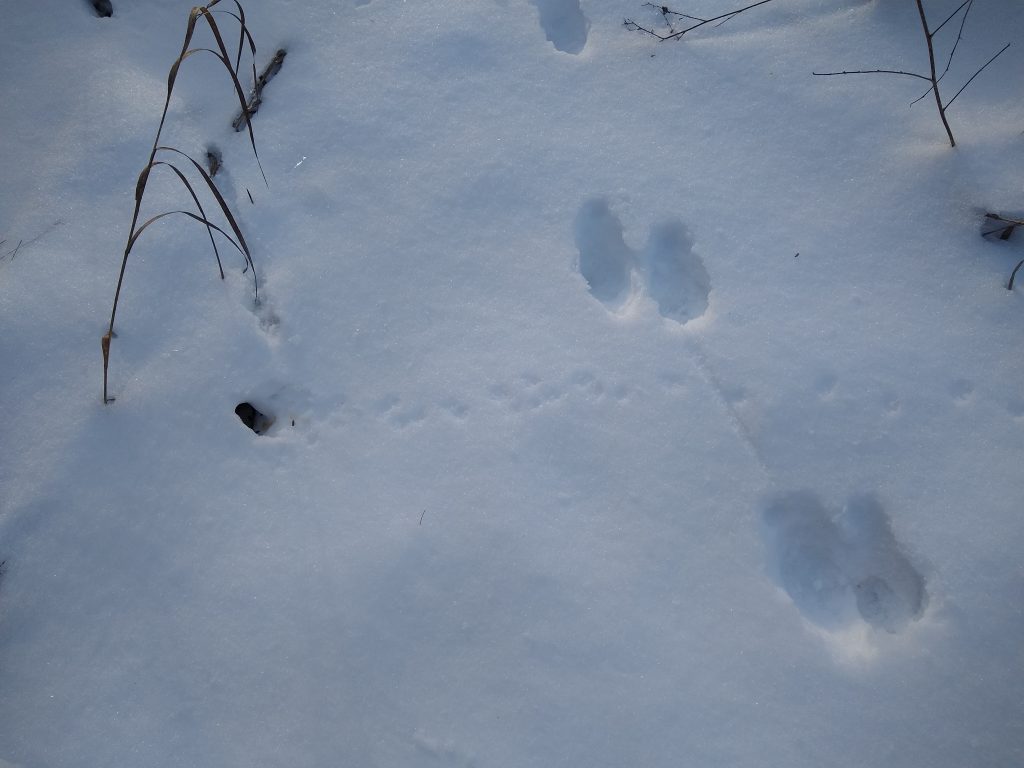
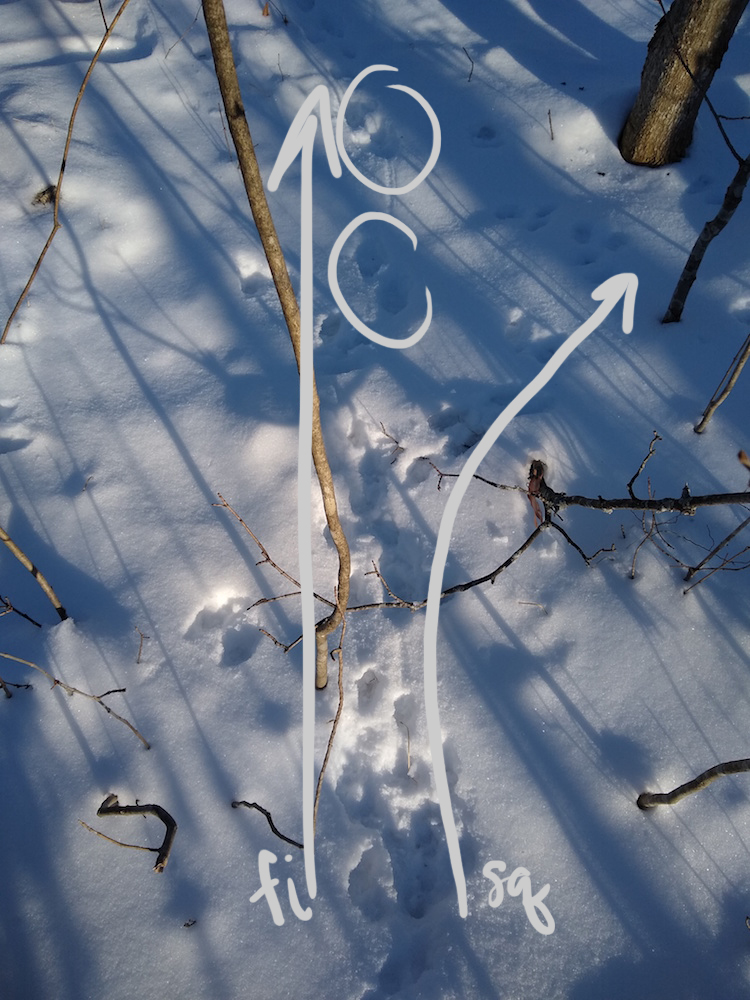
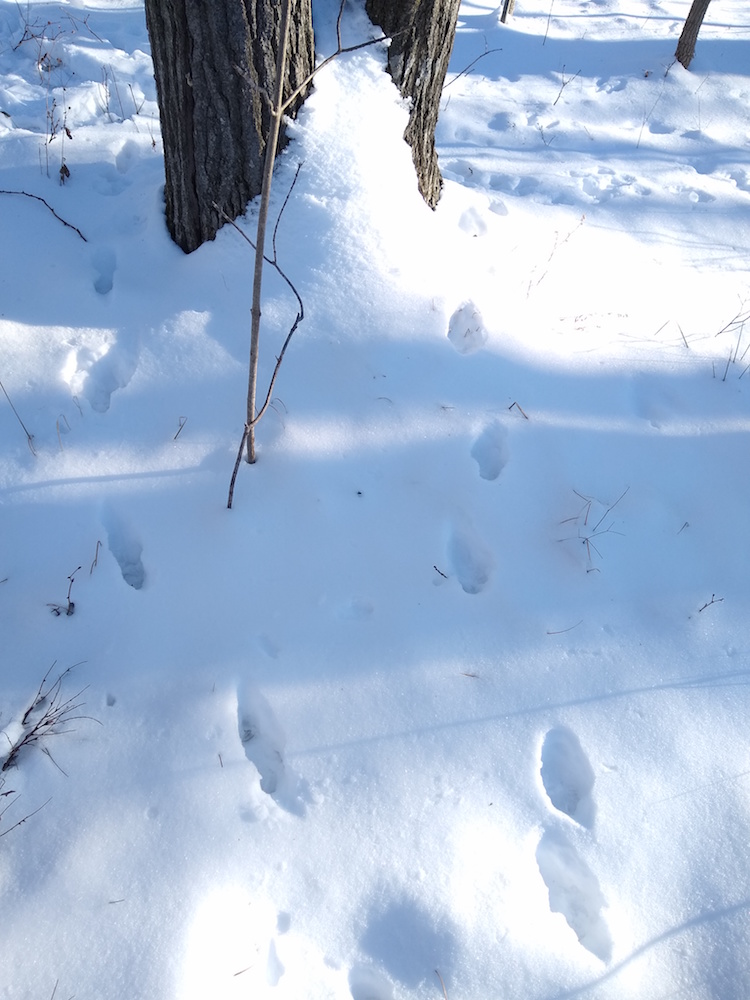
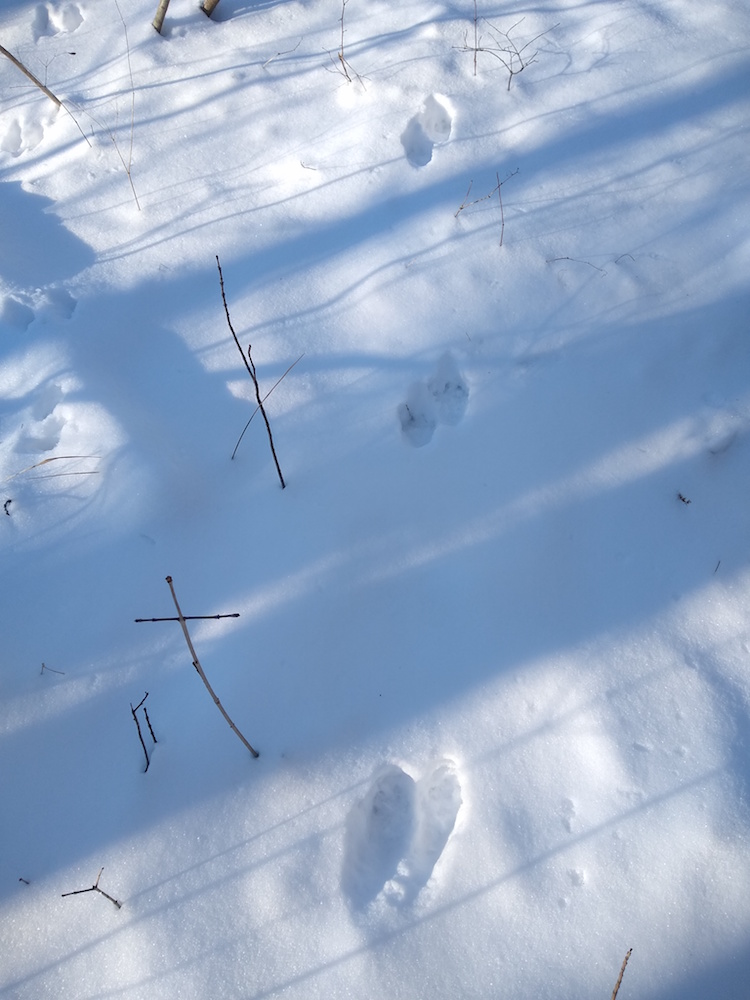
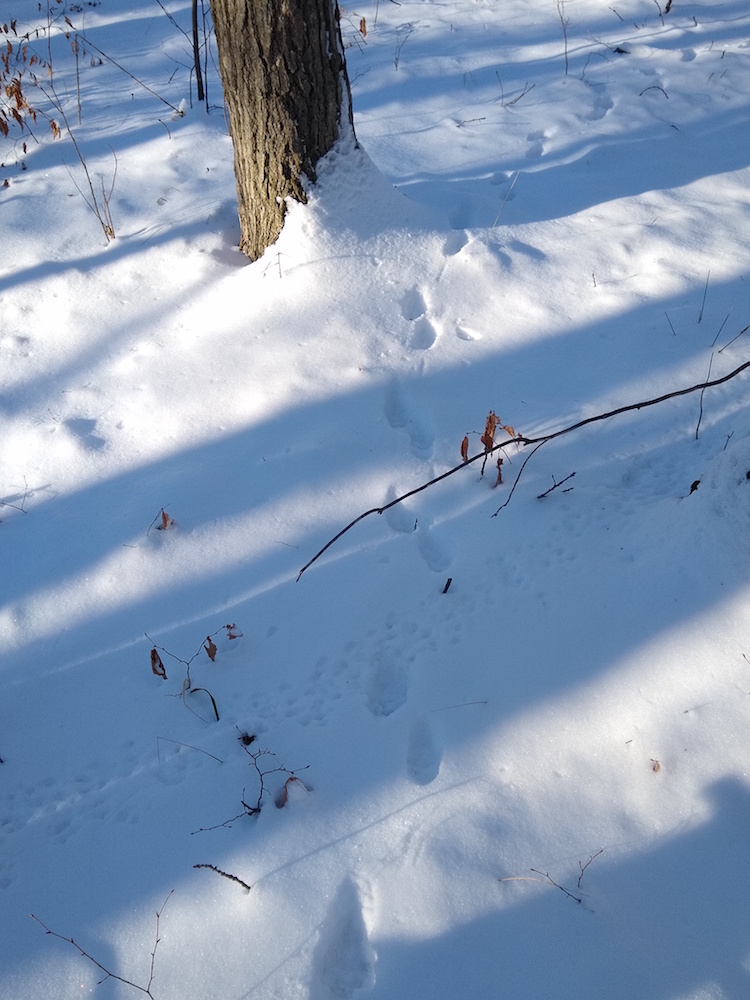
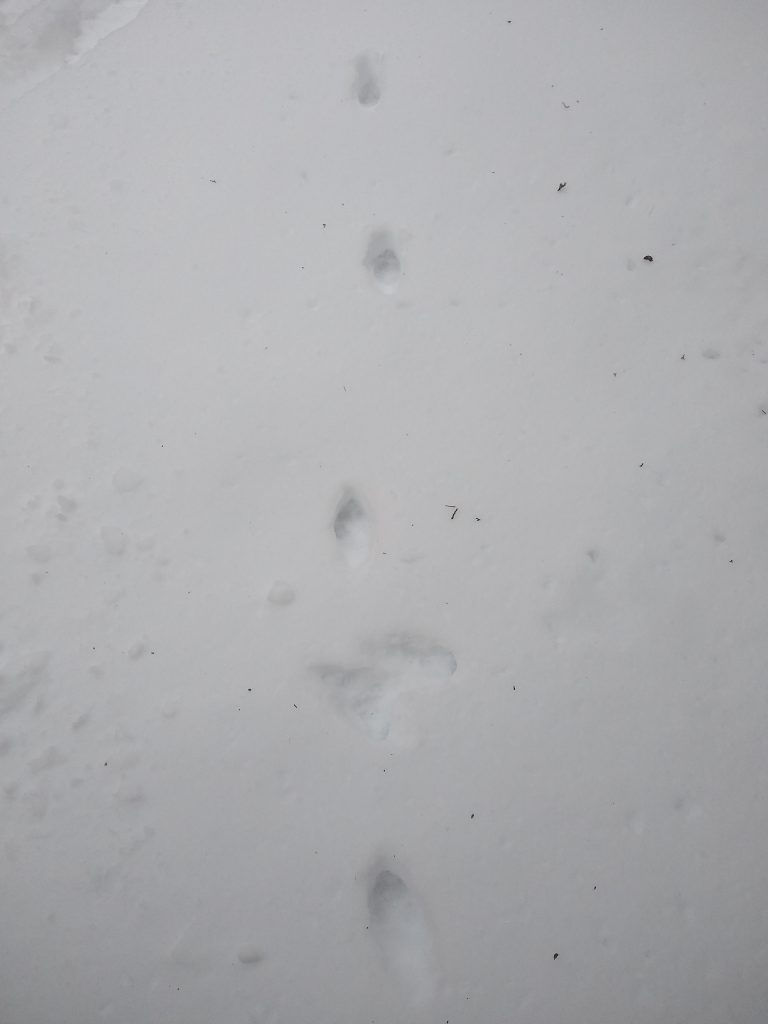
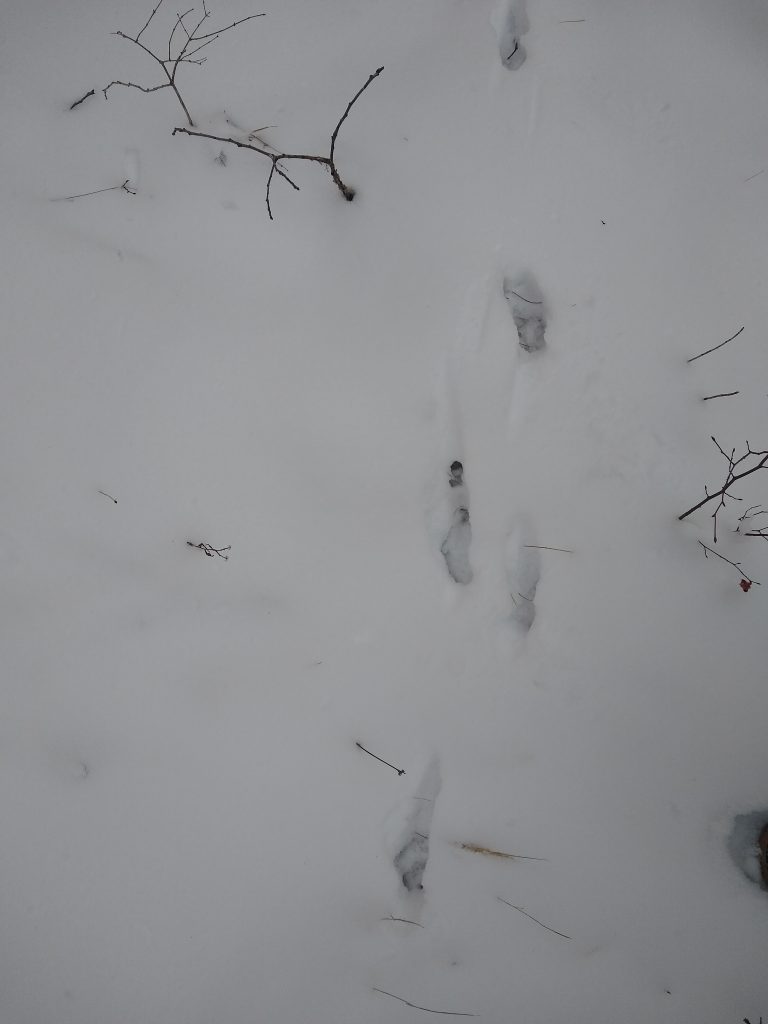
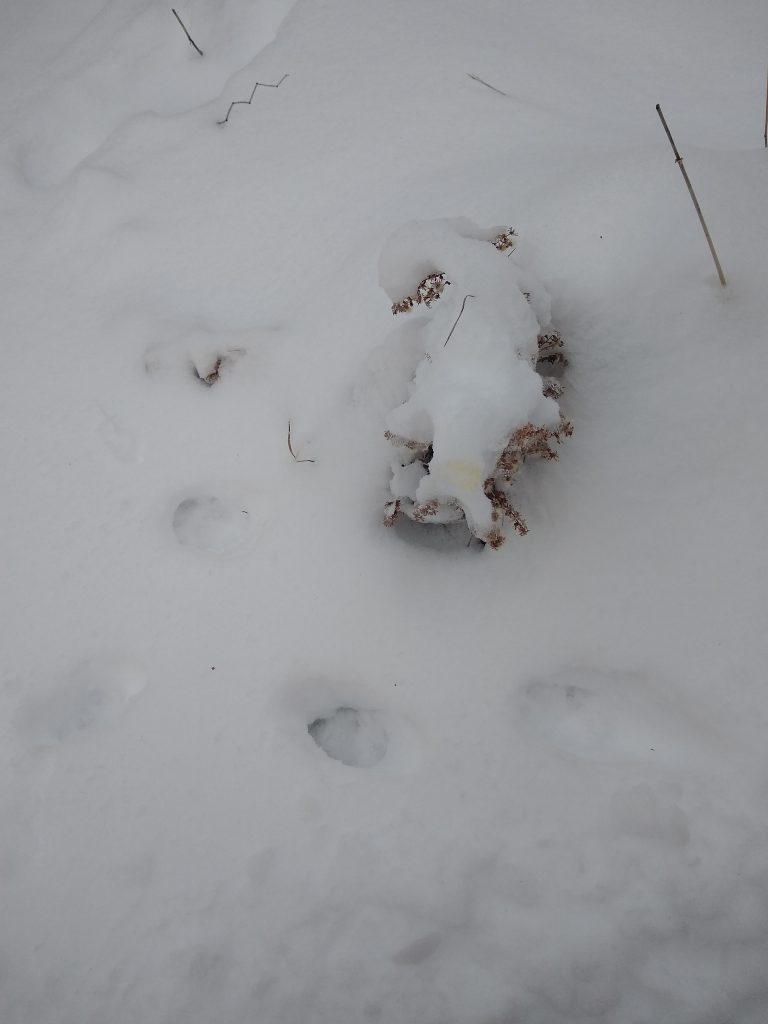
The large tracks are fox, and the small tracks crossing the path are from our mystery critter.

I did an undergraduate degree in Philosophy, with extra attention to the History and Philosophy of Science and Technology. Philosophy is not where I started off in school, but it is where I ended up. Because philosophy contained the most “whys”.

Philosophy let me dip my toes in the most worlds. I could study advertising and environmental ethics. Nuclear bombs and modern symbolic logic. Darwin and art and how the brain works and it was all the same degree.

That’s a little explanation for my love of the “why”. It runs wide and deep. Why is this here. Why is it this shape, in this place, at this time. In tracking I am always skating between the known and the unknown. Being curious, and being methodical. Confidently working the puzzle, but reigning myself in if/when I get too rash or brash. Keeping an eye on my assumptions. Not thinking I have all the answers, but not getting so stuck in the questions that I can’t move forward.

Here is a short piece of an unfinished story. One of so many unanswered whys.
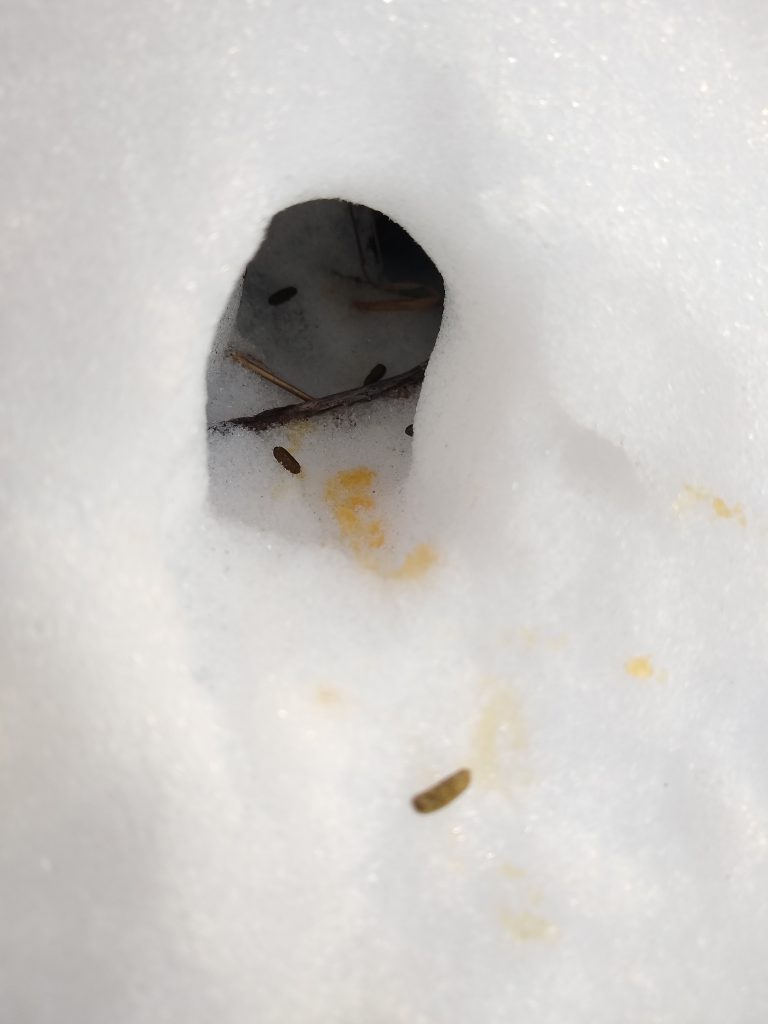
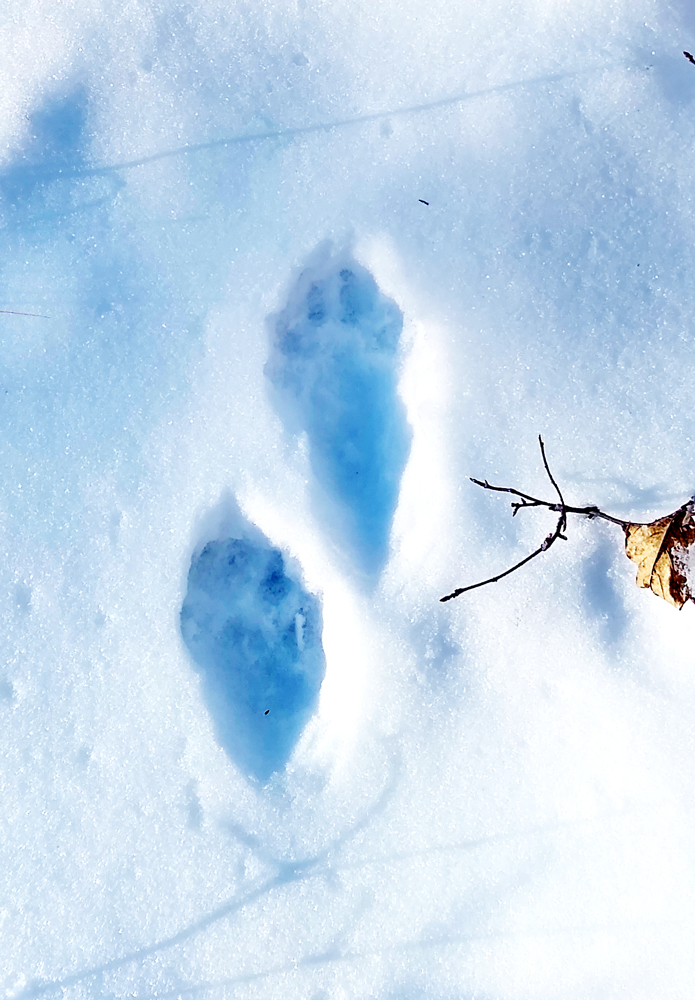
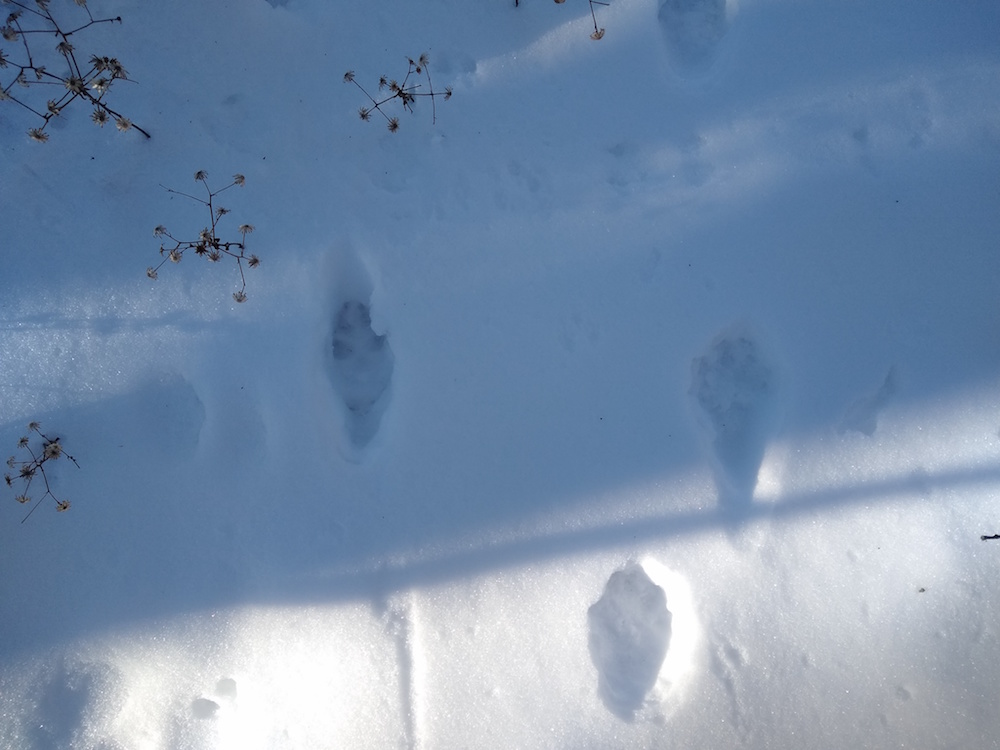
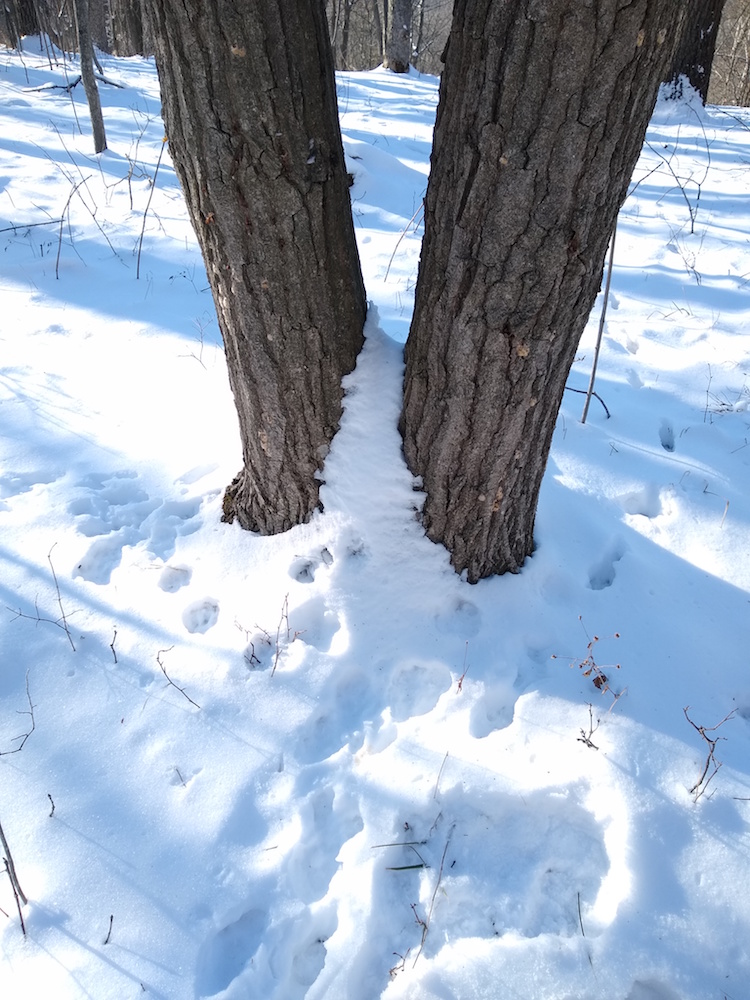
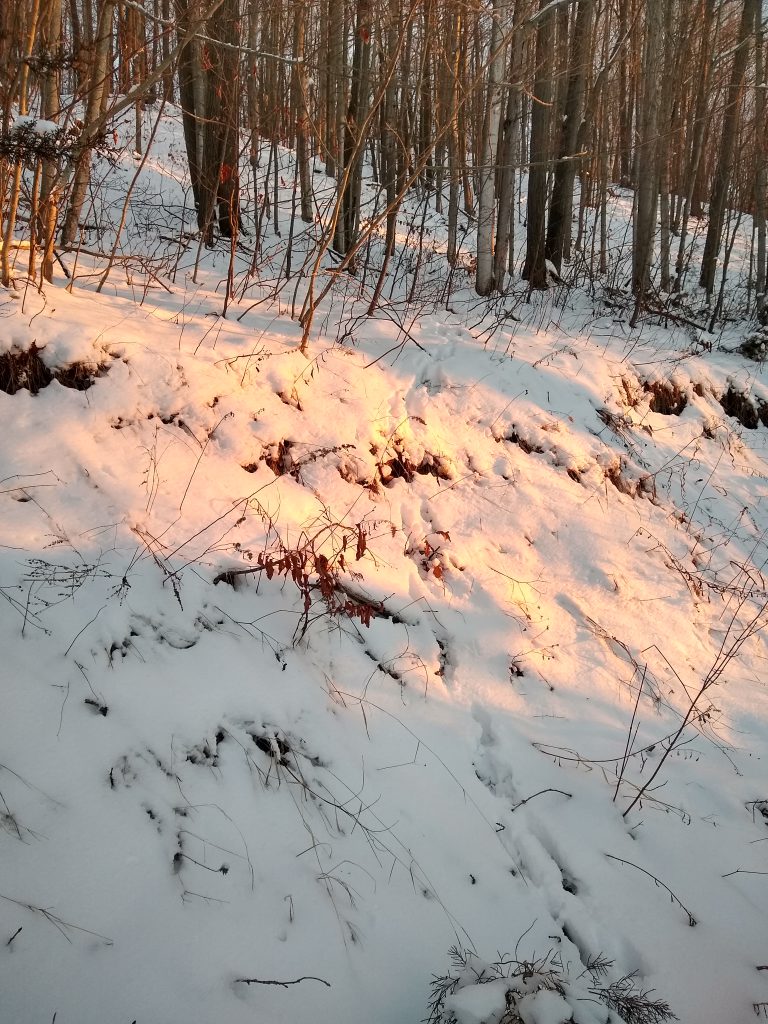
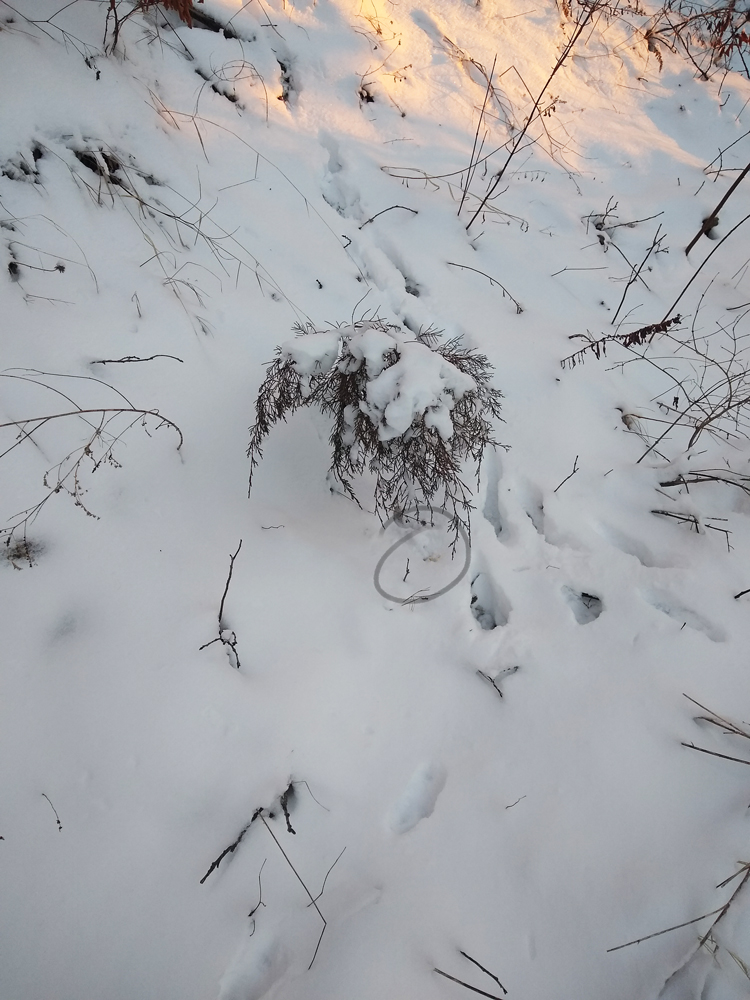
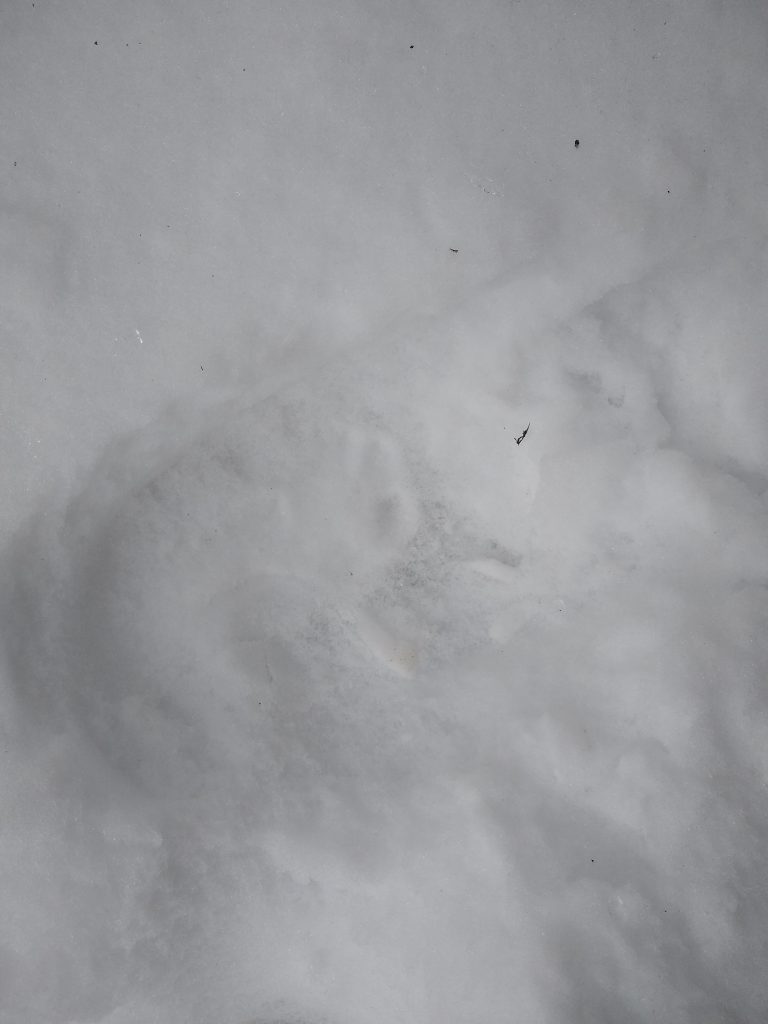
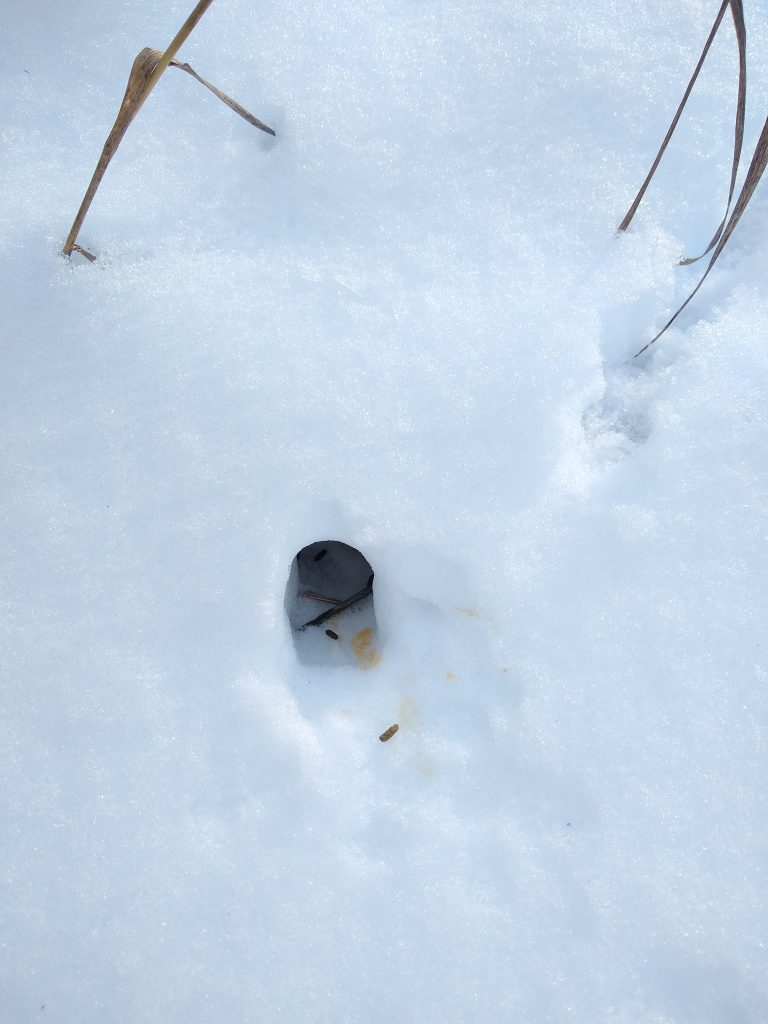
I came across this opening in the snow the other day. It is a small opening, in a grassy part of our property. I found it while following fox tracks, and was surprised by what I saw. Though it seemed to be a little hole for a little rodent, the fox tracks didn’t even seem to pause. Mice make up a good sized part of a fox’s winter diet. So why had this fox gone right past this hole?

Perhaps it hadn’t. Though both tracks had been made since the last snowfall, perhaps it was at different enough times that one wasn’t aware of the other. But also… why was there scat and urine at the opening of the hole? Isn’t that a bit, well, brazen? In a world so affected by smells, so full of critters who can and do literally sniff you out, why would you leave such a signpost on your doorstep?: “Here there be noms.”

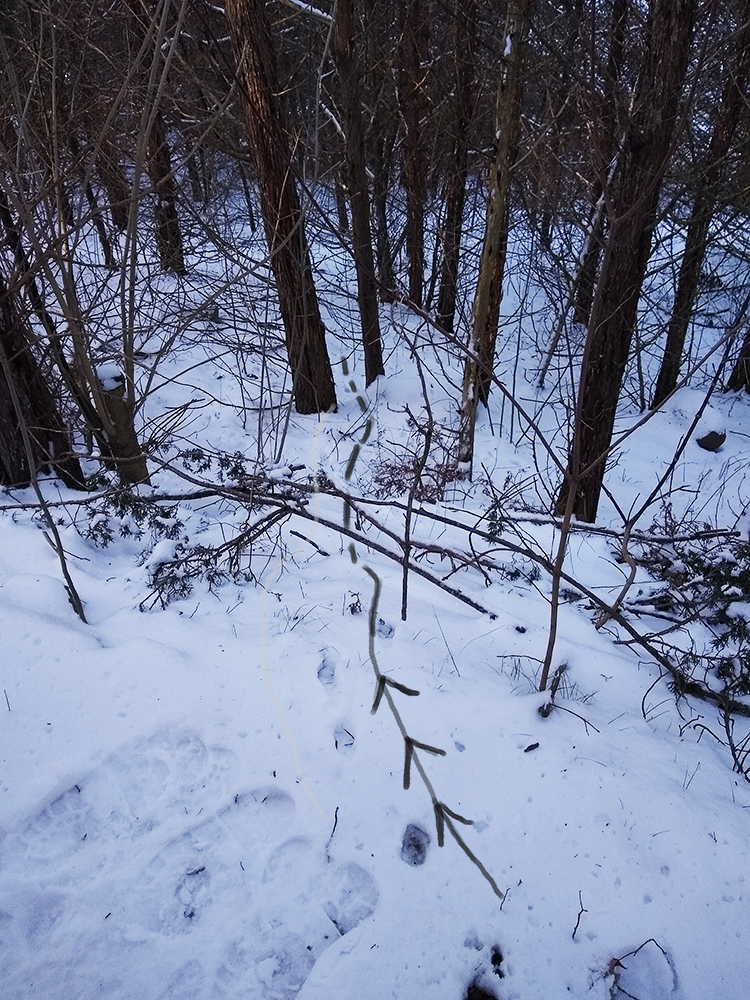
I am not yet able to tell the difference between the tracks of shrew/vole/mice, unless there is some “gimme” to make it obvious. Like these wonderful gimme tracks in our woods, where the mouse very kindly left clear tails print in the snow.
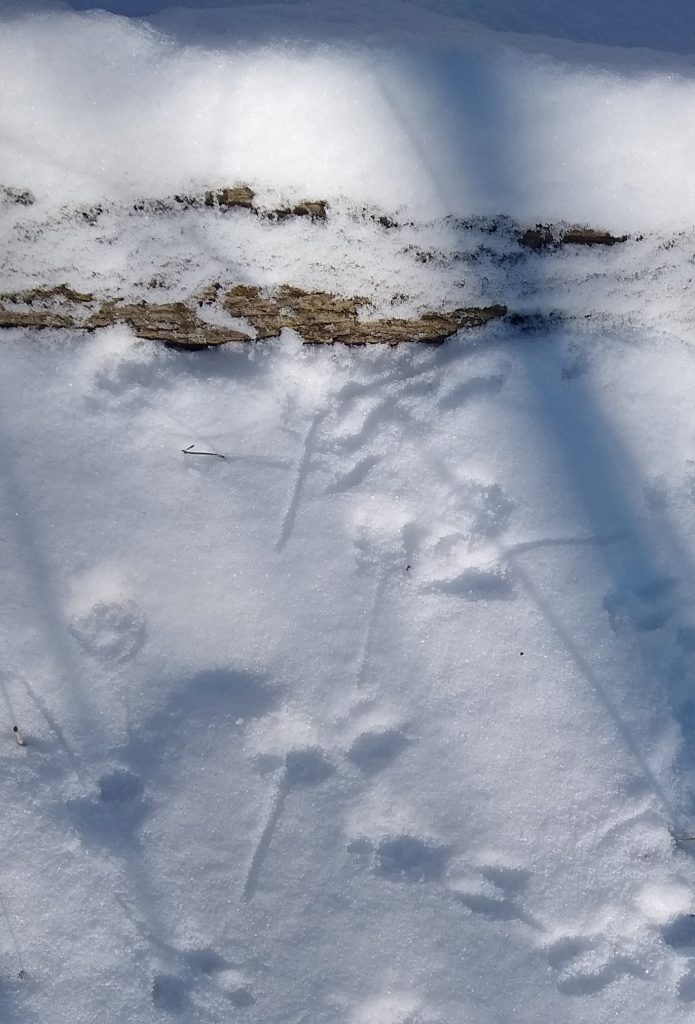
So. Dang. Cute.

As I said, we have mice and voles and shrews here (at least). They each leave slightly different tracks and sign. For my money, this scat and tracks were a bit different than a mouse’s. Pushing us more into vole/shrew territory. Or some other wee rodent/insectivore I did not think to think of.

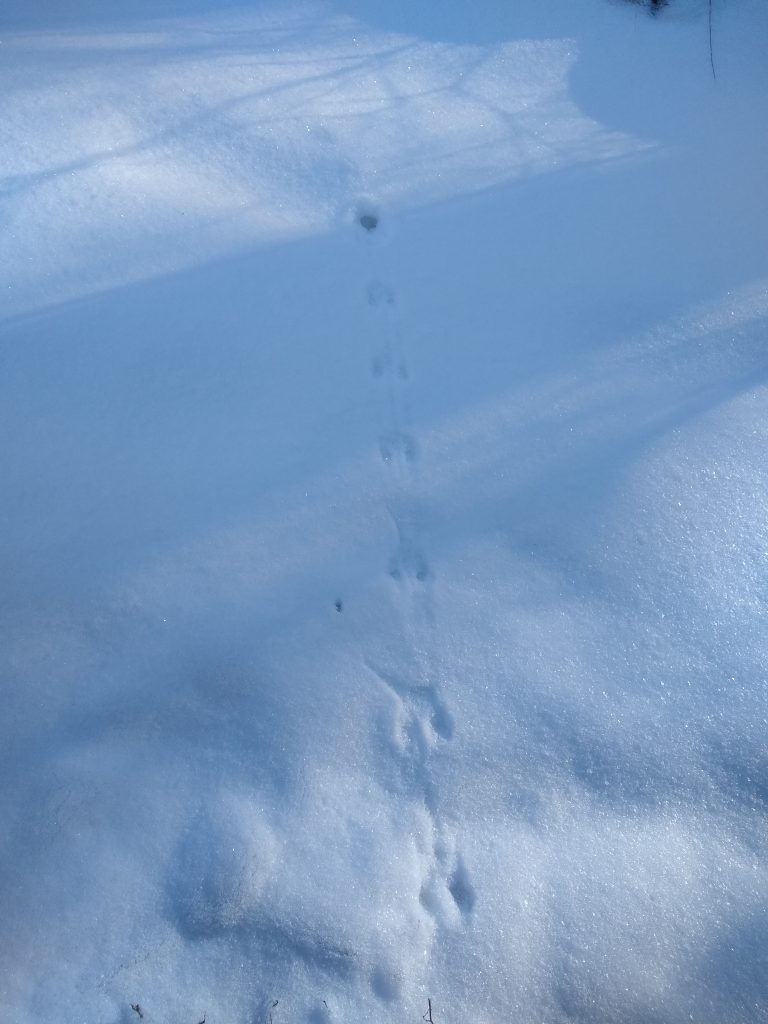
Maybe, I thought, maybe the fox walked past because it didn’t want what was in that hole. And maybe there is a reason the critter who made the hole wasn’t too worried about being found?

Shrews are small insectivores. They are similar in size and shape to mice, except with more of an anteater-style snout. They look a bit like a mouse that got its face stuck in a vaccuum cleaner. One day while out for a walk, I found a dead shrew in our woods. Specfically, and importantly, I found a killed but uneaten shrew in the woods. Before I learned more about shrews, I wondered why on earth critters would pass up a morsel of protein like that?

As is often the case, it’s because the critters knew more than I did. Apparently shrews don’t taste very good. They produce a potent venom in their saliva, making them one of those rare beasts: a venomous mammal. Though foxes and other animals will kill and sometimes eat them, they’re not first on everyone’s menu. And apparently that bite hurts. (Yes, even for us humans. Shrews are best left untamed.)

Like I said, I don’t have an answer for this particular puzzle. It might be a shrew, it might not. We just have some pieces and plenty of “whys”.

Alongside the “whys”, here are a few things we do know:

  • the scat was left, along with what appears to be urine, at an opening to a tunnel
  • the tunnel appears to be in the “subnivean” layer. Literally meaning “under snow”, subnivean is the area above the surface of the ground and below the surface of the snow. Mice, voles, and shrews all use this layer as winter habitat. (Once, on a a truly magical winter walk, I walked past a snowy spot where I heard some scurrying around. Still one of my favourite memories.)
  • Though the timing is a mystery to me, both this creature and a fox used the same area. Either the fox went through and then the little critter moved in, or the little critter was already there when the fox went through.

What happened when, and what that critter was… I don’t yet have an answer. I could have dug into the tunnel to try and find out who lived there, some trackers do. But my curiousity has limits, and digging up another critters’ home, to satisfy an idle “why”, is on the other side of them.

T.S. Eliot wrote:

“We shall not cease from exploration
And the end of all our exploring
Will be to arrive where we started
And know the place for the first time.”

I’ve always enjoyed that poem. But I think this short stanza is too long to happen within a human’s life. We’ll never meet the end of our exploring. The place is too rich, too full of mysteries, too full of whys. I’ll go back to where I started, and I will know the place a little better. But the exploring, that never ends.

Categories
fauna tracks & scat

Snow Stories: Fowl Play

So many snow stories in the stack! But we’ll go in reverse order this time — even if there are some shrew-d observations and im-possum-ble sightings that came before this one.

Today, tale of turkeys. Though not the *tail* of turkeys, just their footprints.

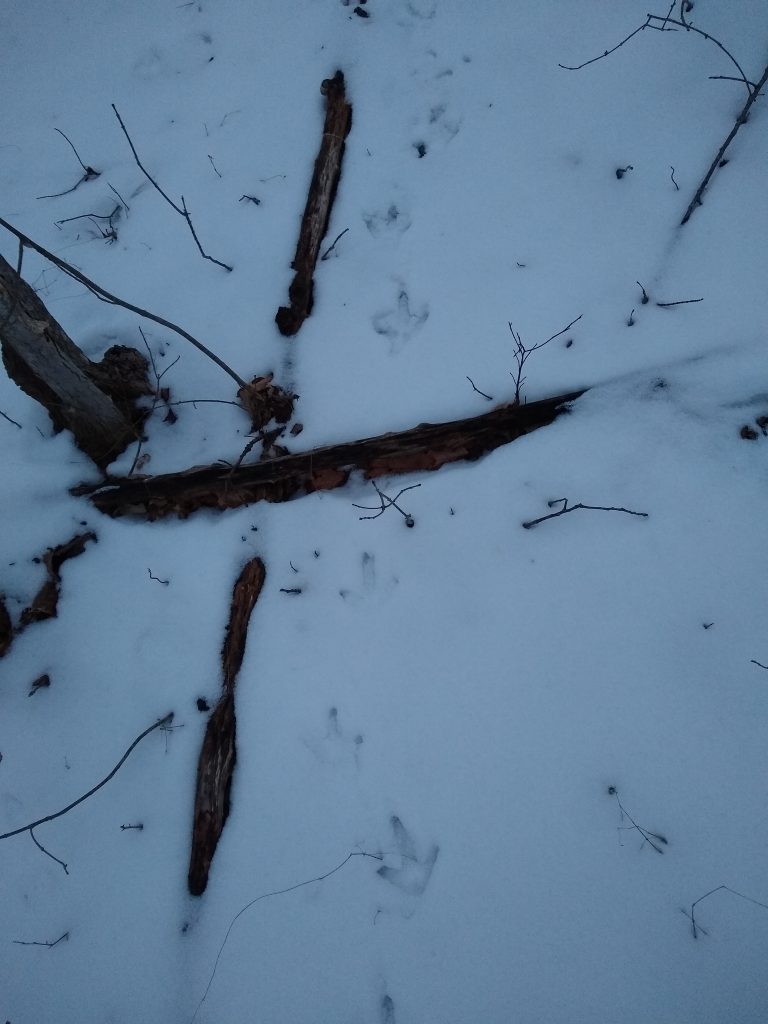
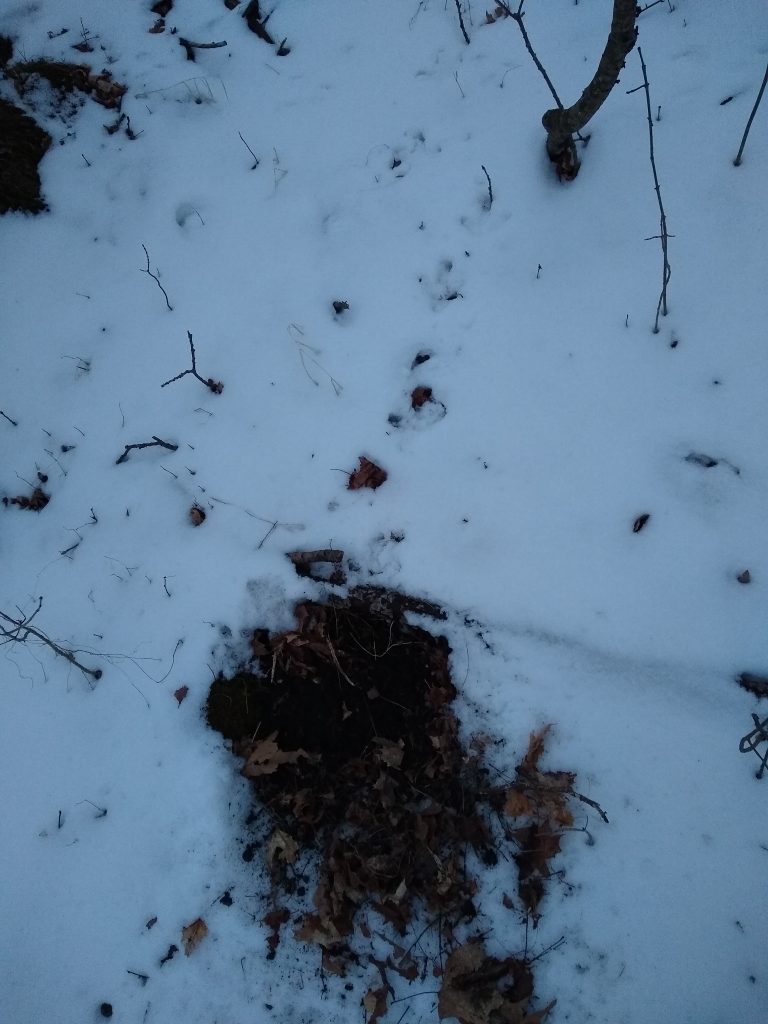
I’ve seen what I believed to be turkey sign in the woods a few times over the past weeks, before there was snow. Sizable areas of ground that had been thoroughly scratched up. But without tracks, I couldn’t be certain. There was one day where I found turkey scat inside the scratched patch, so that one was pretty conclusive, but the rest were conjecture. I love turkeys, and always like to see confirmation that they are around.

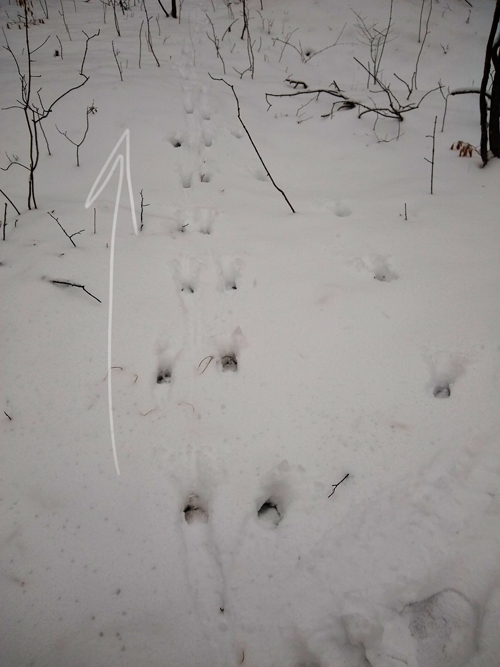
Scratched ground from turkey foraging at bottom of the image, tracks leading away up top.

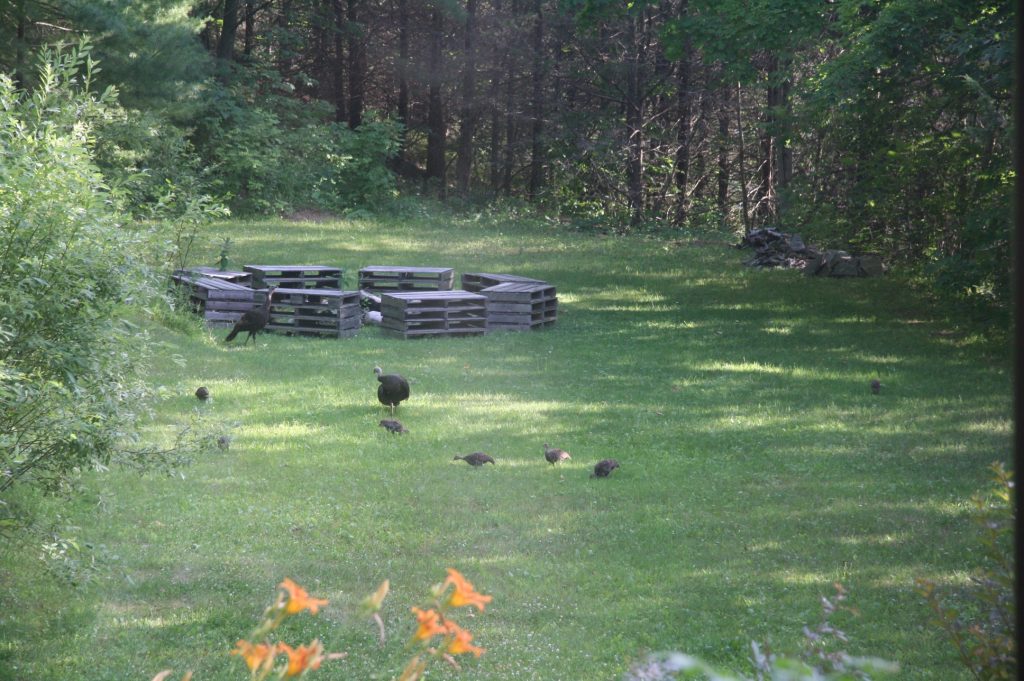
Our first summer here we had a little turkey family who would pass through our yard like clockwork every evening. A bundle of baby turkeys, trundling through the yard alongside their adult protectors. It happened over a few weeks, and we got to watch those goofy little turnips growing up before our eyes.

Another summer, we had a large tom come and take advantage of a sand pile we keep in the yard near our firepit — he used it to have a truly epic dust bath. If you thought it was enjoyable to watch a tiny silkie chicken enjoying a dirt bath, you should see a tom going to town for his spa-day.

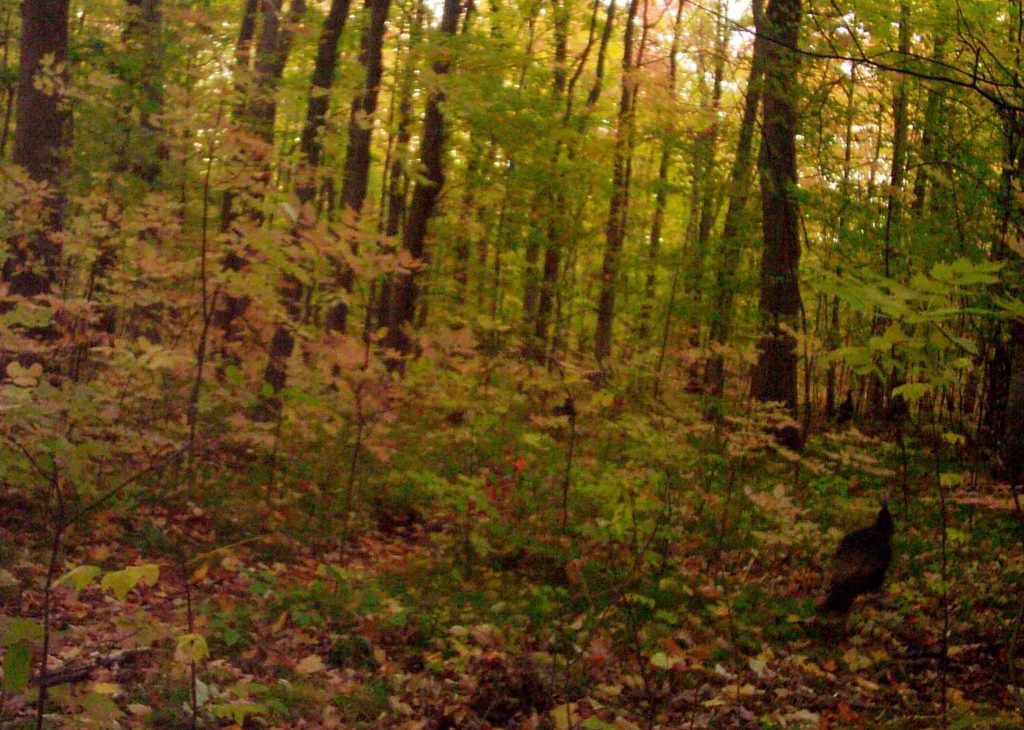
Our trail camera has managed to record turkeys in our woods a few times. Unlike the savvy fox and the skittish deer, turkeys give fewer bleeps. When we’re up there at the same time as a flock, and see them in person, they make a noise I think of as a turkey clearing its throat, and then everyone just walks a little faster and in the opposite direction to us.

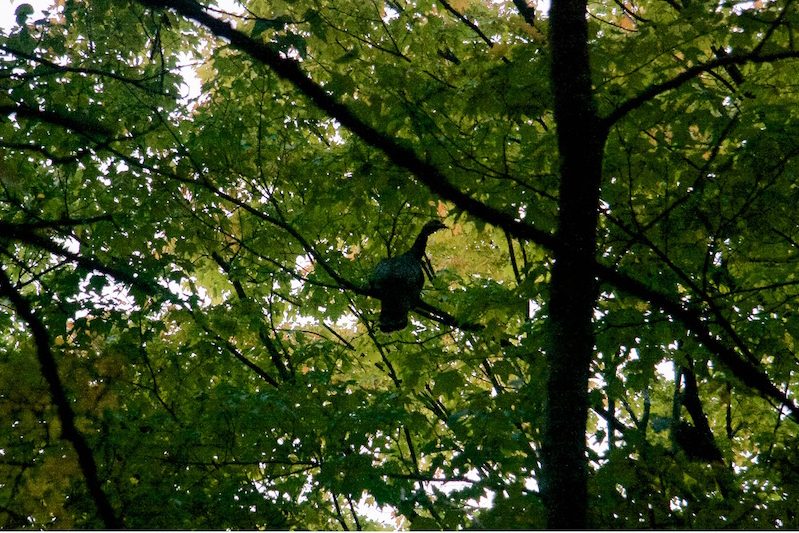
From the trail camera, around 7:30AM on an October morning. There are at least two turkeys in this photo… see them both?

As I said, I love wild turkeys. Much like the chickens, I love that they have their own turkey agendas and they are just getting on with it. They have places to be and things to do.

Besides their overall temperment and interesting looks, here are three specific things I enjoy about turkeys: (1) you can tell the sex of a wild turkey from the shape of their poops; (2) they roost in trees; and closely related to 2, (3) wild turkeys can fly.

I don’t know why it took me until adulthood to learn that turkeys can fly. If you’ve only known “meat birds”, it’s a pretty easy fact to miss. The poultry we breed for eating has been thoroughly messed with. We alter not only their diet and the environment we force them to live in, but also the fundamentals of their biology. We’re so focused on forcing them to grow large amounts of breast meat, that a bird who should be capable of flight is grounded for the whole of its life, all for a larger portion of meat at Thanksgiving. Ugh.

How I learnt wild turkeys can fly, and that they roost in trees (don’t worry I’ll circle back to the poop bit) happened in an incomparably magical way. On YouTube one day, I stumbled across a video of turkeys taking flight, and was gobsmacked. The very next day, I went for a walk in our woods, and saw turkeys take off from our walking path and roost for the night in our trees. Now that is an immersive learning experience.

Though they don’t roost there anymore (that I know of), there were a number of evenings when if I went for a walk at dusk, and looked closely, I could spot turkeys tucking themselves into high branches for the night. For such large birds, they are surprisingly difficult to spot once they are still! Watching a wild bird settle into the branches of a tree for the night settles your soul.

Sweet dreams.

On turkeys’ more rambunctious side, I had another extremely memorable encounter, on one of those S’Marchy days in the seasonal borderlands between late winter and early spring. I was standing in our yard, making maple syrup. I heard some kerfuffling on the hillside, and looked up to see a gang of turkeys turkeying through the woods, headed my way. While I was recording them… well, see for yourself!

I like to think that turkey was trying to give me a high-five.

Last but not least, let’s talk poop. Scat is such an important part of tracking, and it’s wonderful to learn some of its right-in-plain-sight secrets.

Male and female turkeys leave different shaped deposits of poop behind. Male turkeys, “toms”, produce scat that is more of an “I” or “J” shape, while female turkeys, “hens”, poop more of a coiled or shapeless mass. It all has to do with their plumbing.

Here is a very good description of why:

“The quirk of clumping results from the fact that turkeys, like many birds, expel their droppings from a multi-functional orifice also used for reproduction. Separation of the terminal ends of their genital and digestive tracts just isn’t their thing. And that a one-stop shop is called a cloaca.

In female turkeys, the droppings exit the large intestine into the cloaca. Because this little corridor is large and stretchy (remember, it fits around their eggs as well), the droppings can curl and clump before finally exiting.

Male turkeys have a rudimentary phallus in their cloacas located near the tail end of their digestive tract. That means less space for the droppings on their way out — no wiggle room for coiling.

Why don’t all birds show this kind of sex-specific poop shape? In other species, like chickens, the males’ genitalia are further reduced, so their poops are less distinctive.”

~ “Turd Tales“, Discover Magazine

The more you know!

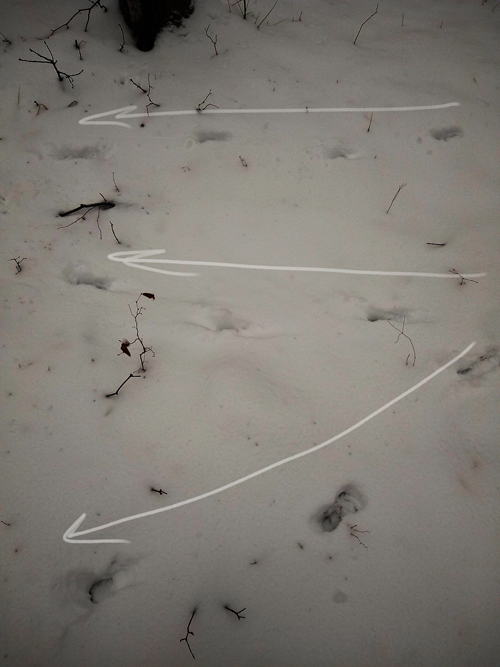
So was it a tom or a hen’s track I was following in the snow, rummaging around the floor of our woods? Well here’s the “evidence” below. I bet you can tell for yourselves now, turkey trackers!

Categories
fauna tracks & scat

Snow Stories: “Gone Fisher-ing”

Well who is this friend?

The tracks I see most often in our woods are canid. A mix of fox and coyote. Well, the tracks I see most often are probably squirrels (eastern grey). But sorry little guys, while I enjoy observing your trails, I rarely spend much time trying to parse them. Rarely… though not never. As we’ll get to in a moment…

The outlier I’m always delighted to see are the mustelids: the weasel family. In particular, fishers. The mega-weasel. I see their tracks infrequently, and it is such a treat when I do. I love that there are fishers on our property.

This is a wildly unpopular opinion. But popularity is rarely my litmus test for worthiness.

My full rant is too long and too, well, rant-y, to insert here, but let’s just say there is no animal I give people a pass to villanize. It is too flat a vision of the world, too often rooted in a mix of ignorance, hearsay, and assumptions. There is no animal that deserves to be outright demonized for being destructive or taking more than it needs — and as humans we better take a dang hard at ourselves before laying down that judgement.

I nearly missed the fisher tracks this time — even though the fisher crossed the full width of the woods… twice. It was only in half-noticing that one of the squirrel tracks intersecting our main trail looked a bit extra “busy” that I discovered there was a fisher track mixed in. (See above: Ignore the squirrel tracks at your peril.) Larger five-toed* prints mixed in with the little squirrel ones. It was a galloping fisher! (*Note: the littlest toe often does not show up in fisher tracks.) Since I was sticking to our trail, and the fisher wasn’t, I nearly missed it.

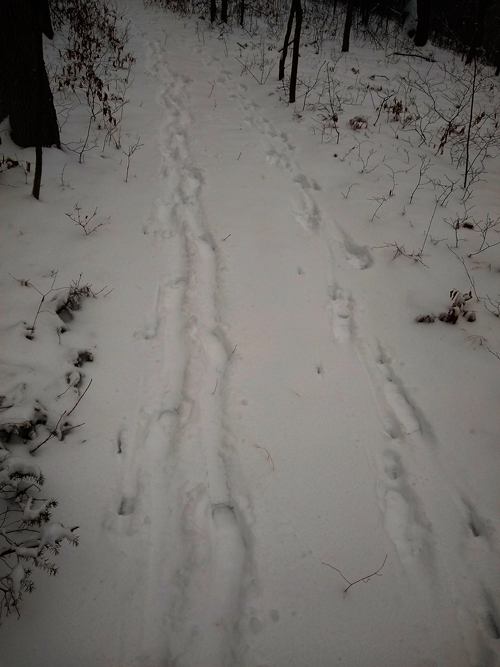
Though I am not very good at working out the timing of a track, I still enjoy seeing the synchronicities. Below you see two visitors to our woods walking in parallel. I don’t yet know enough to know how long ago the tracks were made, or who walked through first, but side-by-side is how they lie now: a fox and a fisher, walking the woods together.

Here’s more of an aerial view so you can see everyone’s toes.

Fox at left, fisher at right.

And here, in one of my favourite bits of the track, a single tree is encircled — initially walking in the same path towards it, the fox goes around to one side, and the fisher to the other. Two roads diverged.

Fisher at left, fox at right.

Only to meet up again on the other side.

Fox at left, fisher at right.

Fishers are a good size, and have some fairly distinct gaits that show up pretty clearly in our woods. But in addition to the tracks themselves, there are the other cues to watch for. There is what the track looks like, its dimensions and spacings etc, but also where it’s going, and how it’s going there.

Galloping fisher

Following coyote here, I most often find they cross the property in fairly straight lines — often with another coyote a little ways off, walking roughly in parallel. The foxes go reasonably straight, but are also pretty likely to go exploring. Their trails wander more than the coyotes, the trail is often marked with their distinct scent, and I’ve found sign of them “tightrope walking” on fallen logs a number of times.
Check out that busy little rodent highway crossing the fisher tracks (the stippled snow on a diagonal)

As for fisher, I (literally) feel the pattern before I notice it — walking with my head down, I keep bumping my shoulders on trees. What seems to be a reasonably direct path is actually playing connect-the-dots: the fisher is choosing a path that moves from tree to tree. Fishers are great climbers, and squirrels are a major part of their diet. The fisher version of checking the fridge…

Take life one tree at a time fisher friend. See you again sometime.

Categories
fauna tracks & scat

Snow Stories: “You’re Invisible, But I’ll Eat You Anyway.”

I went for a walk with a fox yesterday.

Not at the same time of course. He* was long gone by the time I followed in his footsteps. (*I am calling the fox “he” for a reason, which I will get to.) But Neil and I often chat about how spending time with animal sign feels like time with the animal. Perhaps because you are so focused on its fox-ness. Everything but this fox is quiet. You are tracking this fox’s steps. Wondering what this fox was doing. When was he here and where was he going. Okay, he went here, and then here, but then where…. a-ha! over here.

It is a tremendous thrill for me to see the animals who live in or pass through our woods while they are actually in front of me. But what I love about tracks and sign is that I truly feel like I can take a lot of time “with” an animal, without disrupting it. I am not spooking its prey, or jeopardizing its chance at dinner. I am not causing it to waste precious foraged energy running from or avoiding me. It doesn’t need to worry about protecting its young from me. We can be together, apart. A healthy respect for the wild-ness of both its life, and mine.

They are not brethren, they are not underlings: they are other nations, caught with ourselves in the net of life and time, fellow prisoners of the splendour and travail of the earth.”

~Henry Breston

This fox started his visit to our home with a stop for a snack. He came down from the woods via a slope behind our house. The slope is a sort of overgrown garden that we still haven’t fully figured out. Perhaps it once had more form, but I believe it is mostly there as a berm, defending the house from the pressure of the hillside — being situated on a wooded hillside can put an awful lot of (literal) pressure on a house.

The “garden” slope has lots of brush and grasses, which I’m sure are full of all manner of things for a fox to munch on.

The fox, I believe, agreed.

Below is his first stop. A depression in the snow beside a grassy opening makes me think he stopped for awhile to hunt a mouse. Which is the inspiration for this post’s title — lifted from this fasinating article by NPR, exploring how foxes hunt (hint: it may have something to do with magnetics!), which is well worth a read.

Based on an extra footfall, and the indistinct shapes within the prints, I believe the fox then retraced his steps a bit, before continuing on.

Either just before or just after his meal, the fox marked his trail. Under this little cedar was a splash of pee. Usually it is not until I find urine with this distinct foxy scent, that I will confidently switch from “canid” to fox. As is often the case, I was initially following these tracks in roughly reverse order. So I was following “canid” tracks for quite awhile.

After the shrubbery was good and marked, the fox was off again.

From the “garden”, the fox moved on towards the driveway, making another marking pitstop along the way. Here is where I decided the fox was likely a “he”, based on the position of the feet and urine. Both male (dog) and female (vixen) fox will scent mark, though males are much more likely to cock their leg when they do so.

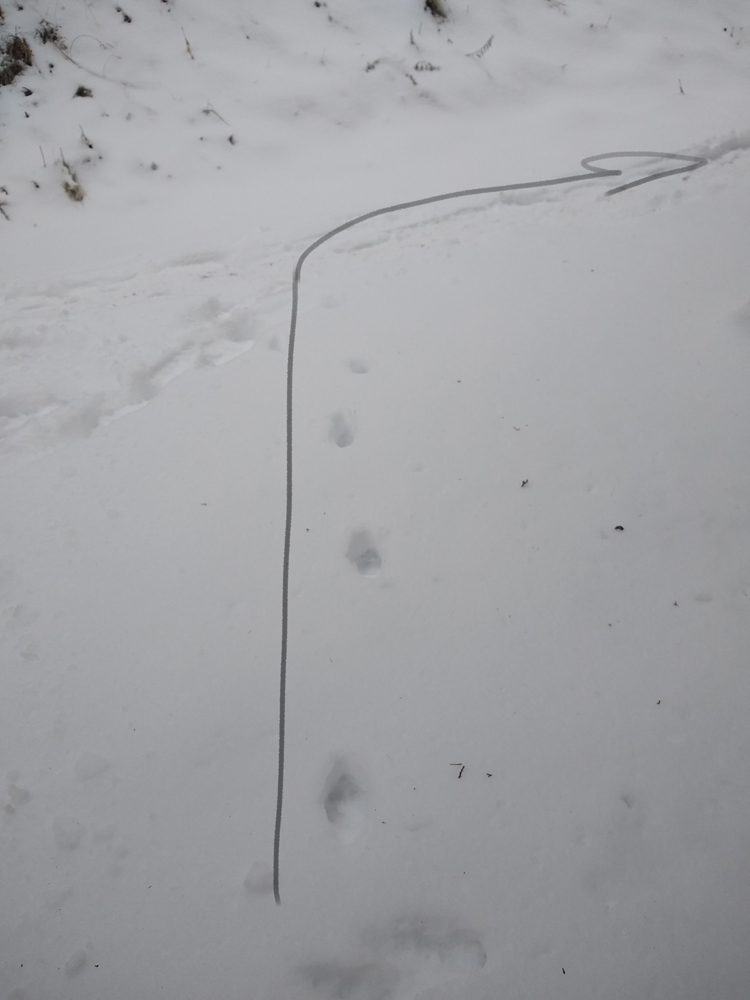
The fox went down our driveway a little ways, before I lost the trail. I then picked up a trail coming back up our driveway, on the other side. I believe this to be the same fox, based in part that we have seen fox do this in real time — they seem to think of “partway down our driveway” as some sort of boundary line …or at least as far as they get before they remember they wanted to check out our yard as well.

Some of the tracks coming back up the driveway were harder to find. There is a lot of “noise” at the top of the driveway. Plow marks, tire tracks, bootprints, and all the various activity under the birdfeeders. Can you spot the fox track in the bootprint below?

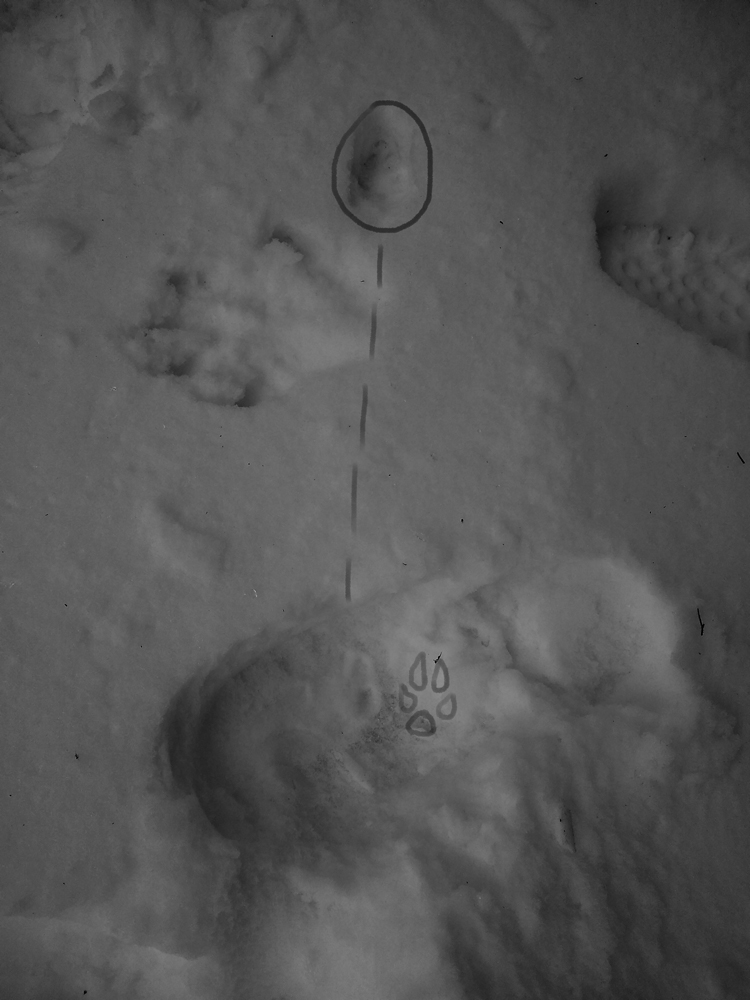
It’s right in the centre of the bootprint, with the toes aiming at the top of the image.

How about now? Sometimes using the spacing from a nearby track can help you find a hard to see print.

Enhancing the photograph to make the print more visible helps as well. 😉 But that’s not really an in-field tool (though I guess it could be…).

The fox then went behind the front garden, around the car tent, over to our walking path through the backyard. When they come through the yard, animals often follow our bootprints, and it’s a bit incredible how well their tracks can disappear into our trail.

Finally the fox went behind the chicken run (note: the chickens are just fine), before trotting away down the lower hillside, into the coniferous woods. There look to be many tracks down there, and perhaps I will go read some of those stories another day.

I hope you got your invisible mouse, little fox. And I hope to see you again soon.

Categories
fauna tracks & scat

Snow Stories: Just the tracks, deer.

The first of the real snowfalls last week. Which means the official start of one of my favourite seasons — tracking! When I get to go read the stories left behind in the snow, from all the critters who wander in the woods, while I’m being a human in our house.

While I can be a patient person, it would be a stretch to say it’s my default setting. Though I am reasonably good at waiting until the snow has actually finished falling before I go looking for tracks. Reasonably.

Worth the wait.

Not far along our main walking loop, I found deer tracks intersecting the trail.

How many deer do you see?

I love animal tracking for a host of reasons, but one is that it can be an exercise in reason. I once received a good piece of advice for drawing, which has proven useful in many areas of life: “Try to see what is there, not what you want to be there.”

I visit the woods to try and read the stories that are held by the snow, but I want to practice seeing what is actually there, not what I expect to find. That said, creativity and empathy are very useful tools in the tracking toolkit. Imagining what an animal might be experiencing, how it thinks, and what its motivations are, may help you follow its path.

While my brain might leap to all sorts of conclusions about what’s in front of it, I am most effective when I stop to separate the idea wheat from the chaff. I can form theories about the tracks I find, but I won’t hold on to them too tightly until I see corroborating sign.

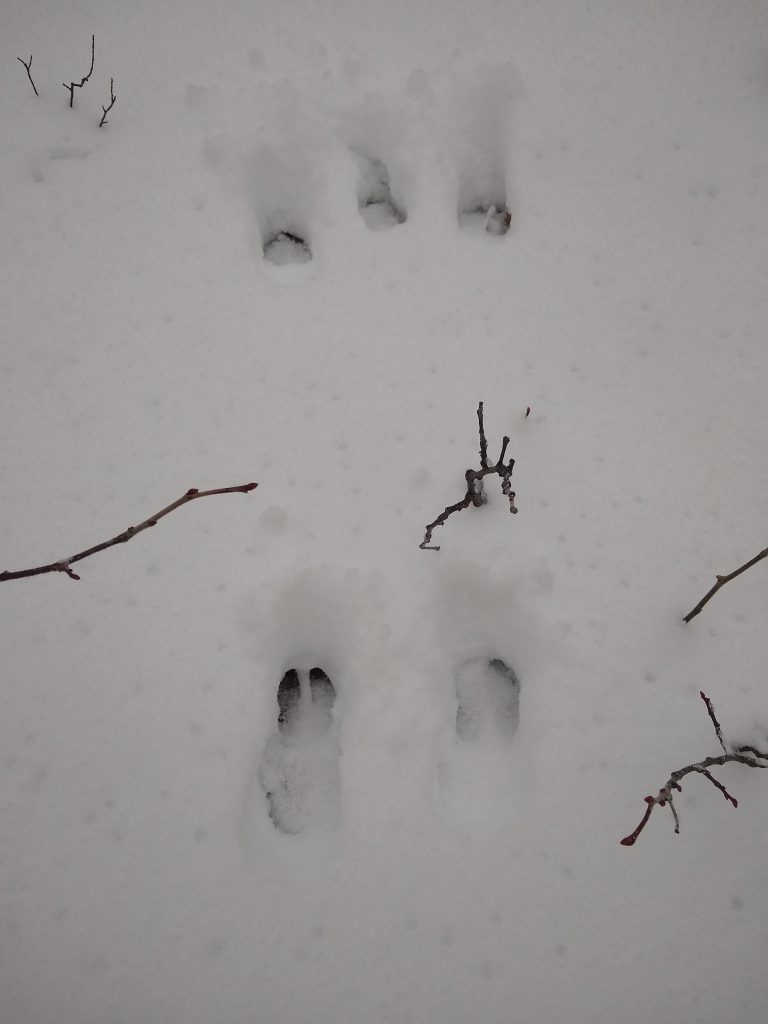
In the photo above, there are tracks from three separate deer. There is a deer gait called a “pronk” or “stot” which results in a 2×2 pattern, which could theoretically explain the tracks on the left. But the spacing is wrong, and it also wouldn’t fit with the rest of the “story” — the tracks at right appear to have been made around the same time, but with a very different gait. I followed the tracks though until I found more clear sign that this was the story of not two but three deer.

Three tracks running parallel, travelling R to L — you can see the middle and lowest tracks diverging at the right of the photo.

I was nearly at the other end of our property when I found the first split, but there it was — the tracks separated out and divided clearly into three separate paths.

Here is what I feel pretty confident I read in the snow that day:

  • I was following the tracks of 3 deer, one notably larger than the other two.
  • The deer travelled through our woods sometime after 1:30PM on Saturday Jan 2nd, and before ~12PM on Sunday Jan 3. I based this on having walked the same area on the Saturday without seeing tracks, and that the tracks I found on Sunday early afternoon were partially filled with the snowfall that began midday. (Meaning the tracks had been made before the new snow began falling.)
  • The larger deer was much more likely to walk a little apart from the other two, which stuck very close to each other’s path.
  • The deer were aware of the route Neil and I had taken the day before, often following our steps. We often joke that we have to go up to the woods and do a lap after a snowfall, to open the trail up for the wildlife.
  • The deer entered our property from our neighbour to the east. They roughly followed the path on the southern edge of our woods, but they turned off the path to follow Neil’s trail — where he went the day before, to go look closer at the bark of a tree.
  • They traversed diagonally from Neil’s tree bark pitstop over to the western walking path, where they followed our footsteps until nearly back up at the north edge, when they turned and headed back east — crossing back into the neighbour’s woods.
Above are my tracks on the left, and Neil’s on the right. I am a little shorter than Neil, and scuff more. There are deer tracks mixed in.

For a long section, the deer followed the footprints on the western trail which Neil and I had left the day before. The deer occassionally switched sides, moving between my (left) and Neil’s (right) footprints. The two smaller deer mostly walked together. Below you can see one of the spots where the three distinct tracks separate, as they switch between which of our footprints they will follow.

Five tracks diverged in a snowy woods

Below is where the deer left our property, to go back into the woods of our neighbour to the east. This was actually where I began tracking, I followed the deer’s trail opposite to the direction they had been walking.

You can also see “neighbour sign” here — he has driven a lap of his woods since the last snowfall.

In collecting data, you see what you see, but you can also see what you don’t see. And what is in the negative space may be as interesting and informative as what’s in front of you.

Here are a few of the things I saw that I did not see:

  • The deer did not stop moving while on our property. They appeared to walk continuously without pausing to eat, rest, or investigate while they were here.
  • The deer were not “spooked” during their walk. Their gait did not change; they maintained a steady walk the entire time.
  • The deer did not appear to urinate or defecate while on the property.
  • The deer did not continue to follow the trail for its full loop. They turned relatively abruptly off the open double-wide walking trail to cut through the woods instead, and cross back over to our eastern neighbour’s property. They were very near the top of the hill when they turned, which is probably the area in the woods which smells the most like us — it’s where we arrive when we drive up in Evie, the EV.

Each walk when I see tracks is many walks in one. My own, and those of each of the animals I am following. The walks that preceded mine, though sometimes literally following in my footsteps. Stories all around. It can have quite a lot to say up there, even when it’s quiet.

There is a phrase — “soft fascination” — to describe the particular restful state we experience when we observe nature. My mind is more active while tracking than it is while softly fascinated by birds in the trees, or summertime ants busily doing ant things. Perhaps it is “actively quiet”.

How long was I up in the woods? I don’t know, I tend to lose track of time in my active quietness… but perhaps I could measure the depth of snowfall on my hat to find out. 🙂

Happy trails folks!