Categories
birbs homestead Uncategorized

The Poetry of Nest Building

Off to work…
//
This spring’s Nests-We-Know-About:

* 2 chickadee families in bird houses
* 2 nuthatch families in tree cavities
* 1 robin nesting under an eave
* 1 phoebe nesting on the house (predated)

And every year I discover new nests in the fall that I completely missed all spring. The birds raise their babies right under my nose and I am none the wiser. It’s wonderful. Keep your secrets little birds.

I love glimpsing the work that goes into nest building. The flights to and from the mud after a good rain. Snatching fur from the stash we leave out in a suet cage. Twigs and needles and caverns in trees. As many kinds of nests as there are kinds of birds.

I have a book — “The Birder’s Handbook” by Ehrlich, Dobkin and Wheye — that dives into the details of birds’ domestic lives. And descriptions of all the different kinds of nests reads like lines of poetry:

“Bed of soft bark shreds, hair…
Hammocklike cup beneath loose bark, of moss…
Often near or over stream; of bud scales, lichen on exterior, bound with spider’s silk…
Also in cave or hollow stump…
Lined with fine dark rootlets…
Lined with plant down, insect cocoons,
Concealed at base of tree, a deep hollow, with preened feathers.”

(Nests of White-breasted Nuthatch, Brown Creeper, Ruby-throated Hummingbird, Turkey Vulture, Wood Thrush, Black-capped Chickadee, Ruffed Grouse respectively)

Have a good Friday folks
//
: I did not make the log birdhouse in the photo. I picked it up one day a couple of years ago while biking to Knuckle Down Farm for my veggies. There is a roadside stand of them on Rosebush Rd just west of Glen Ross. As if you needed another reason to visit Knuckle Down. 🙂
Categories
art D-I-Why Not flora gardening homestead wild inklings

Fresh Asparagus

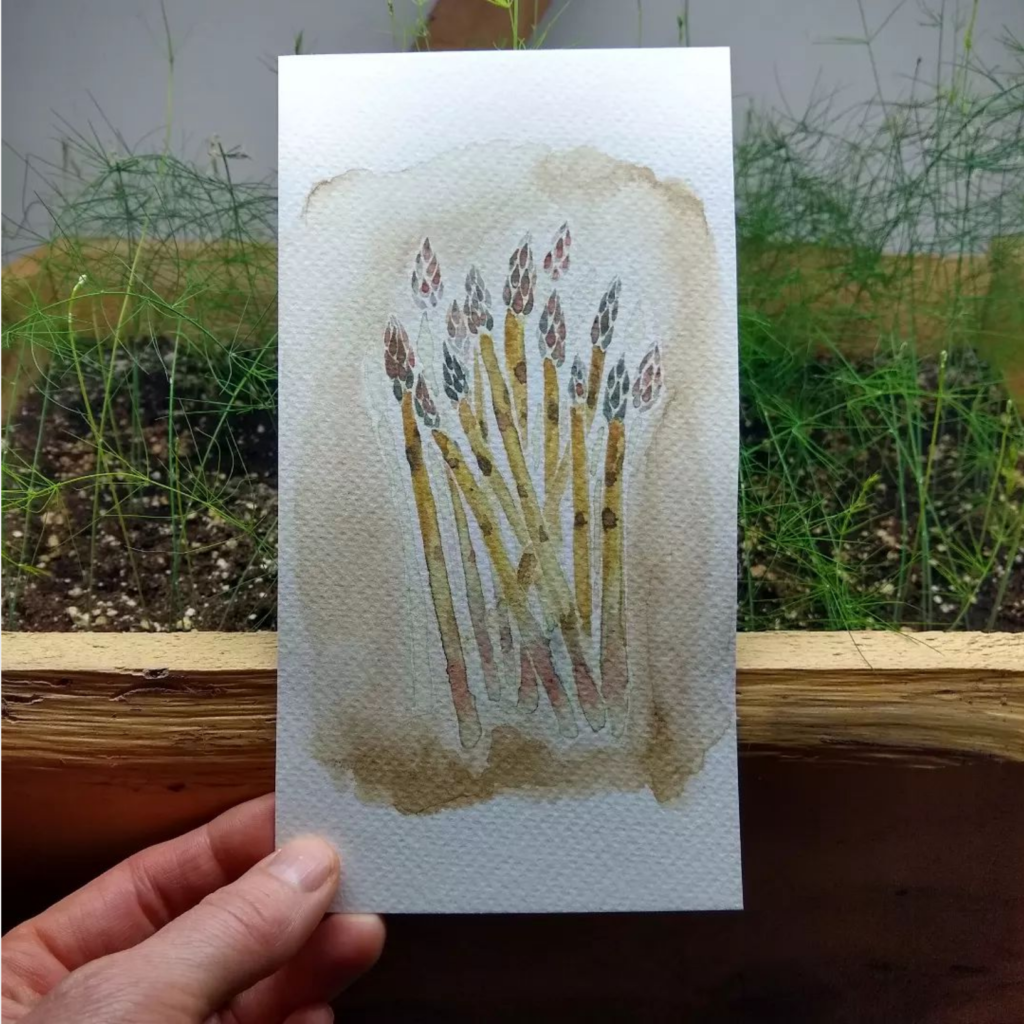
Asparagus with a side of asparagus.

Wild ink painting of asparagus, now 5 or 6 years old. Made with wild grape, dandelion, buckthorn, horsetail, acorn, sumac, and a bit of help from avocado pits.

Painting posed in front of the forest of baby asparagus that’s currently under lights in my studio. These asparagus babies are growing from seeds I collected from our micro-patch last year, hopefully headed to start a much larger patch elsewhere.

From time to time these wild ink paintings do get sold or gifted, but I’m always nervous to do so. Not because I can’t let them go, I love to create things and have others enjoy them. But because some of the wild inks change so much over time. (You can see how different this painting looked like several years ago — here) Fortunately there are many kindred spirits out there who not only accept the paintings will change, but find joy in that they do.

Nothing gold can stay, but who knows what new beauty might arrive next.

Have/make a great day folks!

~Kate

Categories
chickens

Little Lavenders

6 baby Lavender Orpingtons safely home and installed in their brooder in my office. Neil gently dips each one’s beak in water for a drink, before adding it to the flock. (There is no better Papa Hen anywhere.) They were all eating and drinking and sleeping and preening and stretching and pooping within a half hour of arrival.

They’re perfect. No notes.

Have a great weekend!

~Kate

Categories
flora gardening homestead

Where there’s smoke

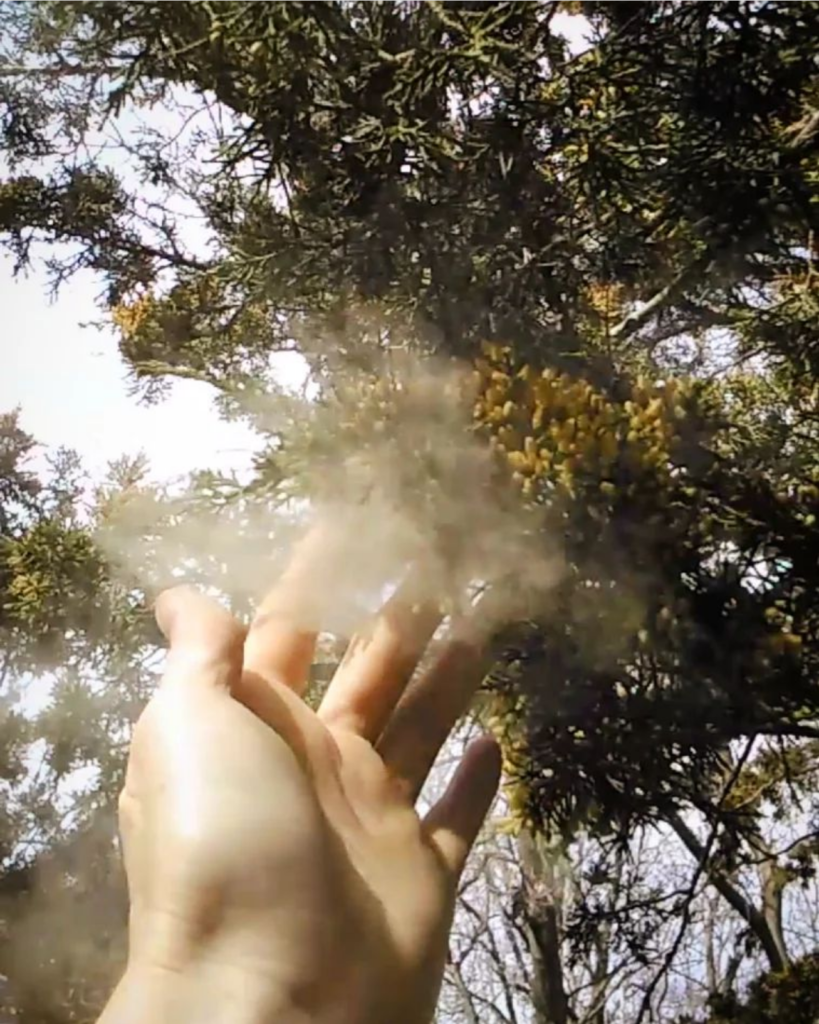
Wrestling with wild grape vine, trying to corral it for fall’s jelly harvest, I’m suddenly surrounded by smoke. I freeze, but my brain can’t work out where the smoke is coming from. Unexpected fires are usually from neighbours burning garbage, but unless I’ve forgotten again, it’s not garbage day. And those fires generally make smells not smoke anyway. This smoke is doubly strange — forming low-hanging yellow clouds that are now billowing lazily towards the driveway. I move again, and even more smoke joins this curious yellow fog, and finally my brain solves the puzzle. It forgot to remember where I’m standing — under the juniper trees, their branches so thickly slathered with pollen that the whole tree is the colour of creamy mustard. As I flail the spent vines over my head, I’m knocking the pollen from the tree behind my back, and it is agreeably taking flight in great plumes on the spring breeze. Later, I see a red squirrel do the same thing as me. She’s not tending grape vines, but leaping through the copse of cedars with the sort of gravity-bending abandon only a squirrel understands. She lands at the tip of a branch, and the tree bounces heavily under her four soft red paws. She’s suddenly invisible behind a curtain of exploding pollen. *Poof* and abracadabra, she makes herself disappear.

Hope you’re having a good week folks. Between the big magic of the eclipse, and the daily wonders too. 🌲💛

~Kate

Categories
homestead thinking big

Chainsaws + Birdsong

Hot Take: You don’t have to like NOISE to use a chainsaw.

You can, but you don’t have to.

I hate the sound of most chainsaws. Though they can be used thoughtfully and productively, there is still an abundance of destructive macho BS around them. And that’s just… bleh.

But I do own and use a chainsaw. And I recently took a practical course on how to maintain and run chainsaws safely. Short version: RTFM.

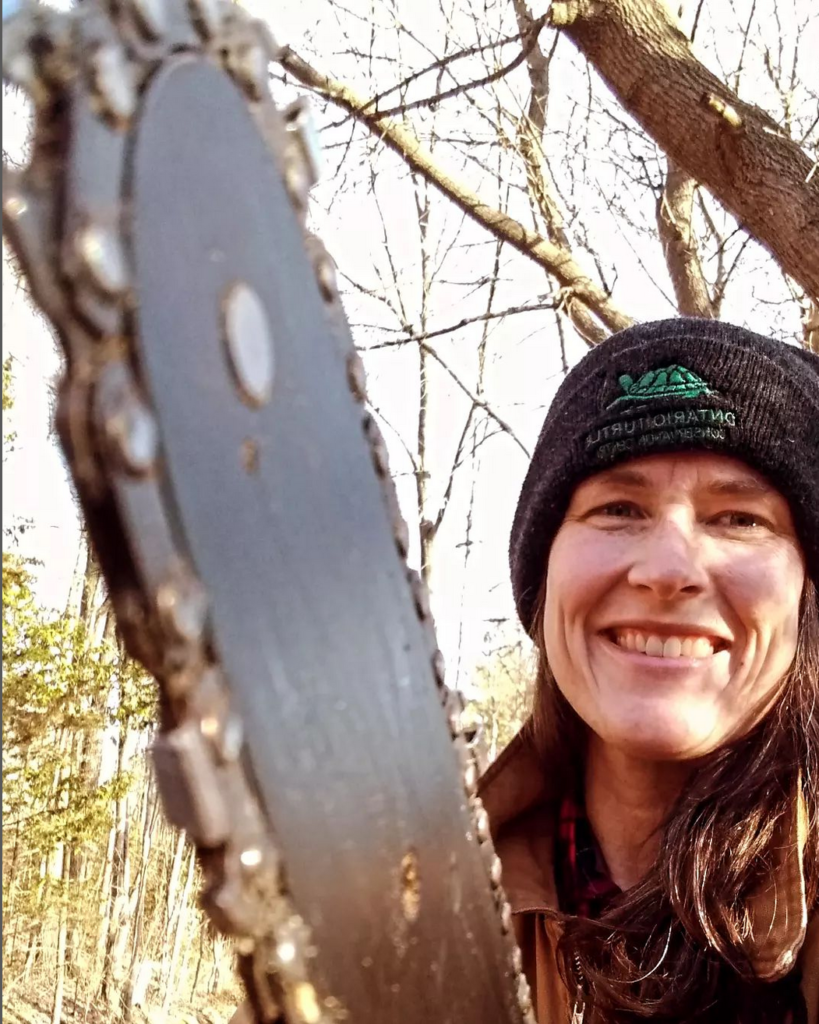
My chainsaw is 16” — and electric. Even while she’s running, you could carry on a conversation. Between cuts, I can hear birdsong.

…I will always choose birdsong.

She’s plenty powerful, and has never been defeated in a task. We get tired before the batteries do. Even if your chainsaw doesn’t go VROOM VROOM, and you never cut down a really big tree if you don’t need to, and your fuel doesn’t take millions of years to produce, you’re still doing a great job. And whether it’s powered by gas or electricity, there are still only two right ways to use a chainsaw: safely and thoughtfully.

(Similarly, whether gas or electric, there is no port that requires insertion of a fleshy male peripheral to operate a chainsaw. So long as you have two arms and a working brain, you’re golden.)

If you want to operate a chainsaw with thought and care and respect for the whole of the forest, you can stand alongside me any day.

…Except not literally of course, cuz we’re operating chainsaws here. You take that path and I’ll work on this one. But we can meet up later for sandwiches.

And listen to the birds.

//
📸: A note on the photo — I wear All The Gear All The Time when operating a chainsaw. Hard hat, eye protection, steel toes, chaps, etc etc. I had this chainsaw out to clean and sharpen it. It has no battery inside. Electric FTW.

Categories
chickens homestead

Backyard Chickens

On my first night keeping chickens, I sat by my new coop and watched in horror as one red hen methodically ripped out, and then ate, the downy butt feathers of a small white one. The white chicken made an upset little squeak each time.

That was 7 years ago. I’ll spoil my own story and let you know now that both chickens went on to live happy, and fully-feathered, lives.

The little white chicken was SooZee the Silkie. The other was LBJ. Christened that evening, and short for “Little Bully Jerkface”.

A chicken rental service had dropped off the coop, supplies, and four hens. It was everything I needed to keep chickens, except experience.

Beyond fresh eggs, I didn’t have many expectations about chicken keeping. I’d thought about some big questions, living as I do alongside fox and raptors. But I can safely say I hadn’t considered the challenge of “light cannibalism”.

Chickens are a poster-animal these days for living a more self-sustaining life. But there isn’t, perhaps, enough time and space given to the thicker, 3D, questions around them. So many new backyard chicken folks are underprepared. Asked mostly to consider which breeds they find cutest, which colour eggs prettiest. (A: Mutts and green.)

Those are fun questions, but they don’t prepare a person for life with a flock of vicious-but-vulnerable dinosaurs. How to decide whether to keep hens who don’t lay. To handle health and illness, from mites to bumblefoot to avian flu. To prepare for free range birds being predated and killed. Or know what to do when hens are left alive, but mortally wounded.

The answers to complex questions like these are likely to change with experience. But if we don’t start with good questions, we’re stuffed for finding good answers.

As for LBJ, I read up on feather-eating. I learned LB, a red sex link, might be bred to generate eggs faster than her body could handle. I supplemented her feed with bugs. The feather-eating stopped. And LB became my landscaping pal, always keen to help check a pile of dirt. There’s nothing she loved more than tree-planting day.

I started out not knowing much, and now I know a little more. One thing I know for sure though — LBJ was a good egg.

Categories
fauna homestead QoTD thinking big wild inklings

“Busy as a Beaver”

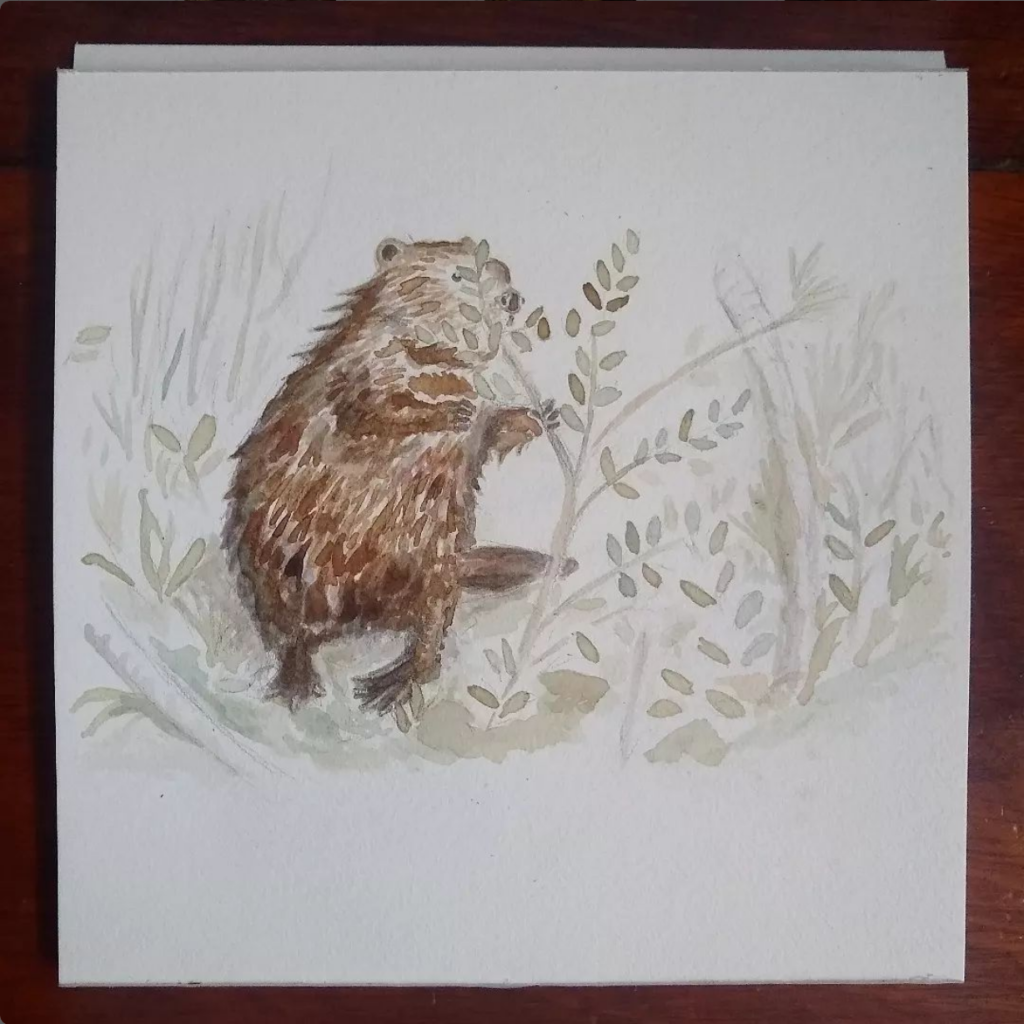
Beaver sketch, painted with acorns, wild grape, avocado pits and oak galls. Based on a b&w photograph by Hope Ryden.
//
For 2024, I’ve resolved to be busy as a beaver.

But not busy as the beavers in my cartoon-simple conception of them, but busy as wild beavers are. And it seems I need to practice a very different way of being busy, if I would like busy beavers to recognize me as kin.

Thanks to these beautiful observations by Hope Ryden (from her book “Lily Pond: Four Years with a Family of Beavers”), I have some idea where to start:

“…Despite the descriptive epithet often applied to the species, beavers are not ‘busy’ animals. On the contrary, they normally proceed at a leisurely pace, unburdened by outside pressures. One stick at a time they drag up on their house, one load of mud at a time they push onto their dam. After doing a certain amount of work, they take a break to feed or groom or play or just float about in the water.

Few species, in fact, appear so oblivious to stress as does Castor canadensis. House wrens, for example, build their nests in a kind of frenzy, as if tyrannized by their seasonal timetable. Not beavers. … One handful of mud at a time, they scooped from the bottom of the pond. And, pressing this against their chests, they paddled slowly to the dam, and shoved it up into the crest. As unhassled as they appeared, however, they were in fact accomplishing two tasks at once–deepening a channel and raising the height of a dam.

Beavers work like that. Interrupting one operation to transport its byproduct to a site where that debris is wanted…

All waste products are recycled: dredged mud becomes house insulation or dam sealant; debarked food sticks become house or dam lumber; wood chips (fallout from a tree-felling operation) are brought to the lodge and spread on the floor for bedding. In this admirably relaxed manner, the efficient beaver accomplishes an enormous amount of work. Watching [beavers] is like attending a morality play, and I often thought I ought to take a lesson from it.”

~Hope Ryden, “Lily Pond”
Categories
homestead

Little kitty, big dreams

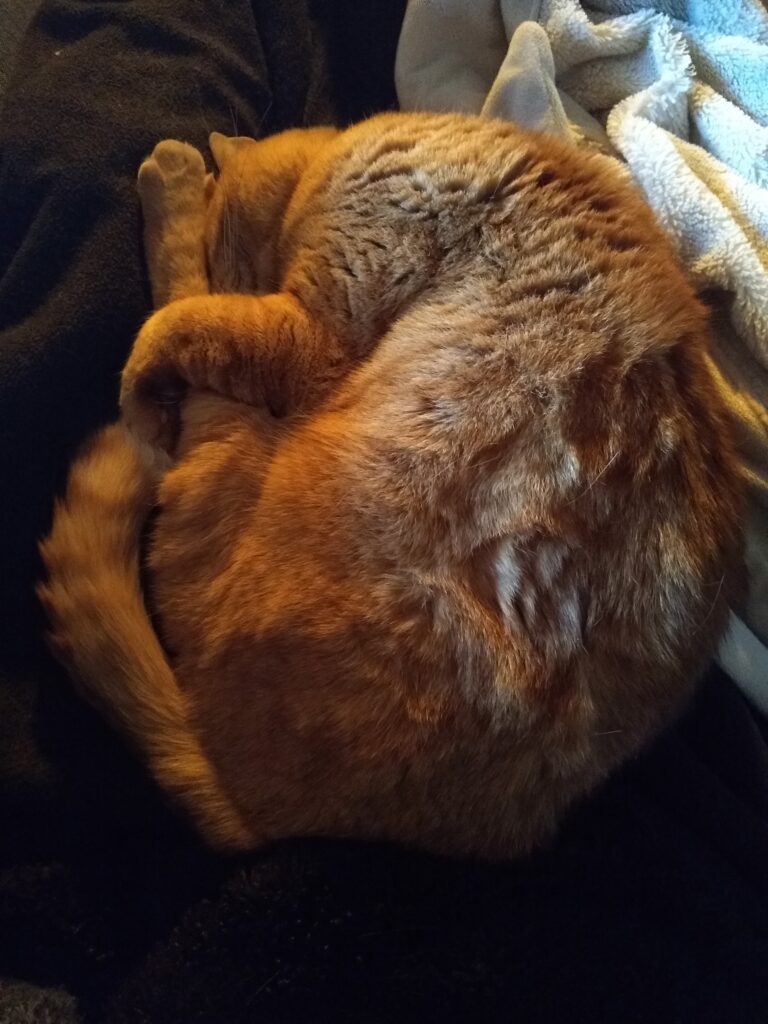
Despite his perfect pike position, one of the judges still only gave Oliver a 9.8, on account of he is a cat. 🐈🏊‍♂️
//
So many exciting things coming up this year, here at The Little Homestead That Could Code.

Updates on past projects (like the holz hausen, potato storage A/B testing, overwintering herbs, and maintaining our 100ft driveway without salt or fossil fuels…) and upcoming ones (growing asparagus from seed, new Orpington chicks!) are coming soon. Along with some very exciting news from the open source software side of our little operation… ✨

But in the meantime, please enjoy our landlubber kitty who dreams of diving.

Have a good rest of your week folks ♥️
//
Props to Laura Corrigan for her assessment that the judge must have been a dog. 😂

Categories
D-I-Why Not homestead

Holz Hausen!

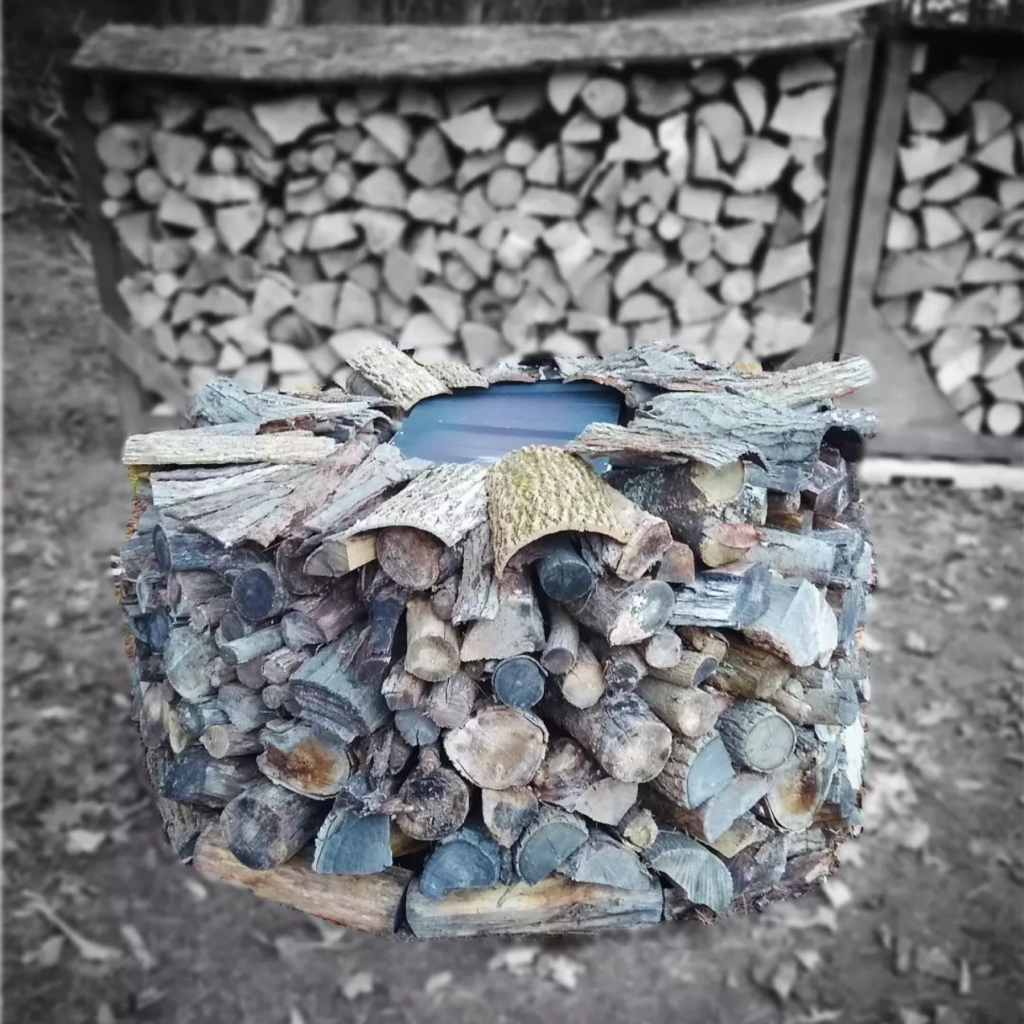
My first off-brand, extra rustic Holz Hausen! If you know what these are, and lovingly craft them yourself, please look away. I mean you no harm or offense.

A Holz Hausen is a self-supporting way to season firewood — to dry it out before burning. Some folks use it as an all-in-one: both to dry green wood and store it. So when I needed to relocate our firepit wood off a rack this week, it was time to try making one of these aesthetically pleasing little scamps.

I usually see “holz hausen” translated as “wood house”. But Translate refuses to corroborate that. I couldn’t convince it “hausen” meant “house”, no matter how many leading questions I asked. Google much preferred “hausen” to mean: “live”, “hang out”, “wreak havoc”.

Wood for living, hanging out, and wreaking havoc. A fine definition for what takes place at a firepit. (Only the best wreaking havoc that is. In the language of social change, the kind of havoc wreaked by “positive deviants”…)

We visit with friends and family outside these days, and the firepit is a nice focus for wintry socializing. It’s also where I like to putter solo in my downtime. The firepit might as well be invisible for all I look at it over the summer, but when winter rolls around, I feel a driving need on Sunday mornings to pull on a snowsuit and go fry eggs in the snow.

Our firepit burns all our oversize and/or gnarly wood. By definition, wood is only there if it is a PITA. Which also means that my raw material was rough.

But I am part of the generation who believes nothing is unstackable, so long as you are humming the Tetris theme song. (Fun fact: It is called “Korobeiniki”, and is a very fun song to learn to play on ukelele.)

And I am surprised to find the Holz Hausen handled all our outlier wood like a champ! At ~4ft around, mine is half normal size, so there was a lot of improvising. And yet, though it’s only had a few days to prove itself, this island of misfit wood seems to be one solid little structure.

As our friend Em eloquently put it: “It’s a nice place where order and chaos meet… and have tea.”

Cheers to that. May order and chaos sit together in balanced companionship more often. ☕🌳

Categories
D-I-Why Not gardening homeMADE homestead

Unwrapping the greenhouse experiment

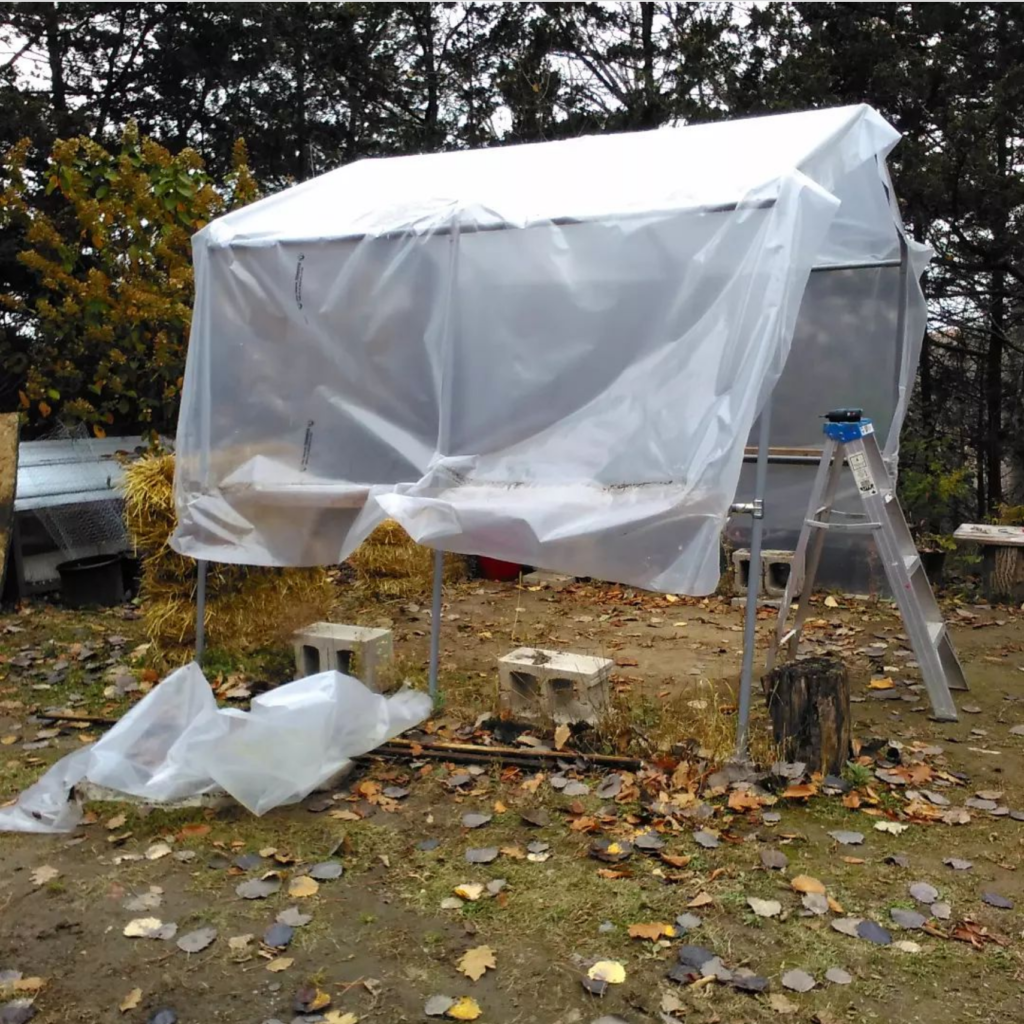
Well that’s a wrap — maybe unwrap? — on the Great Car Tent Greenhouse Experiment 👍
//
🎪✨: The verdict is 8/10, would-do-again. We had an excellent year (for us) in green peppers and eggplants. Chiles and jalapeños did well. And an unexpected bonus of two pawpaw seeds germinated in there! Those are now planted on the hillside, with chicken wire protection against the wild roving rabbits of winter…

🌱🥉: The tomatoes did meh, though I’m not sure why. We got fewer in the greenhouse than from the much shadier raised beds. The lemongrass was fine but not riotous. The carrots hated it. The basil was content and industrious.

🌱✨: I try to be like that basil. These efforts are not about being perfect. Or self-sufficient. I don’t think either of those things really exist. Like it or not, we’re all tied to each other to survive. So it’s not about off-grid, but a better grid. Fewer trips to the grocery store for world-weary produce and packaging. More trips to a farmer, or the garden.

💚♻️: And to do my part in that grid, I figure I have to try and pitch in with what I’ve got. Which means trying and learning and failing and trying again.

🍓❄️: When I’m in the garden in the summer, it’s hard not to just stare at everything going “wrong”. Seeds that don’t sprout, produce that doesn’t produce. I had loads of failures this year, as always. From peas to beans to lettuce to carrots. Some even resown so I could fail twice (or more) in one year. Fail fail fail fail.

🐿️🌰: And yet…here we are. Heading into winter with a freezer partially stocked with our own fruits (mulberries + raspberries) and veg (beans, beets, green peppers, tomatoes). And other goodies literally draped around the place. Chile pepper garland, braids of garlic. A little pile of potatoes. Willow dried for Abbie. Teas and herbs for us. Seeds.

And a whole growing season of trying and learning under our belts, with more ideas germinating for next year.

🐿️🔥:I think those ideas need to be cold stratified though, so I’m gearing up to wind down with some glorious hibernation, nestled by the fire till spring.

Have a great weekend folks!
🌬️🌱🍃

~Kate