Categories
weekly report

Weekly Report for Miscellaneous August Days

❄️🌽: Cold this morning. And the bitey bugs are suddenly quiet. They’ll be back again this evening, in time for corn on the cob, but an intermission. Time to scratch the old bites.

⛵🐿️: Flying squirrels, each evening, clockwork at a quarter to nine. Swoop, land and scurry. From roofline down to the tippy maple. When the sky is still too bright for stargazing. Nautical twilight — time for squirrels to sail.

🐮🌊: One neighbour and then another and another tell me there is a moose nearby. I must watch for sign of this maybe moose!

🦇💡: Big brown bats dazzle and swoop over the yard. They’re well-rested after a day spent dreaming in the eaves. Fireflies fire the starting pistol. Each evening first the fireflies then bats then squirrels. They all know the schedule. But only a few embers of fireflies now. Their season is late. A few blinks in the black.

🐣🏡: Phoebe’s babies have long since fledged from their nest, but we still see Phoebe around the yard sometimes, and say hello.

🧛‍♂️🐁: Tiny ticks, waving in the grass, moving Lyme from there to here. Biting the disease out of mice and barfing it into our blood. A story of mice and men. Careful of the freckles that walk, the poppy seeds with legs.

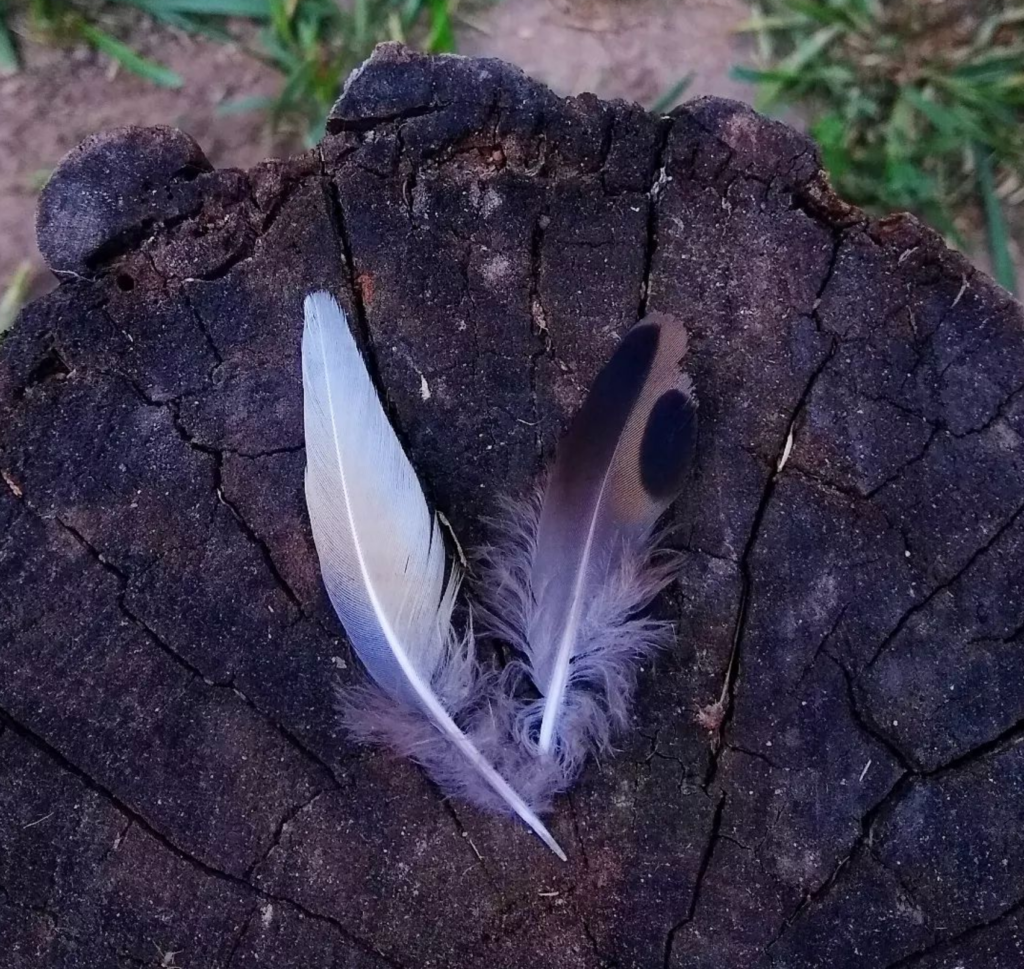
☠️🧵: A mourning dove snatched away from under the feeder. A pile of soft down and a few feathers on the ground. Never noticed before these are polka dot doves. A hawk perhaps, that snipped this dove’s thread, but that day the hawk babies ate and their threads spun a little longer.

🥔🌟: Potato plants pulled, spuds sorted. Dirty treasure. Scrubbed and crisp roasted in rosemary.

I wake a deer on the hill. She raises her white flag and bounces away. This uneven slope her velodrome.

Dark clouds refusing to crack, rain refusing to fall. Careful now, with this water.

Fragrant trimmed tomato branches wheelbarrowed to the compost. Food for next year’s food.

Berries jammed and jammed in jars.
Pickles picked and pickled.

Around and around. A season to stretch out and make ourselves long as the days. The bright dark days of summer.

Happy Thursday folks ☀️

~Kate

Categories
chickens D-I-Why Not homeMADE homestead

“Junk” Coop

Not bad for a pile of junk.

“Scrappy” new mobile chicken coop, check! 🐔🛠️

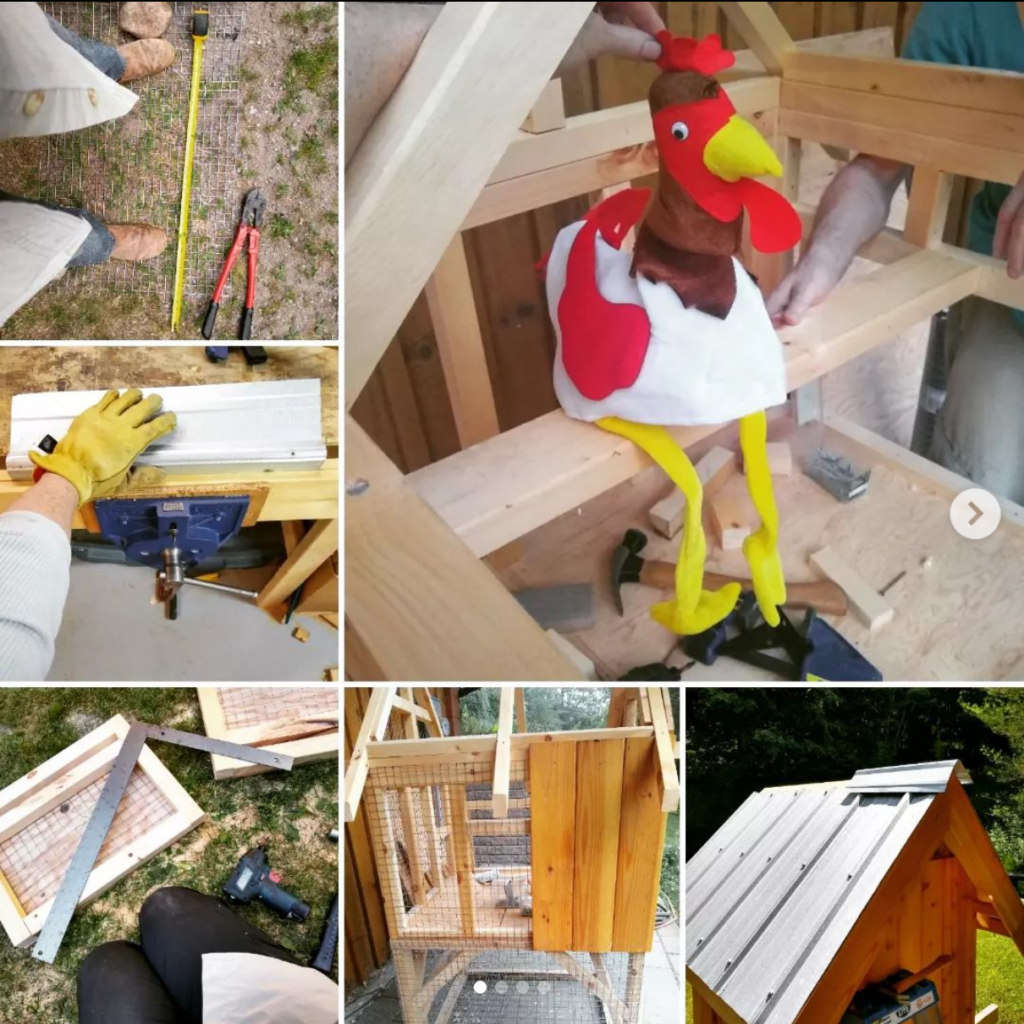
🐤🐤🐤: We built a “new” mini-coop this summer. Sometimes a few chickens need to be separate from the flock for awhile — introducing new birds, a hen with chicks, too many roosters, an injured hen etc etc. Usually you’d pop them in a barn, but we don’t even have a garage, so by “barn” we usually mean “Kate’s office”. While I like my office to be modular, I also like it not to smell like chicken.

♻️🏗️: There is some fresh lumber in this build — we rip down ungraded/seconds 2x4s for the framing. But also so many scraps!! Including extra fence boards from raised beds as cladding, a salvaged steel roof, and part of our friends’ old kitchen island.

✂️🏠: The ridgecap is probably my favourite part of this build. We had just enough metal roofing to solidly patchwork the roof, but no ridgecap. So I took my tin snips to the extra pieces, and with a little 170lb persuasion (I leaned on them), I convinced the offcuts what they really wanted to be was a ridgecap. They generously agreed.


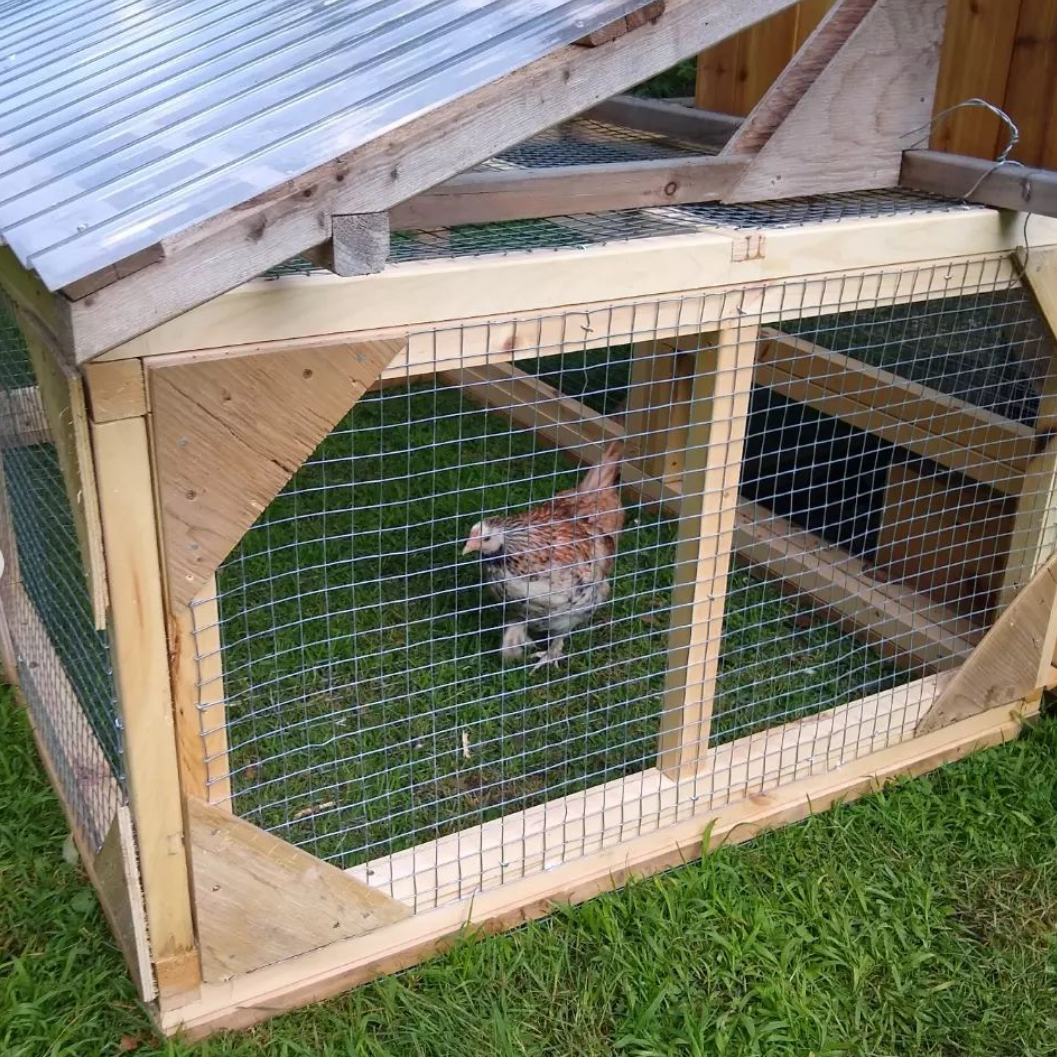
👩‍🚀🐔: A separate 4×6′ extension airlocks on to the main building, so the little dinosaurs have access to a larger patch of greens. Dig dig look, dig dig look…

🌱💦: The temporary clear roof on the extension is repurposed from another build, and is ultimately destined to become part of a water collection and irrigation system for our off-grid garden. It’s like a Matryoshka doll of repurposing. Plans within plans!

Have a wonderful week folks! 🐣

~Kate

Categories
D-I-Why Not homeMADE homestead technology

Hot enough to cook an egg… in a cardboard box?

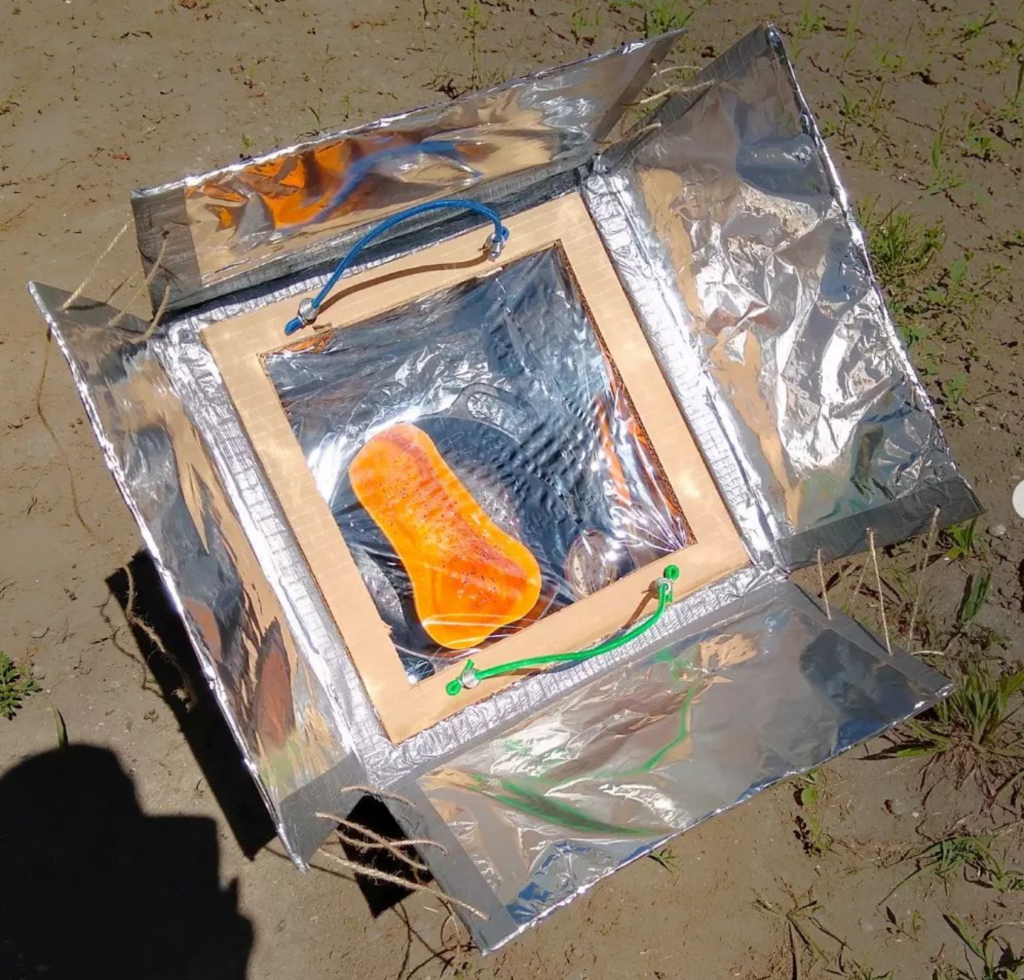
Solar oven — made from a cardboard box! Is it hot enough to cook an egg out there??

Solar oven side quest: Before work on our new chicken coop one day, I decided to try making a solar oven from our recycling. The heart wants what it wants.

✂️📦: Wired has a tutorial on making a solar oven from a cardboard box, insulating material (like styrofoam), duct tape, tin foil, and some cling film. I have those things!

👷‍♀️💭: I modified the Wired design a bit, making the front panel more easily removable (bungee handles), and punching holes and lacing string through the outside flaps, to help direct the sun.

☀️🌡️: After a bit of time outside, the oven temperature got up to a whopping 200F! Okay maybe not “whopping”, but… consistent! A slow-and-steady 200F! The black cast iron pot inside the oven got scorching hot. Too hot for bare hands.

🍆☁️: My first “dish” was half a squash. Which was… ambitious. I have to adjust the box to track the sun (cardboard can only do so much), and we had to go out that day. The shade drifted over and absorbed the oven while we were gone. The squash got sun-kissed, but not cooked through.

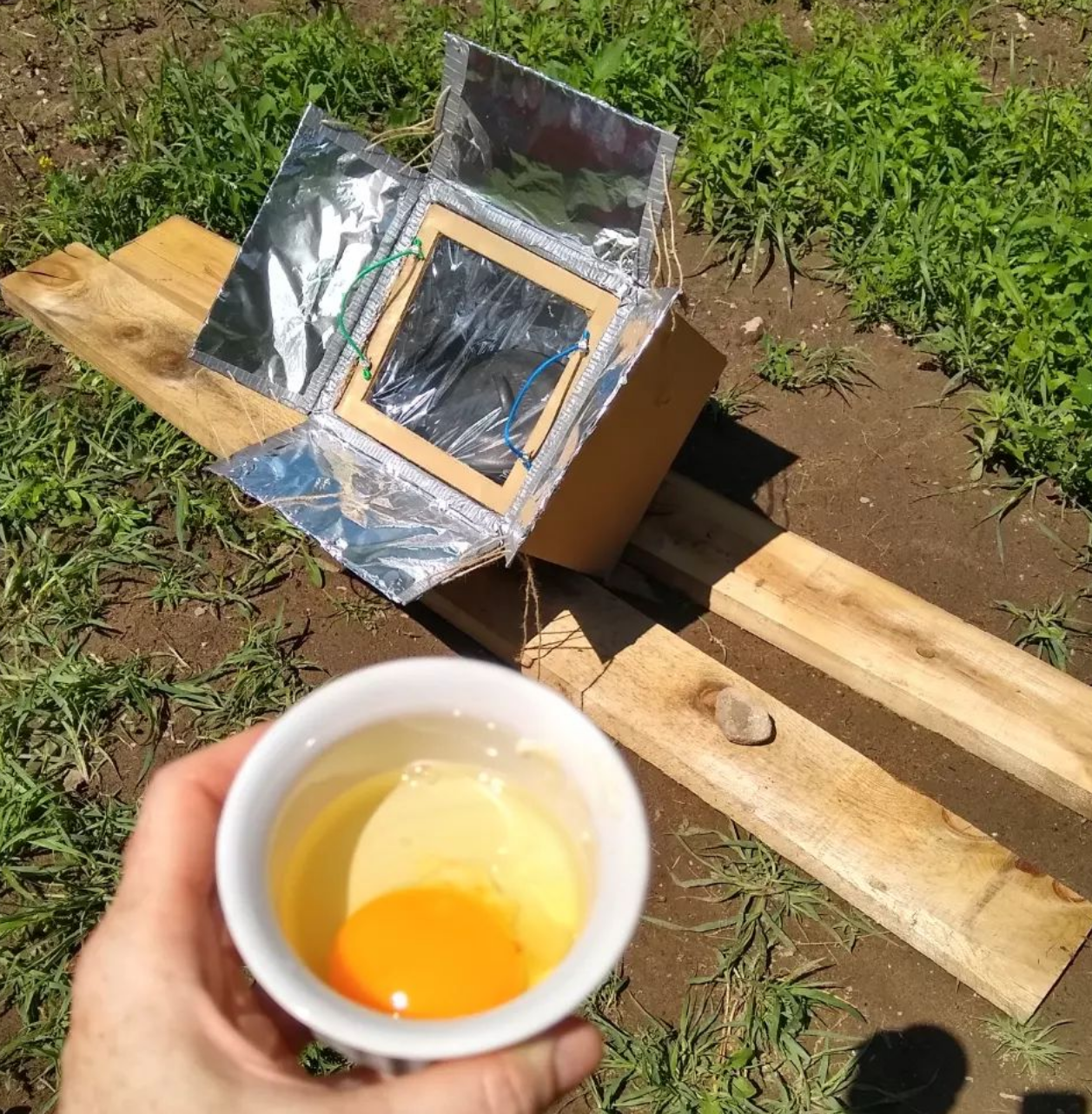
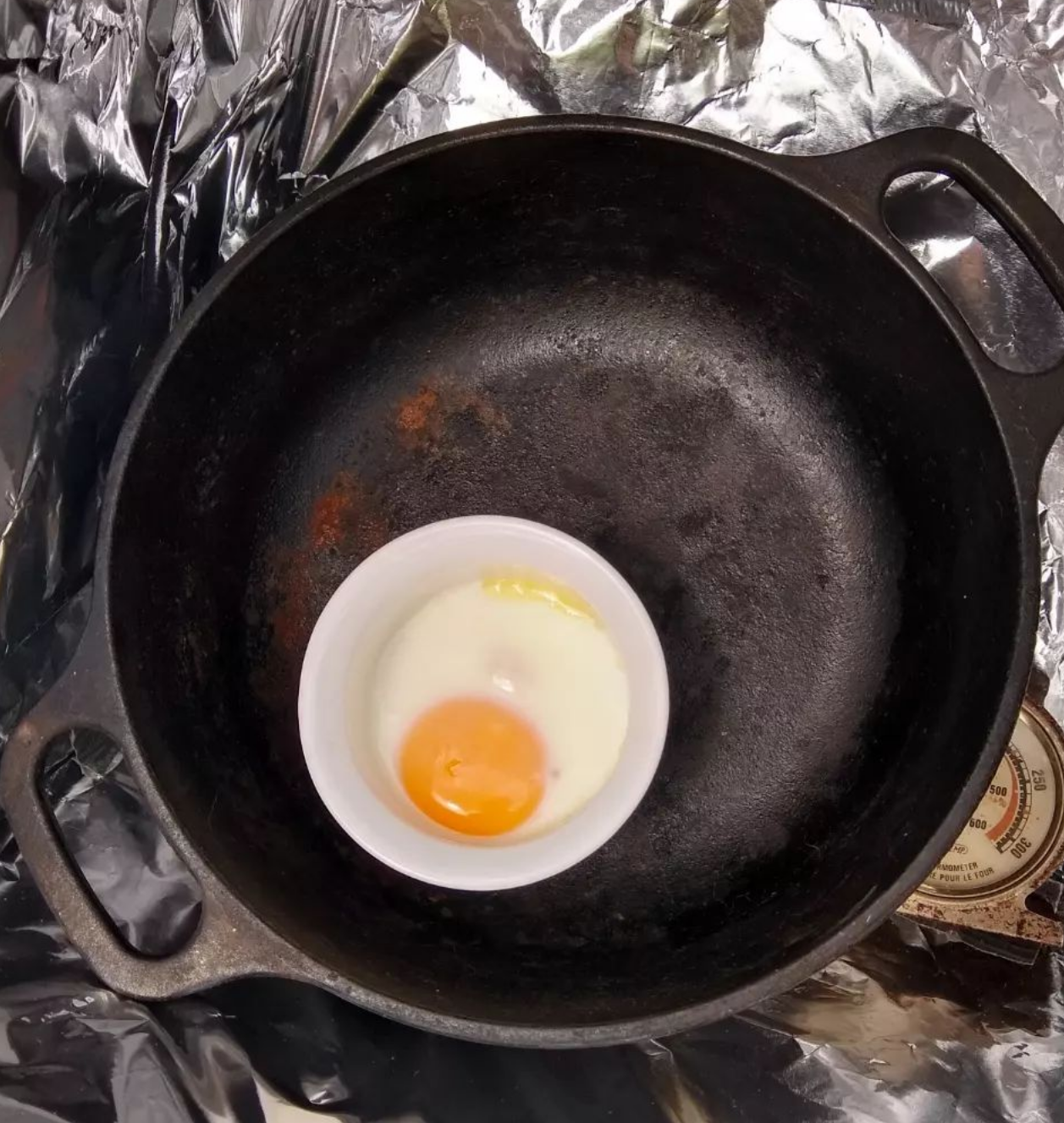
📦🍳: Yesterday I tried round two, this time with an egg. Once again, the oven stayed right around 200F.

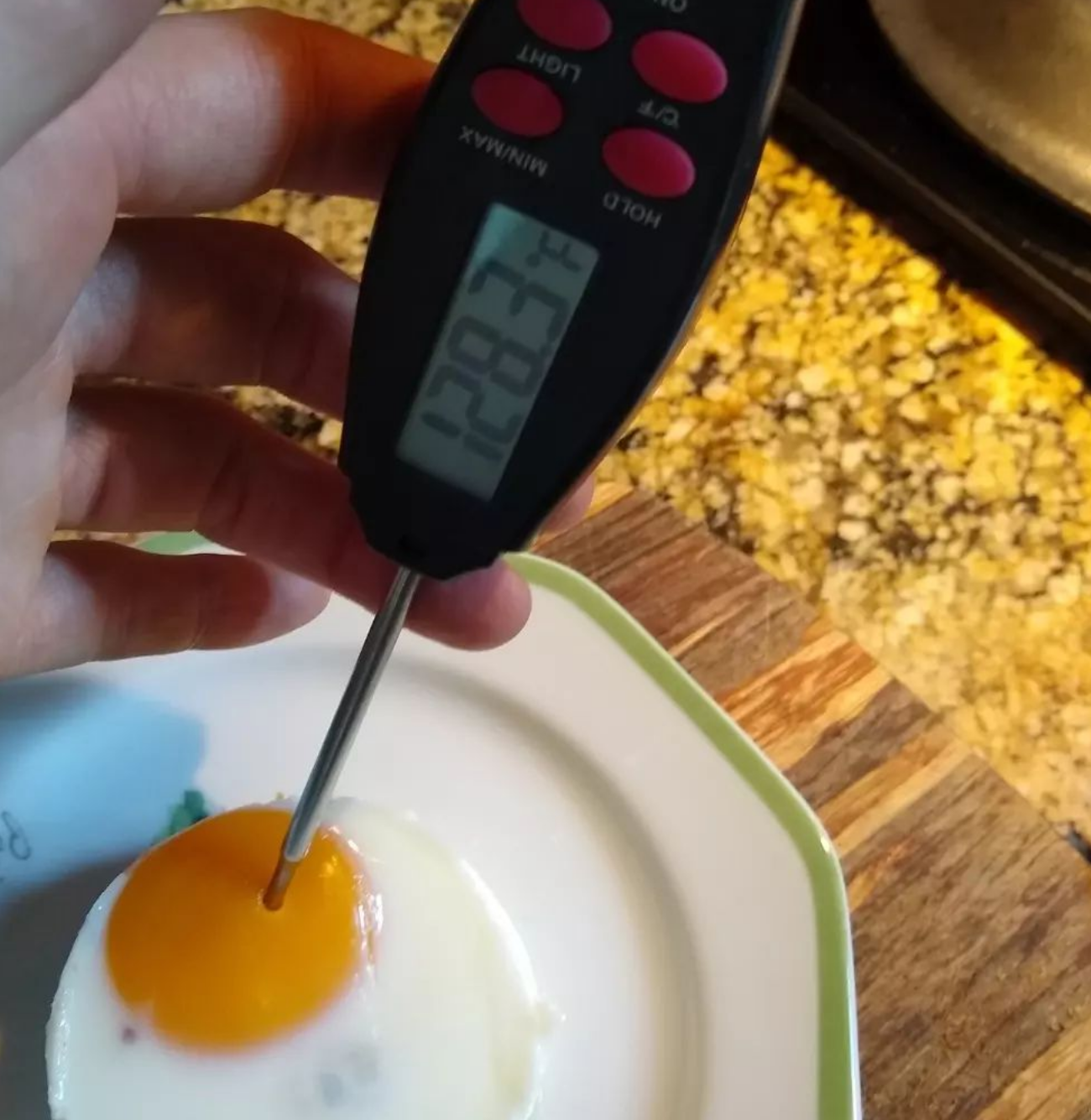
And success! After about an hour the egg was cooked through. I didn’t think to check the internal temperature until the egg had been out of the oven for ~10 minutes. By then it registered around 128F. Safe temperature for eggs is 160F, so I’ll make this a “twice-cooked” egg (heating it up inside) before putting it in my face hole.


🍫🤢: Why mess around with a raw egg instead of just making s’mores you (and Neil) might be asking? You both make a good point, but here we are. Also I wanted to see what would happen. (To the egg, not my GI tract.)

Do you have any suggestions for (very) low-and-slow cooking? I make our granola at 225F, so maybe that is worth a go…?

🌳☀️: Here in the woods, our days of strong overhead sun are only just beginning. Let’s see how toasty I can get this ol’ pile of packaging!

Have a great day folks! ☀️

~Kate

Categories
D-I-Why Not gardening homestead

Sea(of)scapes

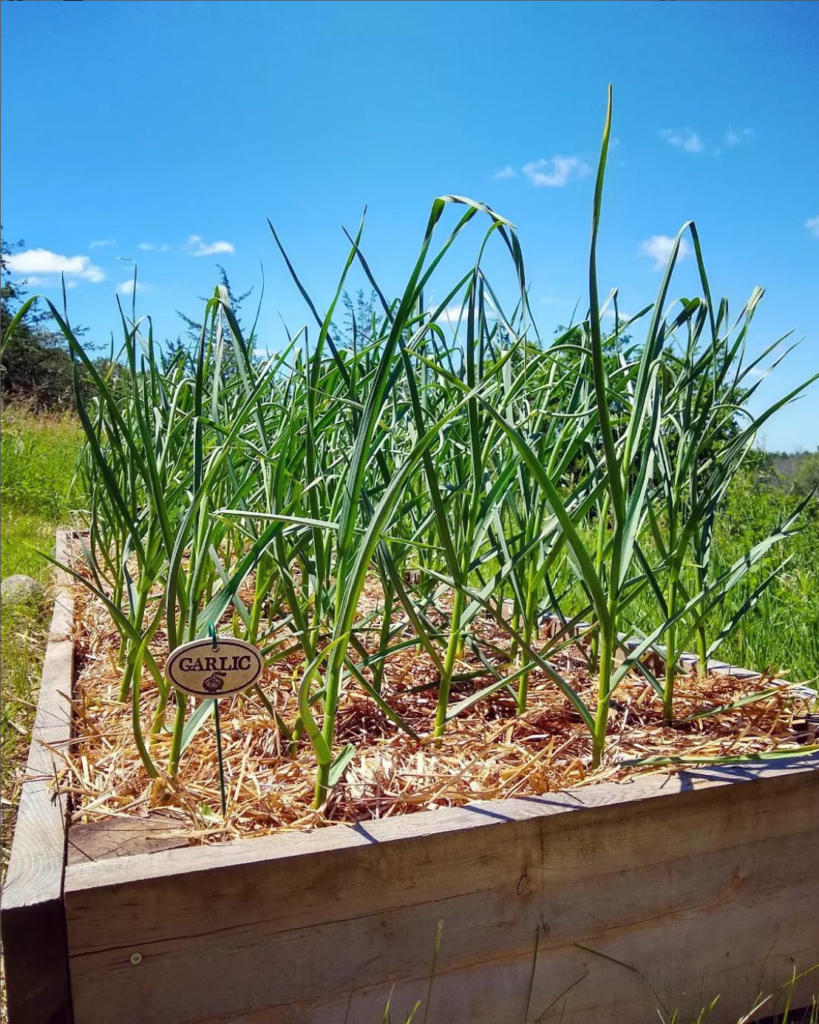
Experiment success! Sea of garlic scapes 💚 Three years to first harvest.

🗓️🗓️🗓️: Year one, we graded and prepped the site (microplastics mistake: we tarped, but should have used cardboard). Year two, we removed the tarp (and every little strand of broken down tarp we could find). Then we built a 3′ x 14′ raised bed from offcut hemlock boards. Then Evie (🚙🔋) and I filled and filled and filled the bed. Finally, planting and mulching. And now, year 3 — garlic!

☀️🧛‍♂️: This area gets a lot of sun, the most of anywhere on our property — and is also full of ticks. As in “I’m going out to Tick-ville to check the fence line… and collect a bunch of ticks on my person.” The bucolic beauty of this place comes with stark realities — flaky power, low water — and ticks are an often unseen part of the picture. (Neil has had Lyme disease, and it’s no joke.) Tick checks and tick management inform our rhythms here. So it was A Decision to see if we could make a garden bed work here, where the wild ticks roam.

🤔💭: This area has only a scrappy thin layer of soil, plenty of bunnies, and no water nearby. So we wanted to plant something that could: largely be left unattended; be unappealing to wild critters; thrive in full sun; get by on rain or irregular watering; and, be harvested in short spurts, not continuously over the season. Garlic!

👷‍♀️💧: We plan to build a rain collector out here, and more beds that fit these criteria (Planting suggestions welcome!). But for now we will make giant bangle bracelets with our bountiful scape harvest, and enjoy the fruits, shoots, of our labours.

…After a tick check, of course. 😉

Happy Thursday folks! 🌱

~Kate

Categories
gardening technology thinking big

In Seeds As In Software

Some of Maker’s Dozen’s work is in technology. Open source software development. And in open source, you share your source code.

It’s like sharing your recipe. Here, we made you this cake, and here’s how we did it.

It acknowledges the work of the people who came before us, and contributes our work back to the commons, so others can build on it too.

In the early days of computers, this was pretty normal. Most programmers were pretty open about sharing their work with others — so everyone could get the most value from these newfangled machines. But the cancer of proprietary everything has spread so far, that many people don’t even realize the locked in, closed source ideas of technology weren’t always considered normal. Or that open source never went away, and is in fact thriving. (If you are looking at this on an Android phone, you are using open source technology.) That there is a choice. Another way of doing things.

I think about this while I’m in the garden, planting our plants. It’s the ol’ “pull on one thing and find they’re all connected” deal.

Many of our vegetables this year are grown from seeds I saved out of last year’s garden. I love to save and share seeds, to be part of that essential cycle of self-sustenance. But we are miles and miles away from total self-sufficiency, and it’s not really our goal. We can’t grow and save the seeds for everything we plant and eat, even if we wanted to. We don’t have the right conditions here, don’t have the room to isolate plants properly etc etc.

We need others to carry the seeds too. To share back with us. So that there is diversity and abundance and resilience and growth. Plant it, grow it, share it with others. Be a good ancestor.

“Seeds, especially of food and other useful plants, should be taken care of by the people. They are too precious for all of them to be placed under the exclusive control of the few. The more hands that hold them, the safer they will be.”

~Jude and Michel Fanton (Seed Saver’s Network Australia)

Happy Friday folks! Have a great weekend. 🐁🖱️

~Kate

Categories
homestead technology

No power, but not powerless

We lose grid power a lot here. So we’ve learned how to be less powerless about it. The squirrels are all like “hey do you think you have enough dry goods stashed lady?” And I’m like “quit sassing me squirrel! …Are you going to eat that acorn?”

The headlamps are always hung on the hooks with care here… But we also do some things now whenever we know storms, or even high winds, are coming.

Here’s a few of them, in the hopes they might be useful to you too.

  • 💦 Stash water. For drinking and for flushing. My newest trick is to also fill the sink with hot soapy water. Being able to wash a dish during a power outage is wonderful.
  • 🐤 Look after the animals. Baton hatches, fill backup waterers, work out alternate heating solutions. We have options, they don’t.
  • ❄️ Fill a small cooler. Pull essentials we might want out of the fridge and into a cooler with an ice pack.
  • 🧼 Wash dishes — and ourselves if we have time. For dishes, pans that can go on the BBQ or fire especially.
  • 👔 Tie the fridge shut as soon as the power goes. Or put a chair in front of it. Habits are *powerful*! A fridge or freezer can stay cold and foodsafe for ages if left closed. But you throw that under the bus when you go to grab the milk before your brain kicks in…
  • 🔋Charge phones.
  • 🗄️Tidy up. We might be walking around with less or no light. Tripping over that laundry basket you forgot was there is going to suuuck.
  • ☀️Do things that need light while there’s daylight. If the outage was unexpected, that might mean prepping for when it gets dark. But it might be recreation if everything is squared away. Read books while the sun shines.
  • ☕Boil water and put it in a good thermos. There is nothing a cup of tea can’t make a little better.

📝And for next time — make a list of what you’re missing/wish you’d done or have during the outage. You won’t think about how that bathroom has no natural light and could really use a battery powered lamp in it while the power is on, but boy howdy it’ll be top of mind when it’s off.

We hope everyone came through this weekend’s storms and outages safe and sound.

~Kate

Categories
mushrooms thinking big weekly report

Signs of Spring

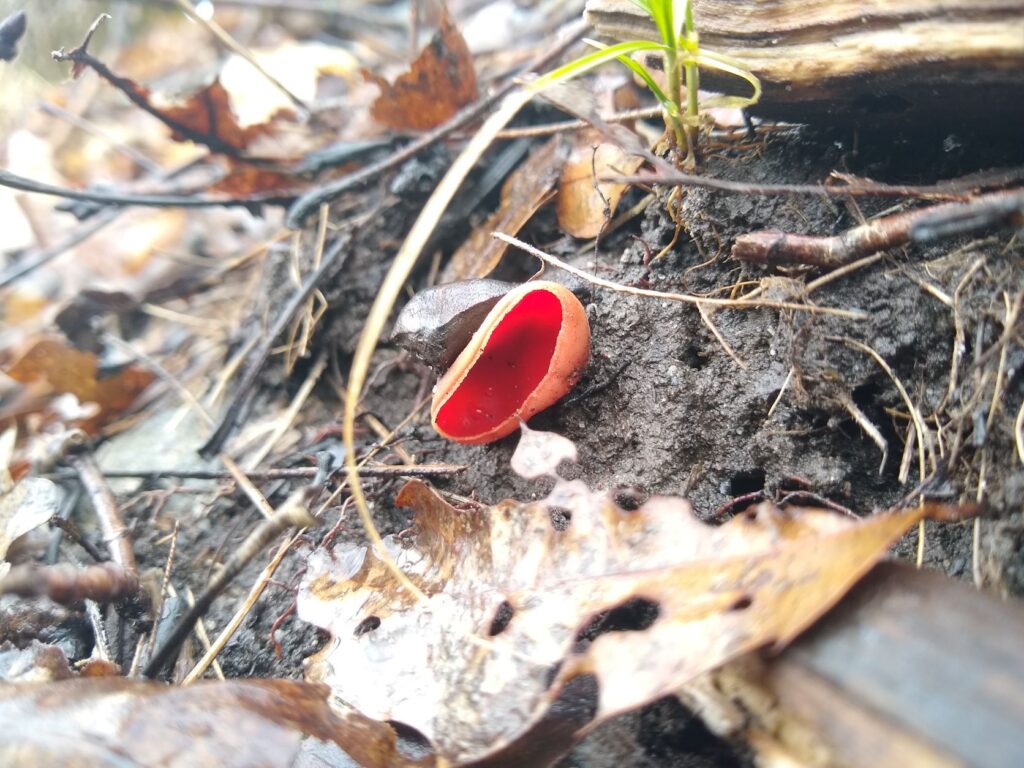
Scarlet cup fungus (Sarcoscypha austriaca).

Above, Scarlet Cup fungus: “One of the earliest of spring fungi, it often escapes attention because it is hidden under fallen leaves.” (George Barron)

Some years we see great flocks of robins here through the winter, so robins are not the harbingers of spring for me that they once were. At least not until they begin their spring construction season, installing nests all over our eaves.

But we glimpse other sparks, hinting that spring is about to ignite…

The cold nights and warmer days pulsing sap up and down the maples.

The first turkey vulture, the first moss upended by turkeys, the first bluebird. Trills of red-winged blackbirds, chickadees inspecting our bird houses.

A skinny chipmunk hightailing it across the gravel drive.

The brilliant red of scarlet cup fungus, half hidden in the duff.

The vernal pools swelling in the woods, seasonal streams percolating over little rock piles. Suddenly soggy places that in a few more months will be bone dry. The return of mud. The smell of thaw. The first walk up the hill without ice cleats. An extra egg in the chickens’ nest box.

The first ticks. Questing on the low branches we have not yet cleared from the trail.

The sun shining a little further into the kitchen, brighter and warmer. The inevitable surprise snow and the suddenly warm days that follow it.

Happy early inching muddy days spring folks.

Have a wonderful week,

~Kate

Categories
flora homestead

Big Friday Night Plans

I’ve got a lot of trees to catch up with.

Categories
weekly report

Weekly Report

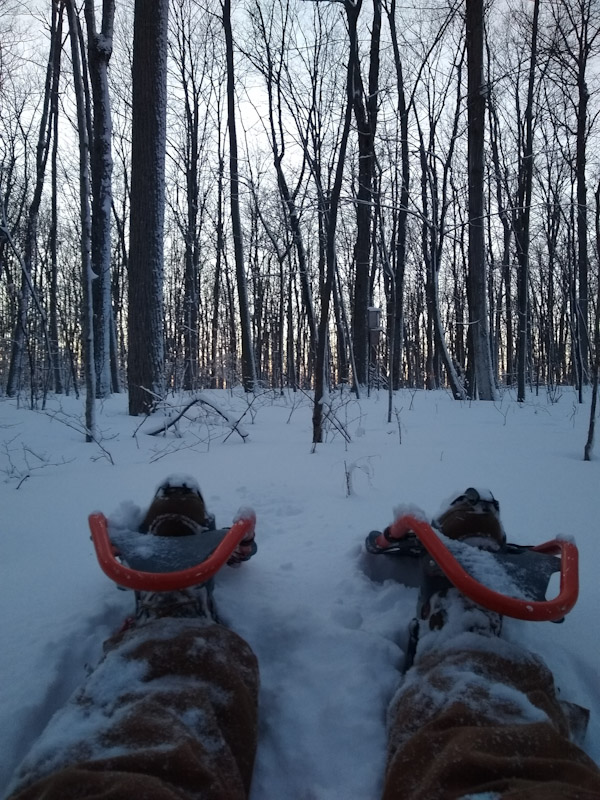
Snow falling on cedars. Though I’ve not read the book or seen the movie, I think the phrase every time the snow falls. Snow fell on cedars. The snowy ground swells up and the heavy cedar branches drift down. It is unapologetically winter here and each luscious cold day is savoured. At the edge of the woods, the wind has sculpted the snowfall into hills and valleys, with drifts higher than our thighs, even with the boost of snowshoes. We pour the winter into ourselves because the snow cannot stay. “…we want more and more and then more of it.”

The chickens’ waterers freeze three times a day, even placed on heaters, but still the little chickens lay their eggs. What must be done. Seasons and bodies both keep their clockwork. On the coldest days, SooZee seems to be doing an impression of a rotisserie chicken, snuggled up so close to the heat lamp’s red light that her feathers look pink. The three “Wyandoodles” and little Turtle — the tiny black and white chicken with the green-shelled eggs — still leave eggs in their nests most days.

Lin, one of our oldest hens, died this week, not from the cold, but from the inevitability of death. She lived a good life here. On her first day with us, she rode shotgun with me, in a box marked “Linens and Mittens”. On her last, she sat in a row with Pedro and SooZee — after pecking Turtle in the head for trying to eat corn before her elders were finished. We did not have to euthanize Lin. She had trouble for a day or so, and then was dead in the morning. There is always a morning you don’t get to see. Fill the days in between with life.

A tiny bunny has started frequenting our yard. Going out around dawn one day, I startled it by the side of the house. A blur of brown bunny darted a few feet, and then decided to “play rock” instead of run. One of the three Fs of self-defence: flee, fight, feign rock. I moved to the outside of the path, and made a show of pointing my forward-facing predator eyes the other way. No rabbits, only rocks here.

On the other side of the house I found a bunny freeway between the dogwoods. A serpentine path of furry feet, stopping for nibbles, and leaving piles of scat. Retracing its path so thoroughly it looks like a trail left by snow snakes. In the dead of winter, bark is delicious. The dogwood can take it. In the warmest months, I’ve pruned it harder.

Tiny mouse tracks are everywhere. Popping out from their world under the snow for a sojourn topside — to run around a twig, and take the next tunnel back underground. I don’t know why that twig is special, but the mouse does. If it could tell me why this one and not that one, I would listen.

Junco tracks zigzag across the fresh blanket of snow, stitching it in place. The little birds are everywhere, their tracks covering the ground so completely you forget that’s not what newfallen snow looks like. My favourites though are when, on a quiet expanse of snow, there is a sudden flurry of feet, with nothing before or after them. Of course I remember, of course. Birds can fly.

“It has always been a happy thought to me that the creek runs on all night, new every minute, whether I wish it or know it or care, as a closed book on a shelf continues to whisper to itself its own inexhaustible tale.”

~Annie Dillard

~Kate

Categories
chickens D-I-Why Not homeMADE homestead

On a cold day

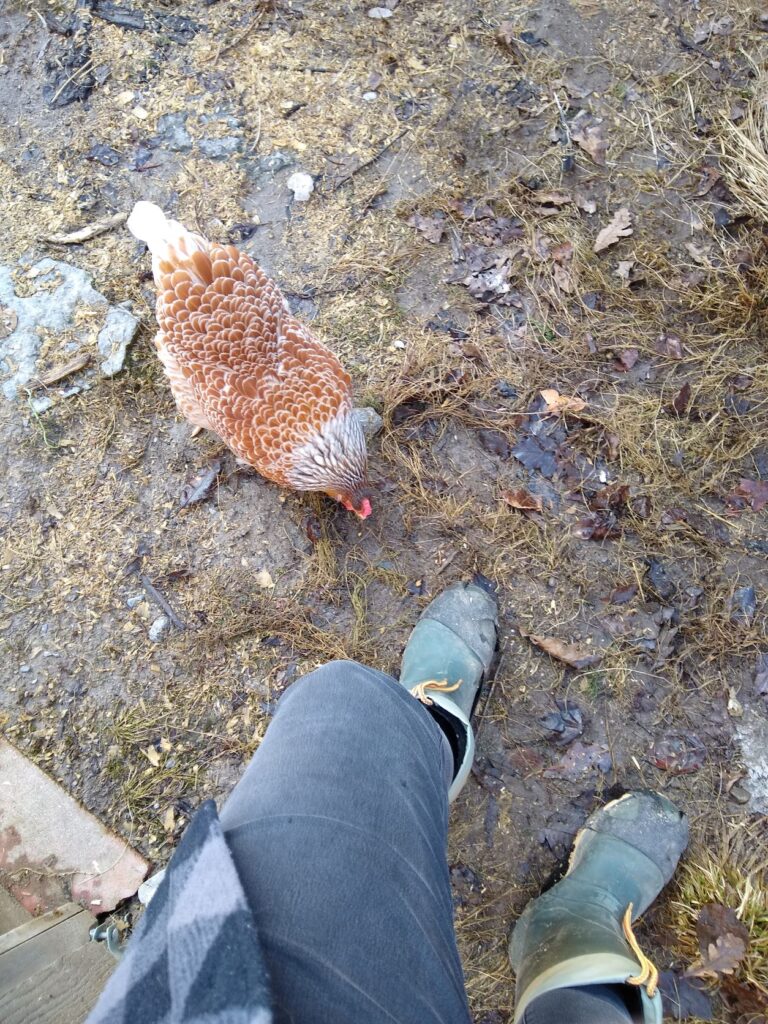
A very cold day here starts with a walk to the chicken coops, around 7:30AM. We close the coop doors when there is windchill or severe lows, so the chickens stay snug as fluffy bugs inside and I let them out in the morning. Next is a check of their waterers. Though the waterers sit on heaters, the water in the reservoirs can still freeze on very cold days. If there is ice building up in the drinking tray, we swap two sets of waterers in and out of the house over the course of the day to keep them thawed. Plenty of food gets dispensed to keep the chooks warm, then back to the house to do the same for the humans.

The OG chicken crew in their coop. Pedro, SooZee, and Lin. Each of them ~8-9 years old+.

We’re not dependent on our woodstove for either heat or cooking, though we often use it for both, and it’s indispensable when the power goes out. When we moved in here, the house had an oil heater. We got rid of that on day one (technically day two…), replacing it with an electric heat pump that has served us well. But we use the woodstove a lot through the winter. The heat pump keeps a nice baseline of “not cold”, and we use the woodstove to top things up to comfortably warm.

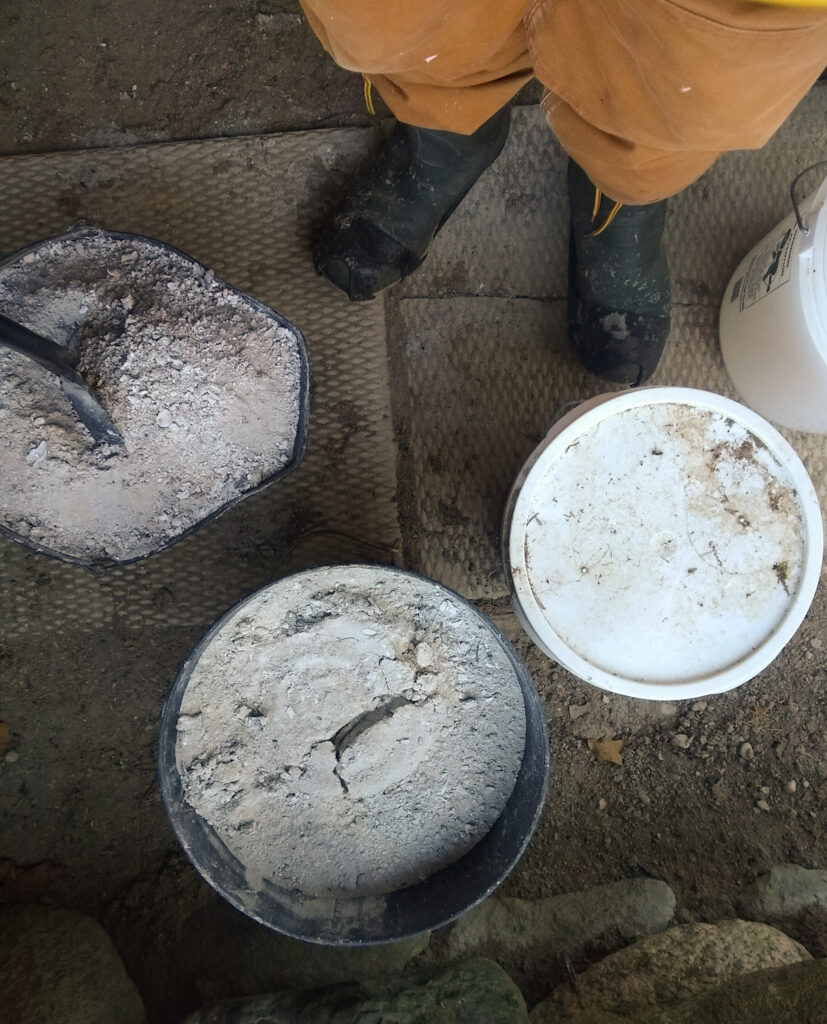
Today that first means clearing out the ash, and emptying the ash bucket. I like things here to get double or triple use, and that’s certainly true of the stove ash. From the stove it goes to a metal container outside, to ensure it is really and truly cold before being put to other uses (too many stories of friends and neighbours accidentally setting their outdoor ash storage on fire). Once it’s stone-cold cold, we use it to help clear ice on the driveway, sprinkle it around for traction, and mix it in to the chicken’s dustbaths to help combat parasites. For household use, I once used the ash to make a batch of lye, which I combined with lard to make soft dish soap. (The soap works beautifully and I hope to make more again sometime.)

Left in metal, fresh from the stove. Centre in metal, chilled outside. Right in plastic, fully cold and ready for use. Human well bundled and wearing ice grippers on her boots.

The ash cleared away, it’s time to get the fire going. Lots of extra shavings from the hand planes in the woodshop provide excellent tinder. The kettle and frying pan get popped on top of the woodstove, to start warming up straight away. While the fire gets going, I’ll get some water in reserve. Any time the weather is very X, there’s a decent chance we’ll lose power at some point. So a big jug is filled with drinking water and grey water tubs topped up with whatever’s left in the chicken waterers (for flushing), to be on the safe side.

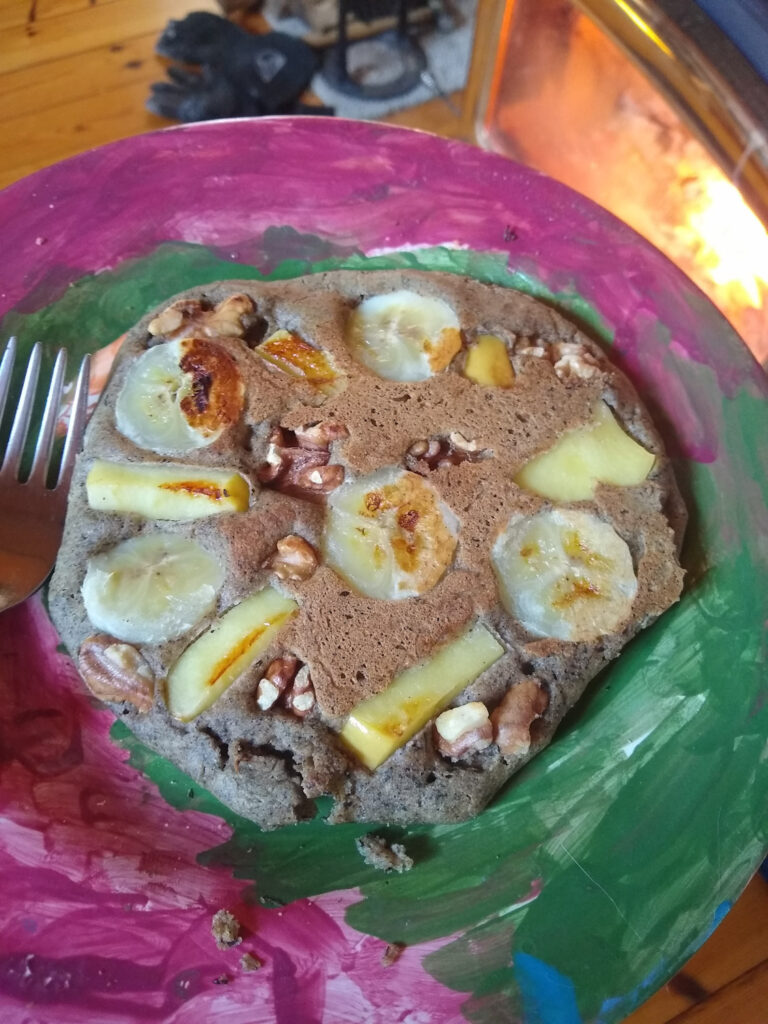
Today’s breakfast will be buckwheat pancakes with maple breakfast sausages, plus a few delicious cups of tea. Then, fuelled up and rewarmed, we’ll embark on the rest of the day. And it seems like a rather perfect day to empty out and defrost the freezer. Since I think we’ll have *no trouble* keeping the contents cold if we pop them outside today… 🙂

Have a wonderful weekend folks!

~Kate

Plate by my Uncle Richard. Thanks Uncle Rich! ♥️