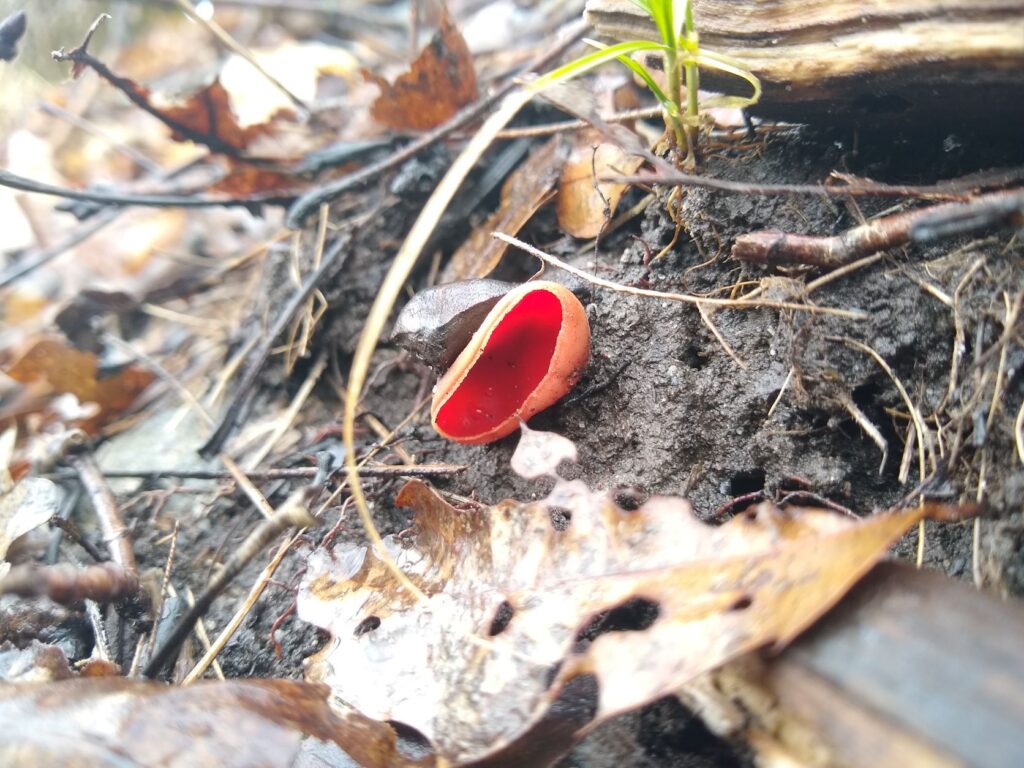
Above, Scarlet Cup fungus: “One of the earliest of spring fungi, it often escapes attention because it is hidden under fallen leaves.” (George Barron)
Some years we see great flocks of robins here through the winter, so robins are not the harbingers of spring for me that they once were. At least not until they begin their spring construction season, installing nests all over our eaves.
But we glimpse other sparks, hinting that spring is about to ignite…
The cold nights and warmer days pulsing sap up and down the maples.
The first turkey vulture, the first moss upended by turkeys, the first bluebird. Trills of red-winged blackbirds, chickadees inspecting our bird houses.
A skinny chipmunk hightailing it across the gravel drive.
The brilliant red of scarlet cup fungus, half hidden in the duff.
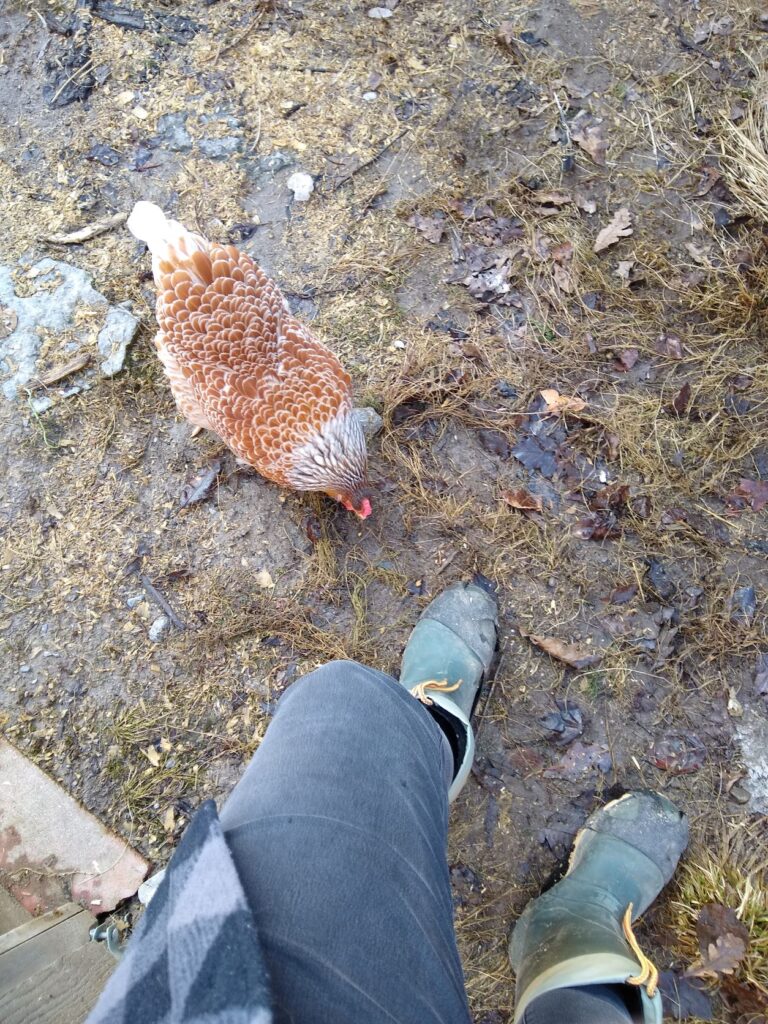
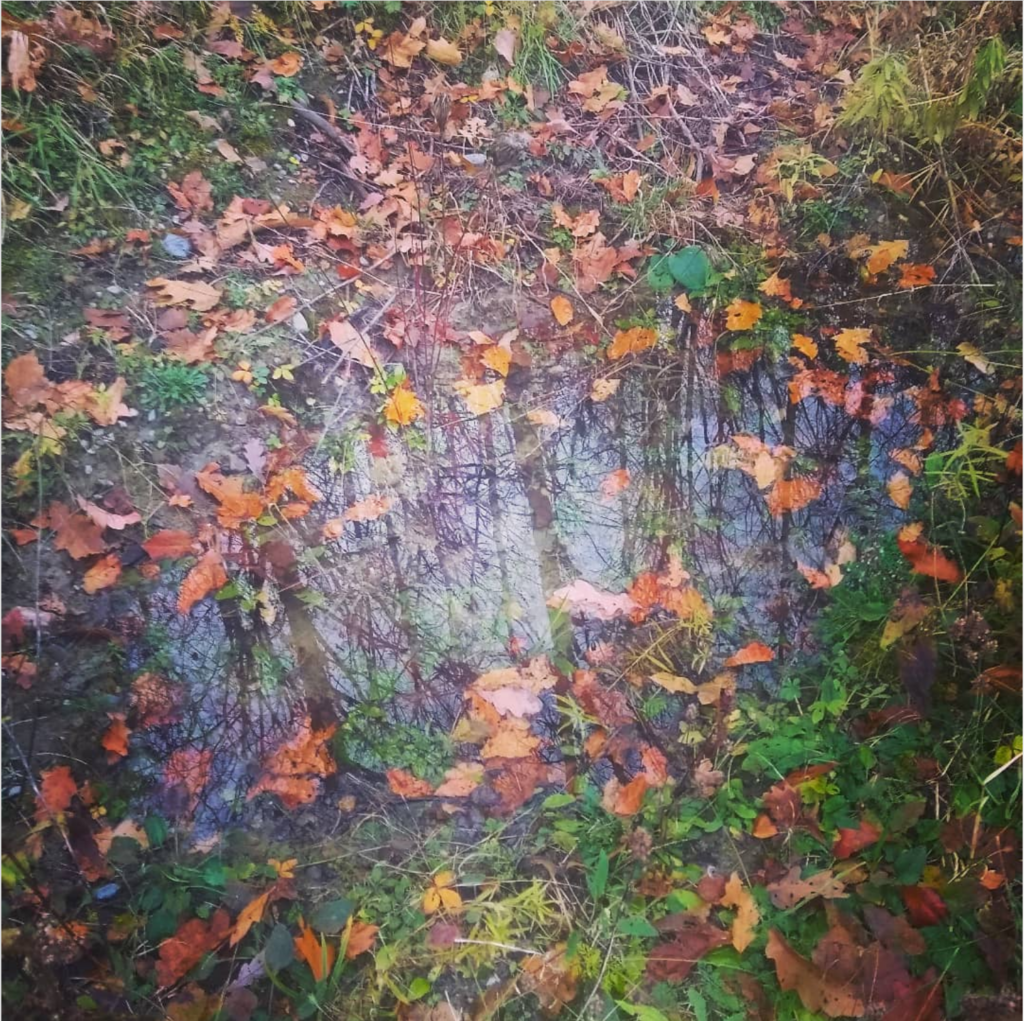
The vernal pools swelling in the woods, seasonal streams percolating over little rock piles. Suddenly soggy places that in a few more months will be bone dry. The return of mud. The smell of thaw. The first walk up the hill without ice cleats. An extra egg in the chickens’ nest box.
The first ticks. Questing on the low branches we have not yet cleared from the trail.
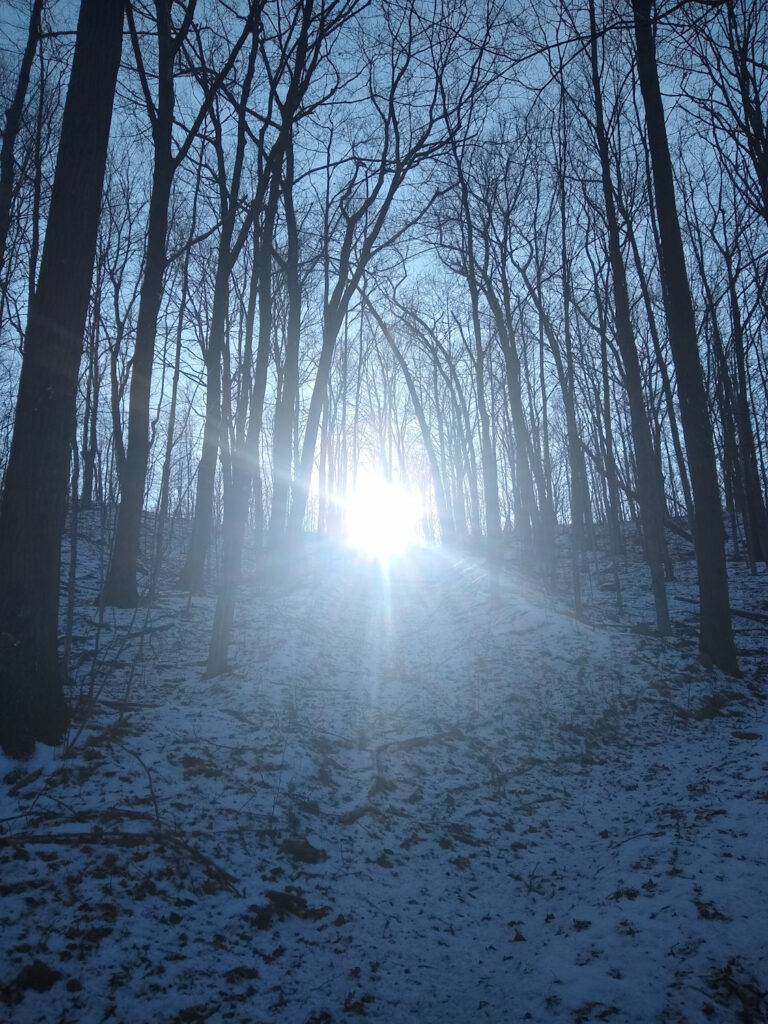
The sun shining a little further into the kitchen, brighter and warmer. The inevitable surprise snow and the suddenly warm days that follow it.
“The best thing for being sad,” replied Merlin, beginning to puff and blow, “is to learn something. That’s the only thing that never fails. You may grow old and trembling in your anatomies, you may lie awake at night listening to the disorder of your veins, you may miss your only love, you may see the world about you devastated by evil lunatics, or know your honour trampled in the sewers of baser minds. There is only one thing for it then — to learn. Learn why the world wags and what wags it. That is the only thing which the mind can never exhaust, never alienate, never be tortured by, never fear or distrust, and never dream of regretting. Learning is the only thing for you. Look what a lot of things there are to learn.”
It is easy for me to write many words quickly, but writing a few good ones takes me longer.
Making anything of value — out of pixels or wood or words — includes time spent on editing and revision. The quick burst of creation roughs out the shape, but sandpaper, polish, and time are needed to find the lustre.
If you, like me, find rambling easier than revising, I would recommend this piece a friend recently sent me. It investigates the origins of the quote “If I had more time, I would have written a shorter letter”. It seems to be one of those persistent human observations that crosses boundaries of time and space. With versions of the quote traced to Twain, Cicero, Thoreau…
According to an anecdote published in 1918 Woodrow Wilson was asked about the amount of time he spent preparing speeches, and his response was illuminating:
“That depends on the length of the speech,” answered the President. “If it is a ten-minute speech it takes me all of two weeks to prepare it; if it is a half-hour speech it takes me a week; if I can talk as long as I want to it requires no preparation at all. I am ready now.”
Anything worth doing is worth doing well. Pass me the red pen fellas.
~Kate
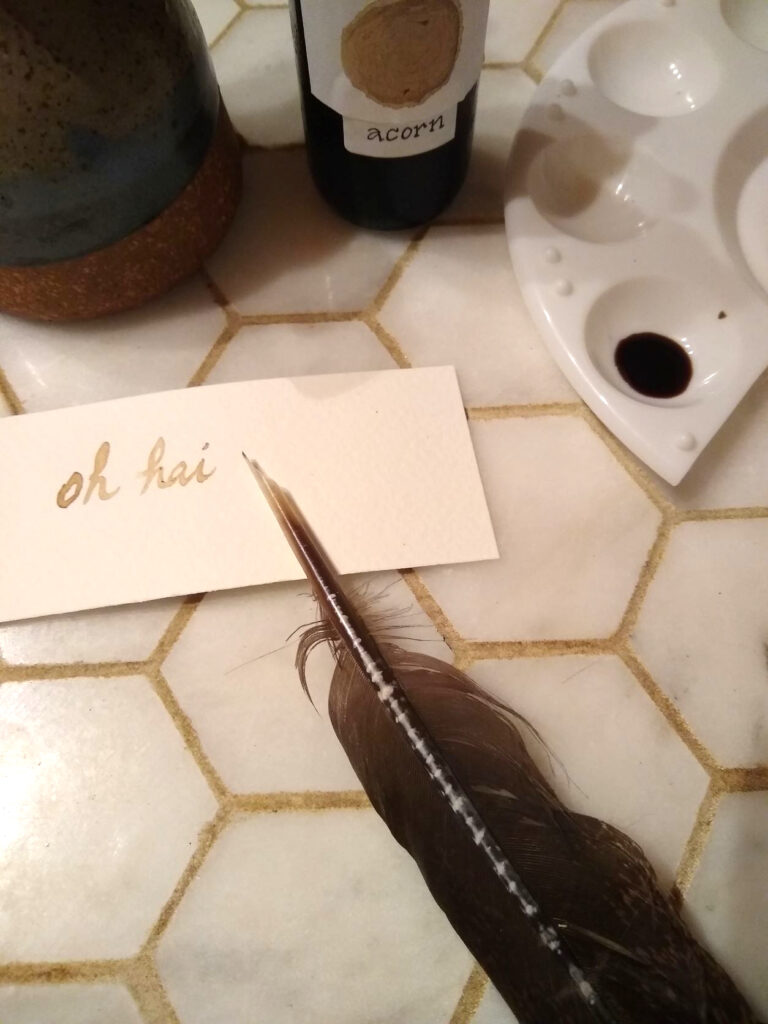
Related maker projects: Homemade turkey feather quill and acorn ink.
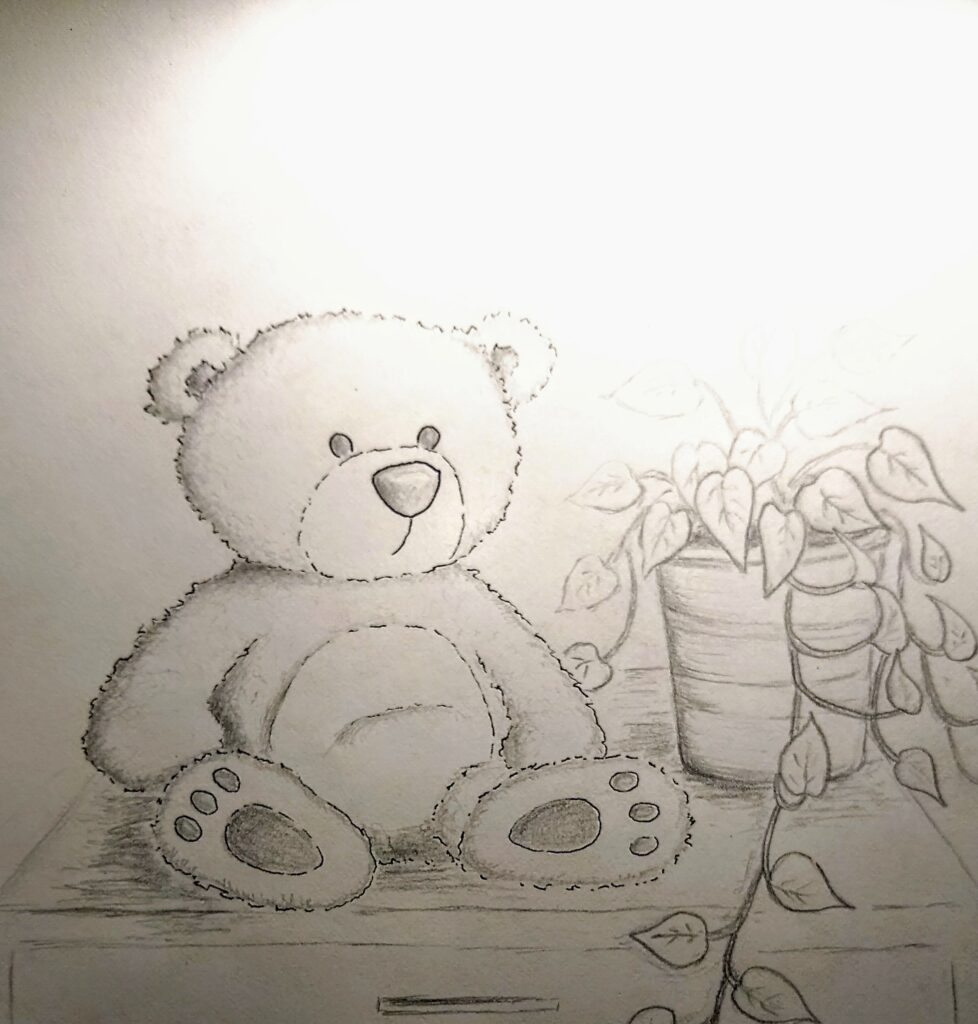
There is a bear at Stanford who sits on top of a filing cabinet. It’s a stuffed toy bear, and it belongs to one of the professors. When the professor’s students get stuck on a problem, and want to ask for his help, they first have to go and explain their problem to the bear.
Most of the time, the bear is able to solve the problem.
Or rather, the students are able to solve their own problems, by talking them through “with the bear”.
I can’t find the right combination of search terms to dig up the origin of this story again. And who knows how much truth has merged with fiction. But whether this teddy bear-tactic professor ever really existed or not, this story is true at our house.
We don’t literally leave a stuffed bear around. And anyways my only stuffed animal options are an alligator, a puffin, a monster dressed as a ninja, and a flying squirrel. As stuffed animals go, they’re solid. Though I don’t know if any of them are good listeners.
But Neil and I are often “the bear” for each other. We work on projects together and alone. If one of us is stuck on a problem, the other person might understand enough about what we’re doing to offer a helpful suggestion, a fresh perspective, or a different tactic. But even when the stuck person is working way outside our expertise, we can still “be the bear” for each other. We simply sit and listen, while the other person explains their problem to us.
Talking to the bear lets you untangle your own thoughts. Brains can be messy, and that’s okay. But sometimes, when we leave a problem in there too long, our thoughts simply pull the existing knots tighter and tighter.
Our minds are capable of holding contradictory or “gappy” ideas. But the plot holes and conflicts often become apparent once we start teasing our thoughts apart into sentences. As we start to untangle our ideas, because we’re trying to communicate them to someone else — even if that someone else is a stuffed bear — we can often uncover the crux. And find our way out of the tangle, all “on our own”. It might even seem incredibly obvious as soon as we begin speaking aloud. A handful of sentences spoken aloud to the bear uncovers the root of, and solution to, a problem you’ve been rolling around in your mind for an hour.
At our house, if we notice the other person is stuck on a problem, we will say “do you need me to be the bear?” and come sit in their office for a bit while they figure it out. Or we might seek the other person out, saying “can you be the bear for me?” And occasionally, when Neil has drifted into explaining a complex coding problem to me that he’s stuck on, I will tuck my arms in to my sides and slowly raise them to a 90 degree angle. Sometimes it helps to get into character.
Anyone can “be the bear”. So often we just need someone to sit still with us, and listen.
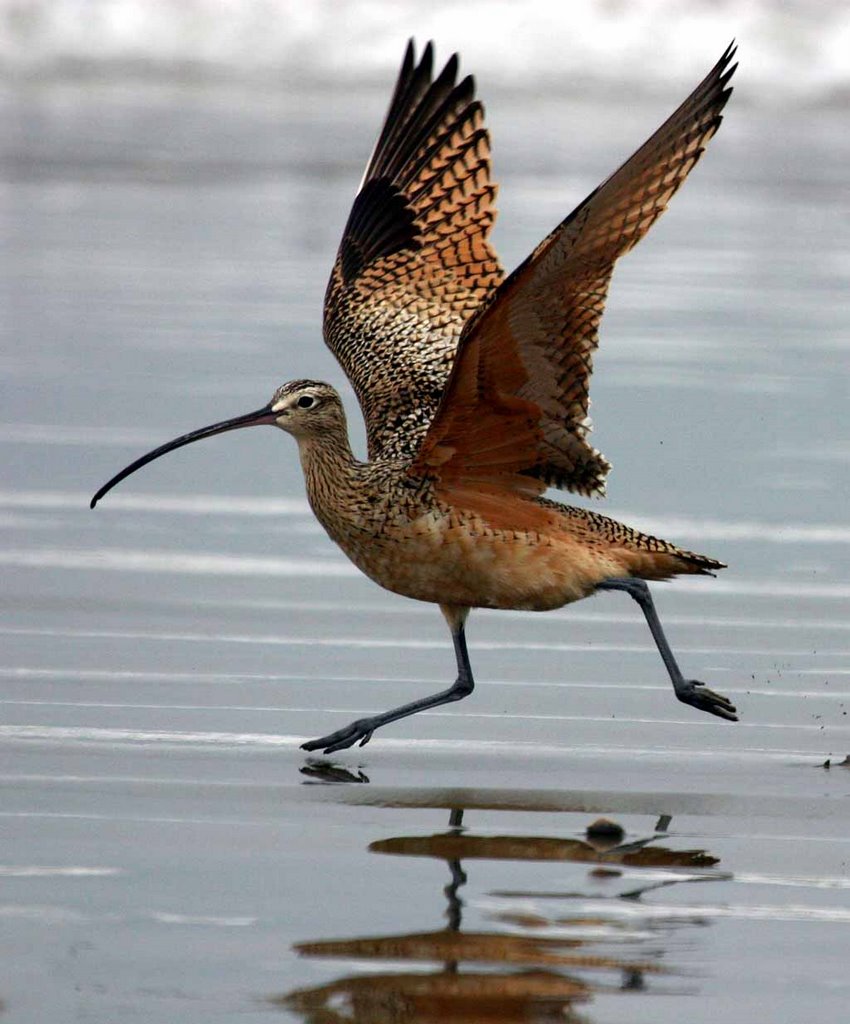
…the Long-billed Curlew protects its territory with a variety of moves, one of which is “Concealment,” in which it runs towards its opponent, then “suddenly flops down in grass, disappearing from view.” The opponent looks around, perplexed, until the defender springs up and advances aggressively, then drops and hides again. I am going to try this on my next zoom meeting.
~Rosemary Mosco. From her excellent newsletter, “Flight Club“
“… It’s here that I’ve begun to feel wonder again. Like when I was a kid. And this makes me deeply happy. I wish I could say ‘Thank You’, just so, straight into the universe.”
I don’t want to give it to despair; I don’t want to take refuge in detached ridicule of unironized emotion. I don’t want to be cool, if cool means being cold to or distant from the reality of experience. I want to feel what there is to feel while I am here.
“When I was a child…before I learned there were four seasons to a year, I thought there were dozens: the time of night-time thunderstorms, heat lightning time, bonfires-in-the-woods time, blood-on-the-snow time, the times of ice trees, bowing trees, crying trees, shimmering trees, bearded trees, waving-at-the-tops-only trees, and trees-drop-their-babies time. I loved the seasons of diamond snow, steaming snow, squeaking snow, and even dirty snow and stone snow, for these meant the time of flower blossoms on the river was coming.
These seasons were like important and holy visitors and each sent its harbingers: pine cones open, pine cones closed, the smell of leaf rot, the smell of rain coming, crackling hair, lank hair, bushy hair, doors loose, doors tight, doors that won’t shut at all, windowpanes covered with ice-hair, windowpanes covered with wet petals, windowpanes covered with yellow pollen, window panes pecked with sap gum. And our own skin had its cycles too: parched, sweaty, gritty, sunburned, soft. …
Once, we lived by these cycles and seasons year after year, and they lived in us.
…They were part of our soul-skins–a pelt that enveloped us and the wild and natural world–at least until we were told that there really were only four seasons to a year…
But we cannot allow ourselves to sleepwalk wrapped in this flimsy and unobservant fabrication… and therefore to suffer from dryness, tiredness, and homesickness. It is far better for us to return to our own unique and soulful cycles regularly, all of them, any of them.”